




 DISCORD
A City on Mars
Kelly Weinersmith, Zach Weinersmith

 The New York Times Best Sellers


 120 Min Reading Time
 Audio Version Available
About this book
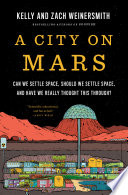
From the bestselling authors of Soonish comes a witty and insightful exploration into the future of space settlement. Earth's in trouble, and the allure of a fresh start among the stars—free from climate change, war, and Twitter—is stronger than ever. But is escaping to space the answer?
Kelly and Zach Weinersmith embarked on a mission to write the definitive guide to building new societies beyond Earth. What they discovered raises profound questions about whether this dream could become a nightmare, both for those who venture out and those left behind.
A City on Mars fearlessly tackles the challenges of creating life in space: Can we raise families? How do we build sustainable economies? What happens when corporations and nations clash in the final frontier? Will there be a lunar housing crisis? And yes, what's the deal with space cannibalism?
With their trademark humor, deep expertise, and the signature wit of Saturday Morning Breakfast Cereal illustrations, the Weinersmiths compel us to confront the biggest questions facing humanity as we reach for the stars. Buckle up—it's time to rethink our future among the planets.
Summary of Key Ideas
- •
Questioning the Urgency of Space Settlement
Space settlement is not as urgent or necessary as commonly believed. The authors challenge the prevailing narrative that humanity must colonize space for survival, arguing that many pro-settlement arguments are flawed. They suggest that focusing on solving Earth's problems should take precedence over the allure of Mars.
- •
The Formidable Scientific and Technological Hurdles
The book delves into the numerous scientific and technological challenges involved in creating a self-sustaining Martian city. These include providing breathable air, water, food production, protection from radiation, and managing waste. The authors emphasize that overcoming these hurdles requires significant advancements and resources.
- •
Social and Psychological Challenges of Martian Life
Beyond the practical challenges, the authors explore the profound societal and psychological implications of living in a closed, isolated environment on Mars. They discuss potential social hierarchies, governance structures, and the psychological toll of long-duration space missions on individuals and communities.
- •
The Need for a Robust Legal and Ethical Framework
The book highlights the importance of establishing a well-defined legal and ethical framework for space settlement. This includes addressing issues such as property rights, resource allocation, dispute resolution, and the rights and responsibilities of Martian colonists. The Weinersmiths suggest current space law is inadequate for dealing with future scenarios.
- •
The Sobering Economic Realities of Space Colonization
Explores the economic realities of space colonization, pointing out that the costs are enormous and the potential return on investment is uncertain. They suggest that more affordable solutions, such as robotic exploration, may offer better value for scientific discovery than human settlements.
- •
Learning from the History of Colonization
The book uses historical analogies of past colonization efforts to highlight potential pitfalls of space settlement. By examining the failures and injustices of historical colonies, the authors caution against repeating similar mistakes in the context of Martian colonization, particularly regarding exploitation and environmental disregard.
- •
Environmental Considerations and Ethical Stewardship
The Weinersmiths discuss the implications of Martian settlements on the environment, both on Mars and on Earth. They caution against repeating Earth's environmental mistakes on another planet and argue for responsible stewardship of Martian resources. They also address the ethics of terraforming and potentially altering the Martian environment to suit human needs.
- •
The Risks of Unintended Consequences and Hubris
The authors explore the potential for unintended consequences and unforeseen problems in a Martian colony. They emphasize the importance of careful planning, risk assessment, and adaptability in addressing unexpected challenges that may arise in a complex and unforgiving environment. They suggest that hubris and overconfidence can be detrimental to the success of any Martian settlement.
Chapter Recap

About The Author
Kelly Weinersmith
Main Quotes
"Space is looking more promising every day. There's no political corruption on Mars, no war on the Moon, no juvenile jokes on Uranus."
"Settling in space will not make us wiser, it will not make us richer, and, more importantly, it will not make war less likely"
"If you want a Mars that can survive the death of Earth, you'd better make sure Earth doesn't die for a very long time."
"We cannot tell you how many times a space enthusiast has told us that space law is stupid because all law will go out the window once we leave Earth."
"The dream of space is, for many, a dream of escaping Earth."
"Space offers a chance to start fresh."
"The most important thing we can bring to space is a healthy dose of skepticism."
"We need to be honest about the challenges and risks of space settlement."
"The fantasy of space settlement often involves a projection of our earthly hopes and fears."
"The reality of space settlement will likely be far more complex and messy."
Who Should Read This Book
Space exploration enthusiasts
Readers interested in the science and technology of space colonization
Individuals curious about the economics, politics, and societal implications of settling on Mars
People who enjoy popular science books that blend humor and research
Readers interested in a critical and realistic perspective on space settlement
Those interested in the ethical considerations of space colonization
Fans of the authors' previous works and their signature blend of science and humor
Individuals involved in space policy and planning
Science fiction writers seeking realistic world-building ideas
Readers interested in history, law, and psychology alongside hard sciences
Book Summaries Like
A City on Mars


FAQ

Free Access to LitNotes