




 DISCORD
A Thousand Brains
Jeff Hawkins


 Apple Books


 64 Min Reading Time
 Audio Version Available
About this book
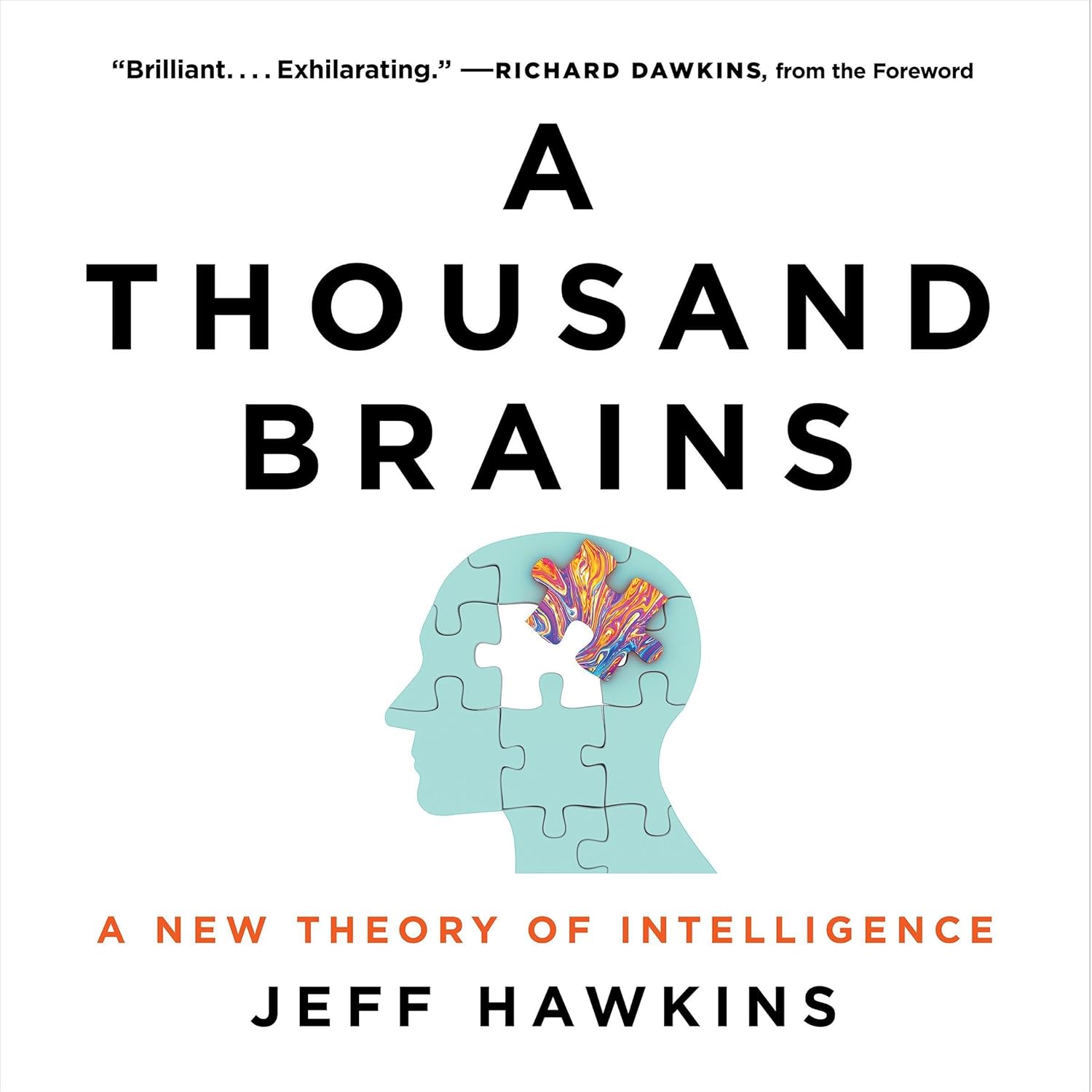
From bestselling author, neuroscientist, and computer engineer Jeff Hawkins comes a revolutionary theory of intelligence, poised to reshape our understanding of the human brain and the future of AI. Despite neuroscience's advancements, the fundamental question remains: How do simple brain cells create intelligence?
Hawkins and his team discovered that the brain constructs a world model using map-like structures, creating not one, but thousands of models for everything we know. This breakthrough allows Hawkins to explore how we perceive the world, our sense of self, and the origins of higher-level thought.
A Thousand Brains introduces the "Thousand Brains Theory of Intelligence," proposing that our brains are organized into thousands of independently computing units called cortical columns. Each column processes information and builds a complete, unique model of the world based on its connections. Your brain then sorts these models through a voting process, managing thousands of individual thoughts every moment.
Hawkins tackles neuroscience's enduring questions, like the purpose of pain and how we maintain perspective as we move. More than just theory, A Thousand Brains paves the way for creating truly intelligent AI, exploring how we can build machines that learn, addressing fears about superintelligence, and envisioning a future where human and machine intelligence converge. Prepare for a revolution in understanding intelligence, heralding a new era for both our minds and our machines.
Summary of Key Ideas
- •
The Thousand Brains Theory: Cortical Columns as Independent Model-Builders
The core of Hawkins' theory revolves around the neocortex and its functional units, cortical columns. He proposes that each cortical column operates as a complete intelligent unit, capable of building a model of the world through a process of prediction and feedback. These columns don't act in isolation; instead, they work together, forming a consensus-based perception of reality. This distributed intelligence model contrasts with the traditional view of a centralized 'control room' within the brain.
- •
Location, Location, Location: The Brain's Spatial Framework
Hawkins emphasizes the importance of location in the neocortex's functioning. Each cortical column doesn't just recognize *what* an object is, but also *where* it is in relation to the observer. This 'location, location, location' mantra highlights how the brain creates a spatial framework for understanding the world. By integrating location information, the brain can make more accurate predictions and navigate its environment effectively. This spatial understanding is also crucial for higher-level cognitive functions.
- •
The Brain as a Prediction Machine: Anticipating the Future
The book posits that the brain is fundamentally a prediction machine. Every cortical column is constantly making predictions about future sensory inputs based on its learned model of the world. When predictions are accurate, our perception is seamless. When there's a mismatch between prediction and reality, the brain updates its model to improve future predictions. This continuous cycle of prediction and error correction is key to learning and adaptation.
- •
The Origin of Self: Modeling the Body and its Place in the World
Hawkins addresses the question of consciousness and self-awareness by suggesting that our sense of self arises from the neocortex's ability to model itself. Just as we create models of external objects, we also create models of our own bodies and our place in the world. This internal model provides a sense of continuity and identity, allowing us to reflect on our past, present, and future. The sense of self is therefore not a mystical phenomenon, but a product of the brain's modeling capabilities.
- •
Reference Frames: How the Brain Represents Location
The book explores the concept of 'reference frames' which are coordinate systems that the brain uses to represent the location of objects relative to itself. These reference frames are hierarchical, with simpler frames representing the location of individual features and more complex frames representing the location of entire objects. The ability to manipulate and transform these reference frames is essential for tasks such as object recognition, navigation, and motor control.
- •
Hierarchical Structure: Building Abstractions in the Neocortex
A Thousand Brains theory proposes a hierarchical structure in the neocortex, allowing for the creation of increasingly abstract and complex models. Lower levels of the hierarchy process raw sensory input, while higher levels integrate information from multiple lower levels to create more generalized representations. This hierarchical organization allows the brain to understand concepts and reason about the world in a flexible and adaptable manner.
Chapter Recap

About The Author
Jeff Hawkins
Main Quotes
"The world we think we live in is not the real world; it is a simulation of the real world."
"The brain is not a computer. It is a memory system that stores experiences and uses them to predict what will happen next."
"Intelligence is fundamentally about prediction."
"The neocortex builds a model of the world, and everything we perceive and understand is based on that model."
"The most important function of the neocortex is to create a high-fidelity model of the world, and then use that model to predict the future."
"Every group of people I ask thinks the world is more frightening, more violent, and more hopeless—in short, more dramatic—than it really is."
"The brain uses reference frames to represent the location of things relative to ourselves."
"The longer you work on a problem, the more constraints you discover and the harder it becomes to imagine a solution."
"We have become an intelligent species. We are the first species on Earth to know the size and age of the universe. We are the first species to know how the brain works."
"In the battle between the old brain and the neocortex, the old brain usually wins. We eat the cake."
Who Should Read This Book
Individuals interested in neuroscience and how the brain works
Readers curious about artificial intelligence and its future
Technology enthusiasts seeking to understand the biological basis of intelligence
Businesspeople and technologists interested in the applications of AI
Lay readers with little background in brain science or computer science
Anyone interested in a big-think book about intelligence
Book Summaries Like
A Thousand Brains

FAQ

Free Access to LitNotes