




 DISCORD
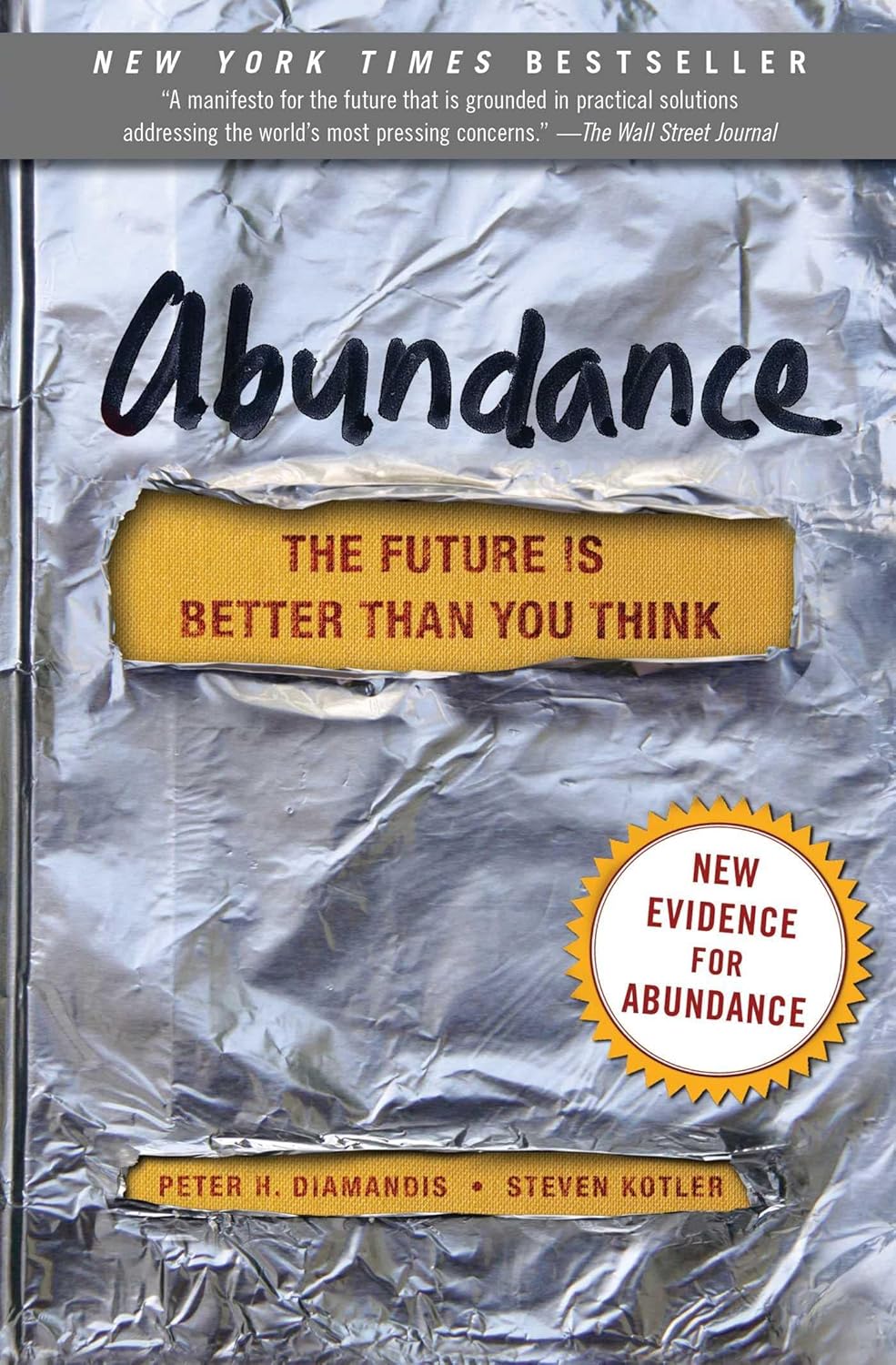
Abundance
Peter H. Diamandis, Steven Kotler


 Goodreads Choice Awards
 Apple Books


 72 Min Reading Time
 Audio Version Available
About this book
Conventional wisdom says a world of abundance for all is impossible, but Abundance dares to disagree. Visionary entrepreneur Peter H. Diamandis and award-winning science writer Steven Kotler reveal how exponential technologies—artificial intelligence, robotics, and more—are converging with the power of the DIY innovator, the rising billion, and the techphilanthropist to create a future where basic needs are not just met, but exceeded for every person on the planet.
From water and food to energy, healthcare, education, and freedom, Abundance explores the groundbreaking innovations and audacious entrepreneurs who are tackling humanity's grandest challenges. Meet the minds driving this revolution and discover a strategic roadmap for governments, industry, and individuals to build a future brimming with possibility. Abundance isn't just a book; it's a manifesto for a world worth fighting for, offering hard targets for change and a powerful dose of optimism.
Summary of Key Ideas
- •
Technology-Driven Abundance
The book argues that we are entering a period of radical transformation where previously scarce resources can become abundant due to technological advancements. This concept challenges conventional Malthusian thinking, which posits that population growth will inevitably outstrip resource availability. Diamandis and Kotler present a compelling case that innovation, driven by exponential technologies, can overcome resource constraints and improve living standards for everyone. They emphasize that abundance is not about having unlimited resources but about having the ability to easily meet the basic needs of all people.
- •
The Power of Exponential Technologies
The authors highlight the power of exponential technologies – those that double in performance or halve in cost at a regular interval – to drive abundance. They cite examples like computing power, information, and communication technologies, arguing that their rapid advancement is creating unprecedented opportunities to solve global challenges. The decreasing cost and increasing accessibility of these technologies empower individuals and small groups to tackle problems that were previously only addressable by governments and large organizations. This democratization of technology is a key driver of the abundance mindset.
- •
Empowering the Bottom Billion
Diamandis and Kotler discuss how the 'bottom billion' – the poorest segment of the world's population – are increasingly connected and empowered by technology. Mobile phones, internet access, and low-cost educational resources are providing unprecedented opportunities for these individuals to improve their lives and contribute to the global economy. This increased connectivity fosters innovation and entrepreneurship, leading to the development of solutions tailored to the specific needs of developing countries. The book emphasizes that empowering the bottom billion is not just a moral imperative but also an economic opportunity.
- •
The Rise of DIY Innovators and Entrepreneurs
The book emphasizes the crucial role of DIY innovators, tech entrepreneurs, and philanthropists in creating abundance. These individuals and groups are often more agile and innovative than large institutions, and they are driven by a passion to solve problems and improve the world. Diamandis and Kotler showcase numerous examples of successful ventures that have leveraged technology to address challenges in areas like food, water, energy, and healthcare. They argue that these actors are essential to driving the transition from scarcity to abundance.
- •
Cultivating an Abundance Mindset
Abundance requires a shift in mindset from scarcity to possibility. The authors contend that our brains are wired to focus on threats and scarcity, which can limit our ability to see opportunities and create solutions. By adopting an abundance mindset, we can overcome these limitations and unleash our creative potential. This involves focusing on the potential for growth and innovation, rather than dwelling on limitations and constraints. The book encourages readers to cultivate a positive and optimistic outlook, believing that we can solve the world's biggest challenges.
- •
Democratization of Information and Education
The book explores how access to information and education is becoming increasingly democratized through online platforms and open-source resources. This democratization of knowledge empowers individuals to learn new skills, develop innovative solutions, and participate more fully in the global economy. Online education platforms, open-source software, and collaborative knowledge-sharing initiatives are breaking down traditional barriers to education and creating new opportunities for learning and growth. This increased access to information is a key enabler of abundance.
- •
Breakthrough Technologies and Convergence
Diamandis and Kotler highlight breakthroughs in fields like synthetic biology, nanotechnology, and artificial intelligence that promise to revolutionize various industries and address some of humanity's most pressing challenges. These advancements hold the potential to create new materials, develop more efficient energy sources, and enhance human capabilities. They emphasize the importance of continued investment in research and development to unlock the full potential of these transformative technologies. The convergence of these fields is creating a powerful engine for innovation and abundance.
- •
Transforming Healthcare Through Technology
The authors examine how technology is transforming the healthcare industry, leading to more personalized, preventative, and accessible care. Advances in diagnostics, telemedicine, and wearable sensors are enabling individuals to monitor their health more effectively and receive timely interventions. The book envisions a future where healthcare is proactive and personalized, rather than reactive and generic. These technological advancements have the potential to significantly improve health outcomes and extend lifespans for people around the world.
- •
Clean and Abundant Energy Solutions
Diamandis and Kotler address how advancements in energy production, such as solar, wind, and fusion power, are paving the way for a future of clean, abundant energy. These renewable energy sources are becoming increasingly cost-competitive with fossil fuels, and they offer a sustainable alternative that can mitigate climate change and reduce dependence on finite resources. The book highlights the potential of decentralized energy systems to empower communities and individuals, providing them with greater control over their energy supply. This transition to clean energy is essential for creating a sustainable and abundant future.
Chapter Recap

About The Author
Peter H. Diamandis
Main Quotes
"Abundance is not about providing everyone on this planet with a life of luxury—rather it’s about providing all with a life of possibility."
"We will soon be able to meet and exceed the basic needs of every man, woman and child on the planet. Abundance for all is within our grasp."
"Taken together, these four forces—the exponential growth of technology, the DIY innovator, the technophilanthropist, and the rising billion—are building a world of abundance."
"Today’s converged technologies are enabling the individual to do what only governments and large corporations could once accomplish."
"When seen through the lens of innovation, problems are not problems, they are opportunities."
"Resources are not finite; they are created."
"Information is the ultimate resource."
"The truth is that technology is a double-edged sword. Fire can cook our food or burn down our houses."
"A scarcity mindset focuses on what we don’t have. An abundance mindset focuses on what we do have."
"Fear is a major impediment to progress."
Who Should Read This Book
Entrepreneurs
Innovators
Technology enthusiasts
Investors interested in disruptive technologies
Readers interested in future trends
Optimists and those seeking solutions to global challenges
Individuals interested in science and technology policy
People working in fields related to resource management (water, energy, food)
Individuals involved in global development and philanthropy
Readers of science and technology books
Those interested in the impact of exponential technologies
People seeking a hopeful perspective on the future
Students and academics in fields like economics, technology, and sustainability
Book Summaries Like
Abundance



FAQ

Free Access to LitNotes