




 DISCORD
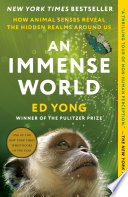
An Immense World
Ed Yong


 Goodreads Choice Awards
 The New York Times Best Sellers


 103 Min Reading Time
 Audio Version Available
About this book
The world around us is alive with sensations we can barely imagine. In An Immense World, Pulitzer Prize-winning science journalist Ed Yong throws open the doors to the sensory experiences of other creatures, revealing the hidden dimensions that shape their realities.
Prepare to be astonished as you explore the scent-scapes of dogs, the electric fields sensed by fish, and the magnetic maps navigated by turtles. Discover that a crocodile's skin is as sensitive as a lover's touch, and that even simple scallops possess complex vision.
With humor, rigor, and a contagious sense of wonder, Yong invites us to journey beyond our human limitations, to truly see and feel the world through other eyes. An Immense World is not just a voyage to strange lands, but a profound exploration of the boundless possibilities of perception.
Summary of Key Ideas
- •
The Significance of Umwelt
Umwelt: Entering Animal Sensory Worlds. The central concept of 'Umwelt,' introduced by Jakob von Uexküll, emphasizes that every animal perceives its environment in a unique way, filtered through its specific sensory apparatus. This book encourages readers to move beyond anthropocentric views and appreciate the diverse realities experienced by other species. Each animal's Umwelt is its subjective sensory bubble, shaped by the senses it possesses and how its brain processes that information. Understanding Umwelt is crucial for truly grasping how different animals interact with and experience the world around them. This idea challenges our assumptions about reality and highlights the limitations of human perception.
- •
Unveiling Non-Human Senses
Beyond Human Senses: Exploring Sensory Diversity. Humans rely heavily on sight and sound, but many animals perceive the world through senses we can barely imagine, such as echolocation, electroreception, and magnetoreception. Yong explores these less familiar senses, detailing how bats use sound to navigate, sharks detect electrical fields, and birds use the Earth's magnetic field for migration. This exploration reveals the vast sensory landscape beyond human capabilities and emphasizes the richness and complexity of animal perception. Understanding these diverse senses allows us to appreciate the full spectrum of environmental information available to different species.
- •
The Link Between Senses and Behavior
Sensory Ecology: How Senses Shape Behavior. An animal’s senses directly influence its behavior, shaping how it finds food, avoids predators, and interacts with potential mates. Yong illustrates how sensory ecology—the study of how animals use their senses to interact with their environment and each other—plays a critical role in survival and reproduction. For example, the elaborate displays of birds of paradise are tailored to the specific visual sensitivities of their intended audience. By understanding sensory ecology, we can better predict and interpret animal behavior in various ecological contexts, providing crucial insights into adaptation and evolution.
- •
Acknowledging Human Sensory Limits
The Limits of Our Own Perception. While humans possess sophisticated sensory systems, they are limited in scope compared to the combined sensory capabilities of the animal kingdom. Yong reminds us that our perception of reality is just one version among many. By acknowledging these limitations, we can avoid imposing our sensory biases on other species. This humility encourages more thoughtful and ethical interactions with the natural world, fostering a deeper respect for the diverse ways animals experience their surroundings. Recognizing our sensory limits is the first step toward appreciating the vastness of the 'immense world'.
- •
Human Impact on Animal Senses
The Impact of Anthropogenic Noise and Pollution. Human activities, such as noise pollution and light pollution, significantly disrupt animal senses and behaviors. Yong highlights the detrimental effects of these disturbances on wildlife, including impaired communication, disorientation, and reduced reproductive success. Understanding how human-generated pollution interferes with animal senses is crucial for developing strategies to mitigate these impacts and protect biodiversity. This includes reducing noise levels in urban areas, minimizing light pollution, and considering the sensory needs of animals in conservation efforts. Addressing these issues is vital for maintaining healthy ecosystems and preserving the sensory worlds of other species.
- •
Decoding Animal Communication
Interspecies Communication and Sensory Misunderstandings. Animals often communicate using sensory signals that are imperceptible or misinterpreted by humans. Yong explores examples of interspecies communication, highlighting the potential for sensory misunderstandings that can lead to conflict or missed opportunities. For instance, the subtle chemical signals used by insects to attract mates can be disrupted by human-made scents, leading to reproductive failure. By understanding the nuances of animal communication, we can avoid inadvertently interfering with their interactions and promote more harmonious coexistence. This awareness is essential for responsible stewardship of the natural world and effective conservation strategies.
- •
Sensory Evolution and Adaptation
The Evolutionary Arms Race of Senses. Senses are constantly evolving in response to selective pressures, leading to an 'arms race' between predators and prey. Yong describes how animals develop increasingly sophisticated sensory capabilities to detect and evade threats, while predators evolve counter-strategies to overcome these defenses. This dynamic interplay drives the evolution of novel sensory adaptations and contributes to the diversity of sensory systems observed in nature. Understanding this evolutionary arms race provides insights into the co-evolutionary relationships between species and the complex interplay of senses in ecological interactions.
Chapter Recap

About The Author
Ed Yong
British-American science writer at The Atlantic. Author of I CONTAIN MULTITUDES, a New York Times bestseller on animal-microbe partnerships. Recipient of a 2021 Pulitzer Prize for Explanatory Reporting for a series on the COVID-19 pandemic.
Main Quotes
"Every animal can only tap into a small fraction of reality's fullness. Each is enclosed within its own unique sensory bubble, perceiving but a tiny sliver of an immense world."
"The majesty of nature is not restricted to canyons and mountains. It can be found in the wilds of perception--the sensory spaces that lie outside our Umwelt"
"Nothing can sense everything, and nothing needs to. That is why Umwelten exist at all."
"There are animals with eyes on their genitals, ears on their knees, noses on their limbs, and tongues all over their skin."
"Every one of us is a zoo in our own right – a colony enclosed within a single body. A multi-species collective. An entire world."
"Evolution has sculpted animals to perceive what they need to survive, and nothing more."
"We treat our senses as faithful reporters, but they are active creators."
"Umwelten are not just about the senses that animals have but also about how they use those senses."
"It is easy to marvel at the sensory feats of other animals, but harder to appreciate the different logic that governs their lives."
"To enter an animal’s Umwelt, you must use every tool at your disposal."
Who Should Read This Book
Readers interested in zoology and animal behavior
Science enthusiasts
Readers curious about sensory perception
Individuals interested in the natural world
General science readers
Readers of popular science books
Readers seeking to expand their understanding of the world
Readers of Ed Yong's previous works
Book Summaries Like
An Immense World
FAQ

Free Access to LitNotes