




 DISCORD
Antifragile
Nassim Nicholas Taleb, Nassim Nicholas Taleb


 Apple Books


 98 Min Reading Time
 Audio Version Available
About this book
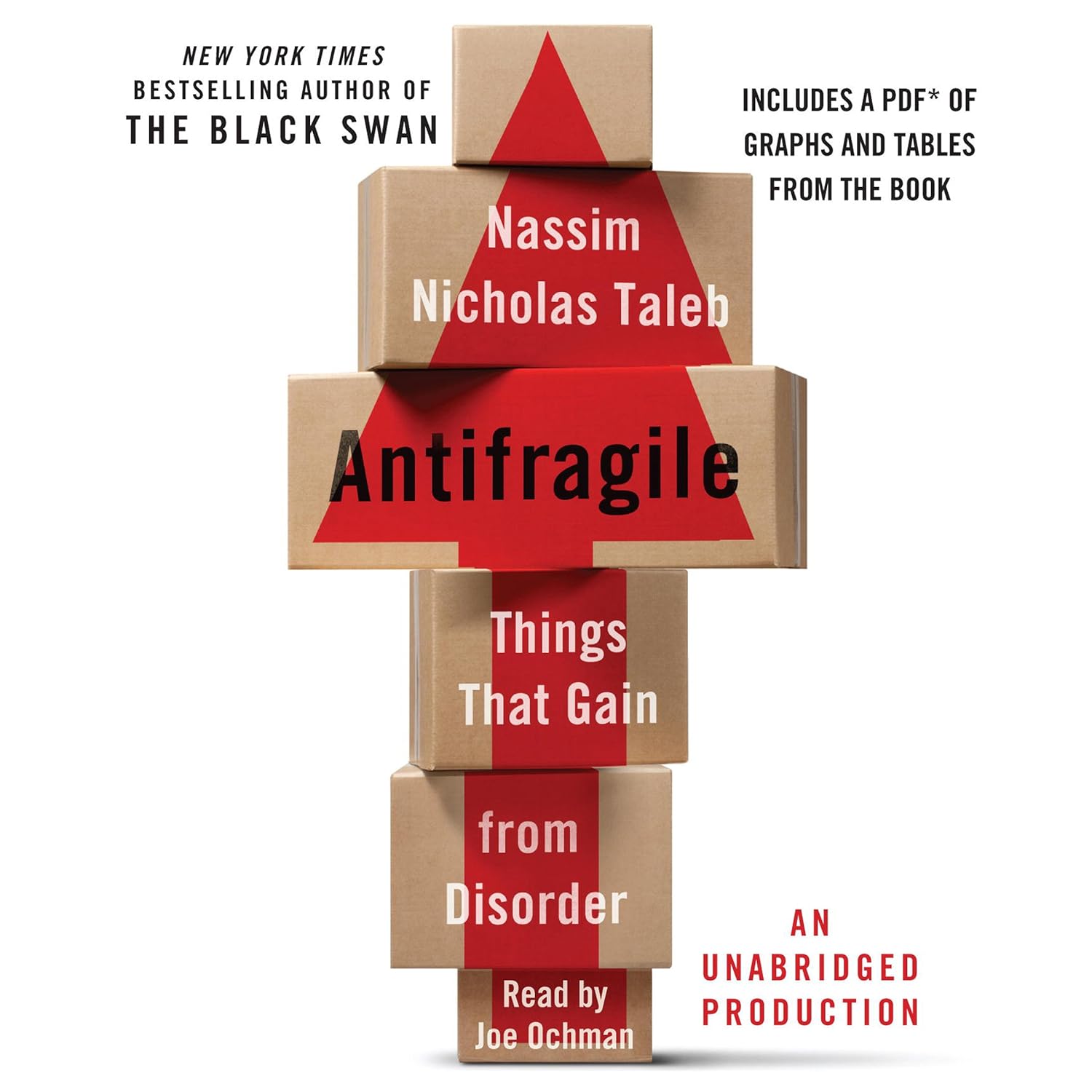
Nassim Nicholas Taleb, the bestselling author of The Black Swan, returns with a revolutionary concept for navigating our unpredictable world: Antifragile. This groundbreaking work moves beyond mere resilience, revealing how certain systems and individuals don't just withstand shocks, but actively benefit from disorder, volatility, and stressors.
Just as our bones grow stronger under stress, and evolution thrives on trial and error, antifragile entities flourish by embracing chaos. Taleb illustrates how to build lives, businesses, and societies that gain strength from disruption, not despite it. He challenges conventional wisdom across finance, politics, medicine, and more, advocating for the superiority of practical experience over rigid planning and explaining why "efficiency" can often be a dangerous fragility.
Drawing on ancient wisdom, street smarts, and a vast array of historical and contemporary examples—from the sinking of the Titanic to the vibrant culinary scene of New York—Taleb provides a powerful blueprint for thriving in a world defined by the unexpected. Discover why debt is a destroyer, why controlled risk is a catalyst, and how to embrace the very forces that threaten to break us.
Antifragile is an essential guide for anyone seeking not just to survive, but to gain from uncertainty. It's a radical new perspective on how to live, succeed, and grow in the face of the unknown.
Summary of Key Ideas
- •
Beyond Resilience: The Antifragile Advantage
Nassim Nicholas Taleb introduces the concept of 'antifragility,' moving beyond mere resilience. While resilient systems resist shocks and maintain their form, antifragile systems actually benefit from them. They thrive on volatility, randomness, and uncertainty, becoming stronger and more capable as a result. This is not about withstanding damage but about using stressors as catalysts for growth and improvement. Taleb argues that in a world characterized by unpredictable events, the ability to gain from disorder is a superior strategy to simply enduring it. This core idea challenges our traditional notions of stability and presents a new framework for understanding how systems, from biological organisms to economic markets, can flourish in an unpredictable environment.
- •
The Triad: Fragile, Robust, and Antifragile
Taleb meticulously defines and differentiates three states of being in relation to stressors. Fragile systems break under stress and volatility, preferring predictability and calm. Robust systems can withstand shocks without breaking, maintaining their structural integrity but not necessarily improving. Antifragile systems, however, are the opposite of fragile; they gain from stressors, becoming stronger and more adaptive. This distinction is crucial for understanding Taleb's thesis. By categorizing systems, he illustrates the inherent limitations of focusing solely on resilience and highlights the unique advantages of actively embracing and benefiting from disorder and uncertainty.
- •
Embracing Randomness and Uncertainty
A central theme of Antifragile is the necessity of embracing randomness and uncertainty, rather than attempting to eliminate or suppress them. Taleb argues that the quest for perfect prediction and control often leads to fragile systems that are brittle and prone to catastrophic failure when unexpected events occur. Instead, he advocates for a mindset that views randomness as a source of opportunity and learning. By understanding and interacting with uncertainty, individuals and systems can develop a greater capacity to adapt and evolve, ultimately becoming more antifragile and capable of navigating the inherent messiness of life.
- •
The Barbell Strategy: Extremes Over Averages
Taleb introduces the 'Barbell Strategy' as a practical application of antifragility. This involves investing heavily in two opposite extremes: virtually risk-free options (like government bonds) and highly speculative, potentially explosive options (like venture capital or options trading). The middle ground, representing moderate risk and moderate returns, is to be avoided. The rationale is that the 'safer' side of the barbell protects against downside risk and 'black swans,' while the 'riskier' side offers the potential for substantial upside. This strategy allows for exposure to extreme events without succumbing to their destructive potential, fostering a form of antifragility.
- •
Via Negativa: The Power of Removal
The principle of 'Via Negativa,' or the negative way, is presented as a crucial method for achieving antifragility. Instead of trying to add beneficial elements, Taleb suggests focusing on removing harmful ones. This means identifying and eliminating sources of fragility, unnecessary complexities, and hidden risks that could lead to ruin. By simplifying, reducing exposure to negative shocks, and stripping away vulnerabilities, a system becomes more robust and, by extension, more antifragile. This approach emphasizes what to avoid rather than what to pursue, a counterintuitive but powerful strategy for building strength and resilience.
- •
The Role of Optionality
Optionality, the presence of choice and the ability to adapt and change course, is a key ingredient for antifragility. Taleb emphasizes that having options provides a buffer against unforeseen events and allows for experimentation and learning. When systems or individuals have a wide range of options, they can better navigate uncertainty and capitalize on opportunities that arise from volatility. This includes having the freedom to say 'no' to unfavorable situations and the capacity to explore new possibilities without incurring ruinous costs. Optionality, therefore, is not just about having choices, but about having the right kinds of choices that enable growth from disorder.
- •
Learning from Failure: The Edges of the Bell Curve
Taleb argues that true learning and progress often come from the edges of the probability distribution – the extreme events and failures, not the mundane averages. Systems that are antifragile can learn from errors and failures, integrating the lessons into their structure and improving their performance. This contrasts with systems that are fragile and seek to avoid any form of failure, thereby stagnating. By understanding that failures are not just setbacks but potential sources of information and improvement, antifragile entities can iteratively enhance their capabilities and become more adept at handling future challenges.
- •
The Problem of the "Black Swan" and Prediction
Building on his previous work, Taleb reinforces the idea that rare, unpredictable, and high-impact events (Black Swans) dominate our world, yet are poorly understood and predicted by traditional models. He criticizes the reliance on forecasts and the illusion of predictability, which often create fragile systems. Antifragility offers a way to thrive in a world shaped by these Black Swans, by not attempting to predict them, but by building systems that can withstand and even benefit from their occurrence. The focus shifts from prediction to preparedness and the ability to adapt to the unexpected consequences of extreme events.
- •
The Lindy Effect: Aging as a Predictor
Taleb introduces the Lindy Effect, which posits that the longer a non-perishable thing exists, the greater its life expectancy. For intangible things like ideas and books, this means that their future life expectancy is proportional to their current age. Taleb applies this to argue that older technologies, traditions, and ideas often possess a degree of antifragility because they have already survived numerous shocks and uncertainties. This provides a heuristic for identifying potentially robust and antifragile elements in society and life, suggesting that survival itself is a form of testing and validation.
- •
Skin in the Game: Bearing Consequences
While not explicitly a central theme in 'Antifragile' itself, the concept of 'Skin in the Game,' elaborated in Taleb's later work, is deeply intertwined. For a system to be truly antifragile, those who make decisions must have something to lose. This direct exposure to the consequences of their actions, both positive and negative, aligns incentives and encourages responsible risk-taking and a genuine desire for robust and antifragile systems. Without 'skin in the game,' decision-makers can create fragility for others while remaining insulated themselves, undermining the principles of antifragility.
Chapter Recap

About The Author
Nassim Nicholas Taleb
French-Lebanese-American essayist, scholar, statistician, former trader and risk analyst
Main Quotes
"Antifragility is beyond resilience or robustness. The resilient resists shocks and stays the same; the antifragile gets better."
"Wind extinguishes a candle, but energizes a fire."
"We need stressors in our lives to build robustness, not to avoid them."
"The opposite of fragile is antifragile."
"Errors are not to be treated like sins; they are to be treated like the symptoms of a disease."
"The truly wise man is he who knows he knows nothing."
"The highest form of intelligence is the ability to adapt."
"We live in an age of the artifact, where we are disconnected from the natural world and its wisdom."
"The most effective way to learn is by making mistakes."
"The market is a complex adaptive system that is antifragile."
Who Should Read This Book
Individuals working in finance and investing
Business professionals and entrepreneurs seeking strategies for navigating uncertainty
Academics and researchers interested in systems thinking and risk management
Individuals interested in philosophy and unconventional thinking
Readers who enjoy thought-provoking and challenging non-fiction books
People seeking to understand and adapt to complex and unpredictable environments
Book Summaries Like
Antifragile

FAQ

Free Access to LitNotes