




 DISCORD
Babel
R. F. Kuang


 Goodreads Choice Awards
 USA Today Best Sellers


 114 Min Reading Time
 Audio Version Available
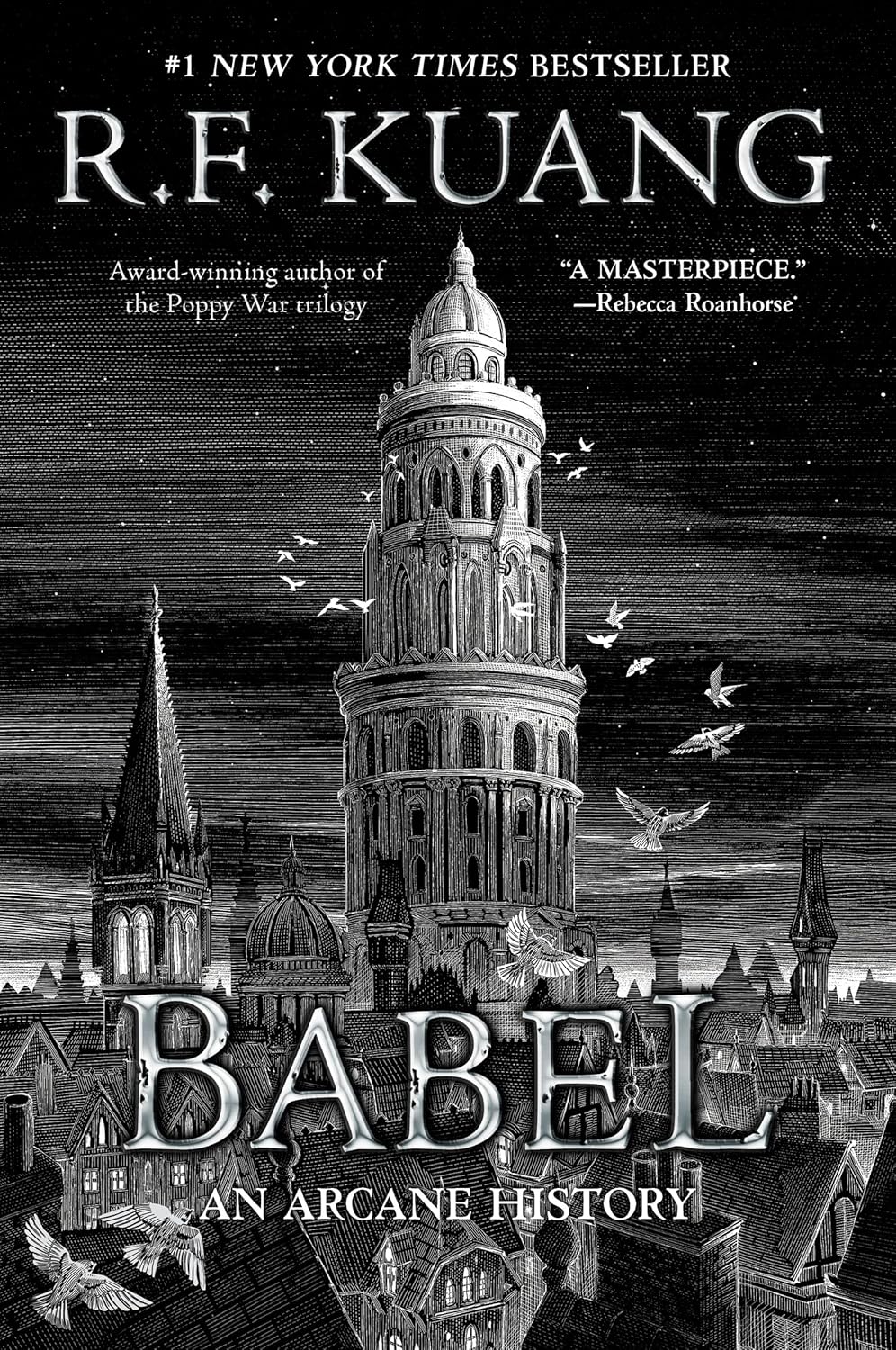
About this book
In 1828, orphaned by cholera in Canton, Robin Swift is whisked away to London by the enigmatic Professor Lovell. His destiny: rigorous training in Latin, Greek, and Chinese, all leading to enrollment at Oxford's prestigious Royal Institute of Translation—Babel.
But Babel is more than just a center for languages; it's the heart of a magic fueled by silver-working, where the nuances lost in translation are alchemically imbued into enchanted silver bars. This power has propelled the British Empire to unprecedented global dominance.
For Robin, Oxford is a paradise of knowledge. Yet, as he delves deeper into his studies, he confronts a devastating truth: Babel's power is built on the subjugation of his homeland. Torn between loyalty to the Empire and his own heritage, Robin is drawn into the clandestine Hermes Society, a group determined to dismantle imperial expansion.
As Britain ignites an unjust war with China over silver and opium, Robin faces an impossible choice: Can he reform a corrupt institution from within, or must he embrace violent revolution to sever the ties that bind Babel to empire? In a world where translation is power and betrayal is inevitable, how much is he willing to sacrifice?
Summary of Key Ideas
- •
Language as Imperial Power
The Power of Language and Translation: "Babel" highlights how language and, crucially, the ability to translate between languages are sources of immense power. Babel, the Royal Institute of Translation, uses silver-working powered by matched meanings in different languages to fuel the British Empire's expansion. This concept illustrates how linguistic expertise can be weaponized to control and exploit resources and territories. The novel suggests that those who control language control the narrative and, by extension, the world. Translation, therefore, is not merely a neutral exchange of words, but an act laden with political and economic consequences.
- •
The Brutality of Colonialism
Colonialism and Exploitation: The book directly confronts the brutal realities of colonialism, particularly the British Empire's exploitation of colonized lands and peoples. Through Robin's experiences and the inner workings of Babel, Kuang exposes the ways in which the pursuit of knowledge and progress can be intertwined with oppression and violence. The silver-working, which depends on the exploitation of linguistic knowledge from various cultures, symbolizes the broader colonial project of extracting resources and labor from colonized populations for the benefit of the colonizers. The characters grapple with the moral implications of participating in this system.
- •
The Scars of Racism
Racism and Identity: Racism is a pervasive force in "Babel," shaping the characters' experiences and opportunities. Robin and his friends face discrimination and prejudice within the seemingly enlightened halls of Oxford. The novel explores how racial identity is constructed and imposed, influencing individuals' sense of belonging and self-worth. Robin's internal conflict stems from his dual heritage and his forced assimilation into British society. The book emphasizes the psychological toll of racism and the challenges of navigating a world structured by racial hierarchies.
- •
The Moral Dilemma of Resistance
The Necessity of Violence vs. Peaceful Resistance: The characters in "Babel" debate the effectiveness and morality of violence as a means of resistance against colonial oppression. Some characters advocate for radical action and sabotage, believing that only violence can dismantle the structures of power. Others favor peaceful methods, hoping to reform the system from within. The novel doesn't offer easy answers, presenting the complexities and potential consequences of both approaches. It compels readers to consider the ethical dilemmas of resistance in the face of systemic injustice.
- •
Institutions as Instruments of Power
The Corrupting Influence of Institutions: Babel, as an institution, embodies the contradictions and compromises inherent in participating in a system of oppression. While ostensibly dedicated to the pursuit of knowledge, Babel is deeply entangled with the British Empire's colonial project. The characters must confront the ethical compromises required to succeed within such an institution, questioning whether it's possible to effect change from within or whether true resistance requires complete rejection of the system. The novel suggests that institutions, even those with noble aims, can be corrupted by power and self-interest.
- •
The Power of Connection
Friendship and Found Family: Amidst the themes of colonialism and racism, "Babel" also explores the importance of friendship and found family. Robin and his fellow students form deep bonds of loyalty and support, finding solace and strength in their shared experiences. These relationships offer a counterpoint to the isolating and alienating forces of colonialism, highlighting the power of human connection in the face of adversity. The friendships serve as a reminder of the shared humanity that transcends racial and cultural divides.
- •
The Price of Awareness
Loss of Innocence and the Burden of Knowledge: Robin's journey from a naive boy to a disillusioned revolutionary reflects a loss of innocence and the burden of knowledge. As he becomes aware of the true extent of the Empire's brutality and the complicity of institutions like Babel, he grapples with the weight of this understanding. The novel explores the psychological impact of witnessing and participating in acts of violence and oppression, suggesting that knowledge can be a double-edged sword, bringing both enlightenment and profound sorrow. The characters are forced to confront uncomfortable truths about themselves and the world around them.
- •
Questioning Progress
The Illusion of Progress: "Babel" questions the notion of progress as it is often defined within a colonial context. The technological advancements fueled by silver-working are presented as a form of progress, but they come at the cost of exploitation and oppression. The novel challenges readers to consider whose interests are served by progress and whether true progress can be achieved without addressing systemic inequalities. It suggests that progress without justice is merely a perpetuation of existing power structures.
Chapter Recap

About The Author
R. F. Kuang
Main Quotes
"Language was always the companion of empire, and as such, together they begin, grow, and flourish. And later, together, they fall."
"That's just what translation is, I think. That's all speaking is. Listening to the other and trying to see past your own biases to glimpse what they're trying to say."
"Sometimes, the kindest thing you can do for someone is to leave."
"Revolution is a negotiation between the ideal and the possible."
"This is how colonialism works. It convinces us that the fallout from resistance is entirely our fault, that the immoral choice is resistance itself."
"History isn't a premade tapestry that we've got to suffer, a closed world with no exit. We can form it. Make it. We just have to choose to try."
"Betrayal. Translation means doing violence upon the original, means warping and distorting it for foreign, unintended eyes. So then where does that leave us?"
"There is no wasted life, no life ended too soon, no life that wasn't lived as fully as it should have."
"The university was founded on a lie. Knowledge for knowledge’s sake? Utter nonsense."
"They want you to believe that you are alone. They want you to believe that no one will help you. But there is always a choice."
Who Should Read This Book
Readers of historical fantasy
Readers interested in themes of colonialism, racism, and revolution
Academically inclined readers
Readers interested in linguistics and translation
Readers of dark academia
Young adults and adults
Readers who enjoy complex, character-driven narratives
Readers familiar with and interested in critiques of imperialism
Readers who appreciate morally gray characters and stories exploring the necessity of violence
Readers of R.F. Kuang's previous works
Book Summaries Like
Babel

FAQ

Free Access to LitNotes