




 DISCORD
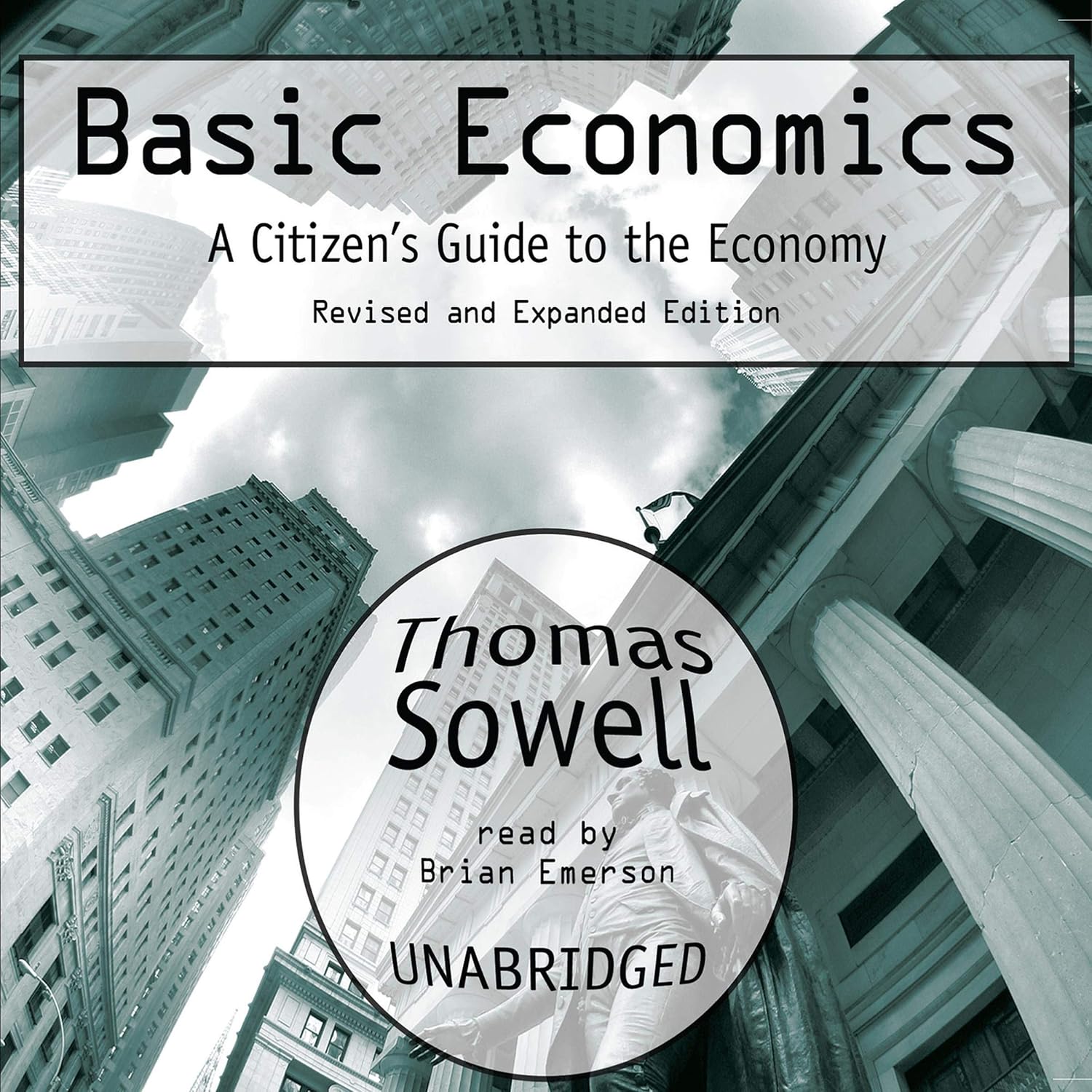
Basic Economics
Thomas Sowell


 Apple Books


 149 Min Reading Time
 Audio Version Available
About this book
Unlock the secrets of the economy with Thomas Sowell's Basic Economics, the essential guide for understanding how the world truly works, without the jargon or complex equations. Sowell dismantles economic myths and empowers you to analyze policies based on real-world incentives, not just proclaimed goals.
From rent control to international trade, explore the fundamentals governing capitalist, socialist, and every other type of economy with crystal-clear explanations and captivating examples drawn from across the globe and throughout history. Discover why some nations prosper while others struggle, and gain the economic literacy you need to form your own informed opinions. Whether you're a student, a concerned citizen, or simply curious, Basic Economics offers a uniquely accessible and enjoyable path to economic understanding.
Summary of Key Ideas
- •
The Scarcity Principle
Economics is fundamentally about the allocation of scarce resources that have alternative uses. This scarcity necessitates choices, and every choice involves a trade-off. Understanding how resources are allocated—what gets produced, how it gets produced, and for whom—is central to understanding economics. Sowell emphasizes that resources are limited, and human desires are virtually unlimited, creating a perpetual tension that drives economic activity. This core concept underscores the importance of efficiency and the role of prices in signaling relative scarcity.
- •
The Price System as a Signaling Mechanism
Prices act as signals in a market economy, conveying information about supply and demand. They coordinate economic activity by incentivizing producers to supply goods and services that consumers demand and rationing scarce resources to their most valued uses. Sowell explains how prices emerge from the interactions of buyers and sellers and how they reflect underlying costs and preferences. Interferences with price mechanisms, such as price controls or subsidies, lead to distortions, shortages, and surpluses, ultimately reducing overall economic efficiency and well-being. Free markets, guided by prices, tend to allocate resources more efficiently than centrally planned systems.
- •
The Significance of Opportunity Cost
Costs are not just monetary expenses but also include opportunity costs—the value of the next best alternative forgone when making a decision. Sowell stresses the importance of considering all costs, both explicit and implicit, when evaluating the economic viability of a project or policy. Businesses must account for all costs to make informed decisions about production, pricing, and investment. Similarly, policymakers must consider the full range of costs and benefits associated with government interventions to avoid unintended consequences. Understanding opportunity cost provides a more complete and accurate picture of economic trade-offs.
- •
The Function of Profit and Loss
The role of profit and loss is crucial in guiding resources to their most productive uses. Profit serves as an incentive for businesses to innovate, improve efficiency, and respond to consumer demands. Loss, conversely, signals that resources are being used inefficiently and that a change in course is necessary. Sowell explains that profit is not simply a matter of exploitation but rather a reward for creating value and satisfying consumer needs. Allowing businesses to pursue profits, subject to market discipline, promotes economic growth and raises living standards. Attempts to suppress profits through regulation or taxation can stifle innovation and reduce overall welfare.
- •
The Importance of Productivity
Productivity is the key to economic growth and higher living standards. Sowell emphasizes that increasing the amount of goods and services produced per unit of input is essential for improving overall prosperity. This can be achieved through technological advancements, specialization, and investment in human capital. Policies that encourage productivity growth, such as free markets, sound money, and secure property rights, tend to foster long-term economic development. Conversely, policies that hinder productivity, such as excessive regulation, protectionism, and inflation, can lead to economic stagnation.
- •
Unintended Consequences of Government Intervention
Government interventions in the economy often lead to unintended consequences that can undermine their intended goals. Sowell provides numerous examples of how well-intentioned policies, such as rent control, minimum wage laws, and trade restrictions, can create distortions, inefficiencies, and unintended harm. He argues that government intervention should be approached with caution and that policymakers should carefully consider the potential consequences of their actions. A thorough understanding of economics is essential for evaluating the likely effects of government policies and avoiding unintended negative outcomes. The market is a complex adaptive system, and interventions can disrupt its natural functioning in unpredictable ways.
Chapter Recap

About The Author
Thomas Sowell
Main Quotes
"The first lesson of economics is scarcity: There is never enough of anything to satisfy all those who want it."
"Economics is not about things, it is about how people make choices in dealing with things."
"In order to understand the world, you have to be willing to see it as it is, not as you want it to be."
"The most basic questions are not whether the government is doing things it has no business doing, but whether it is doing things it is already doing efficiently."
"Few things are harder to imagine than the point of view of people who do not share our values."
"The problem isn't that Johnny can't read. The problem isn't even that Johnny can't think. The problem is that Johnny doesn't know what thinking is."
"Virtually no major issue is as simple as the people who talk about it tend to make it."
"The first lesson of economics is scarcity: There is never enough of anything to satisfy all those who want it. The first lesson of politics is to disregard the first lesson of economics."
"It is not money but the volume of goods and services which determines whether a country is poverty stricken or prosperous."
"Capitalism knows only one color: that color is green; all else is necessarily subservient to it, hence, race, gender and ethnicity are rendered irrelevant."
Who Should Read This Book
General readers interested in understanding economics without technical jargon
Students studying economics or related fields
Individuals seeking a conservative or libertarian perspective on economic issues
Homeschooling parents looking for economics curriculum materials
Readers interested in public policy and current events
Those without formal economic training wanting to learn basic principles
Citizens seeking to understand how the economy functions
Readers looking for a common-sense approach to economic analysis
Book Summaries Like
Basic Economics


FAQ

Free Access to LitNotes