




 DISCORD
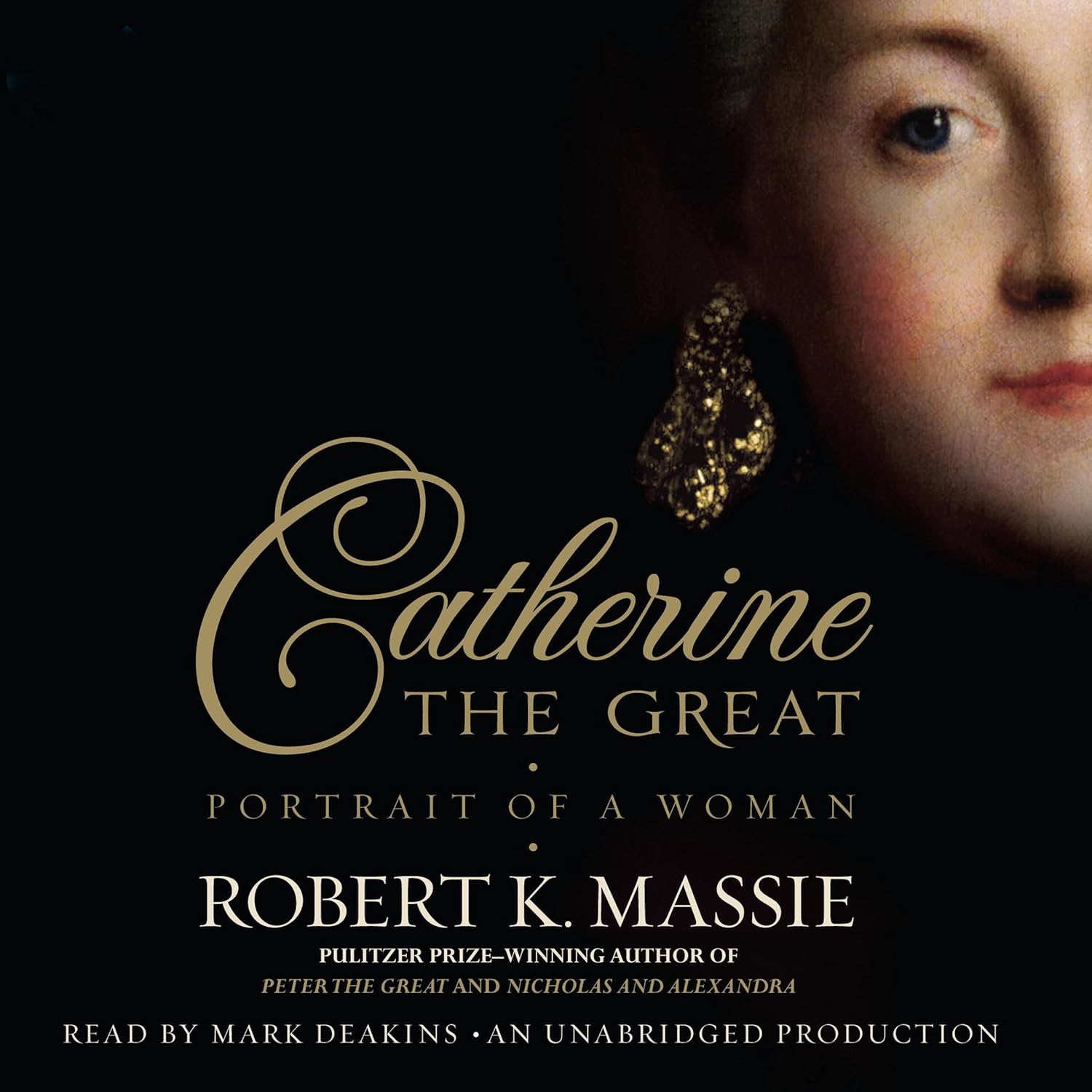
Catherine the Great: Portrait of a Woman
Robert K. Massie


 Goodreads Choice Awards
 Apple Books


 269 Min Reading Time
 Audio Version Available
About this book
From a minor German noble to one of history's most powerful women, Catherine the Great's story is a sweeping saga of ambition, passion, and transformation. In this masterful biography, Pulitzer Prize-winning author Robert K. Massie resurrects the world of the Russian court and the flesh-and-blood woman who ruled it for thirty-four years.
At fourteen, the young princess arrived in Russia and quickly learned to navigate a treacherous court, enduring a loveless marriage and palace intrigue, all in pursuit of the throne. Massie delves into Catherine's complex relationships: her scheming mother, her impotent husband Peter, her tormented son Paul, and her passionate, powerful connection with Gregory Potemkin.
Drawing on personal letters and historical accounts, Massie reveals the brilliant, ruthless, and pragmatic woman who corresponded with Voltaire and Diderot, confronted domestic rebellion and foreign wars, and left an indelible mark on Russia's government, foreign policy, cultural development, and territorial expansion. Catherine the Great is a compelling portrait of a titan, a lover, a leader, and a survivor whose life continues to fascinate.
Summary of Key Ideas
- •
The Making of an Empress
From Obscure Princess to Russian Empress: The book details Catherine's transformation from a minor German princess, Sophia of Anhalt-Zerbst, to one of the most powerful and influential women in history. It explores the ambition, intelligence, and political acumen that allowed her to navigate the treacherous Russian court and seize the throne from her unpopular husband, Peter III. Massie emphasizes the pivotal role of her early experiences and education in shaping her worldview and preparing her for the challenges she would face in Russia.
- •
Enlightened Absolutism
A Stateswoman of the Enlightenment: Catherine embraced many ideals of the Enlightenment, corresponding with Voltaire and Diderot, and attempting to implement legal and social reforms within Russia. Massie explores the extent to which Catherine was genuinely committed to these ideals, balancing her aspirations for a more just and equitable society with the practical realities of ruling an autocratic empire. He analyzes her legislative efforts, such as the Nakaz, and assesses their impact on Russian society.
- •
Expanding the Empire
Russia's Expansion and Modernization: Catherine oversaw a period of significant territorial expansion for Russia, including the annexation of Crimea and large parts of Poland. Massie examines her foreign policy objectives and military campaigns, highlighting her strategic vision and diplomatic skills. He also discusses her efforts to modernize Russia's infrastructure, economy, and military, laying the foundation for its future as a major European power.
- •
The Empress's Entanglements
Love, Passion, and Scandal: Catherine's personal life was marked by numerous love affairs with influential figures, including Grigory Orlov and Grigory Potemkin. Massie delves into the complexities of these relationships, exploring the emotional dynamics and political implications. He examines how Catherine used her lovers to advance her political agenda and maintain her grip on power, while also acknowledging the genuine affection and companionship she sought.
- •
The Weight of the Crown
A Complex and Contradictory Legacy: Catherine's reign was a period of both progress and repression. While she introduced some reforms and promoted the arts and sciences, she also strengthened serfdom and suppressed dissent. Massie presents a nuanced portrait of Catherine, acknowledging her flaws and contradictions while celebrating her achievements and contributions to Russian history. He leaves the reader to grapple with the complexities of her legacy and her place in the pantheon of great rulers.
- •
Crafting an Imperial Image
The Power of Image and Propaganda: Catherine understood the importance of shaping public opinion and used art, architecture, and propaganda to cultivate a positive image of herself and her reign. Massie analyzes how she commissioned portraits, built magnificent palaces, and promoted cultural achievements to project an image of enlightened rule and imperial grandeur. He also examines how she skillfully managed her reputation in the face of criticism and scandal.
- •
Facing Internal Threats
Dealing with Rebellion and Dissent: Catherine faced significant challenges to her authority, including the Pugachev Rebellion, a large-scale peasant uprising that threatened to destabilize the empire. Massie examines how Catherine responded to these challenges, balancing repression with concessions and demonstrating her resolve to maintain order and control. He analyzes the social and economic factors that fueled these rebellions and their impact on Catherine's policies.
- •
The Burdens of Absolute Power
The burdens of absolute power are heavily explored in Massie's Portrait of a Woman. Catherine constantly had to consider the ramifications of every decision she made, both for her country and for her own security. The book explores how she needed to balance the needs of her people with her own desires, and how these often came into conflict. The book explores Catherine's need for control, and her deep understanding of human psychology and politics.
Chapter Recap

About The Author
Robert K. Massie
Main Quotes
"The love of power and the power to attract love were not easy to reconcile."
"In Russia everything is a secret, but there is no secrecy."
"I praise loudly; I blame softly."
"Everyone looks for what they aren't."
"I shall follow my instincts, and my sentiments, without allowing myself to be shackled by the judgments of others."
"If you want to be respected, you must respect yourself."
"Friendship founded on business is better than business founded on friendship."
"The more a man knows, the more he forgives."
"Never refuse to do a kindness unless the act would destroy you."
"I am one of those who never take no for an answer."
Who Should Read This Book
Readers interested in Russian history
Biographers and readers of biographies
Readers interested in powerful female historical figures
Enthusiasts of 18th-century European history
Those fascinated by royal families and political intrigue
Readers of Robert K. Massie's other historical works
People interested in strong female leadership
Readers seeking in-depth character studies
Those who enjoy historical narratives with rich detail
Readers of non-fiction books about European monarchs
Book Summaries Like
Catherine the Great: Portrait of a Woman


FAQ

Free Access to LitNotes