




 DISCORD
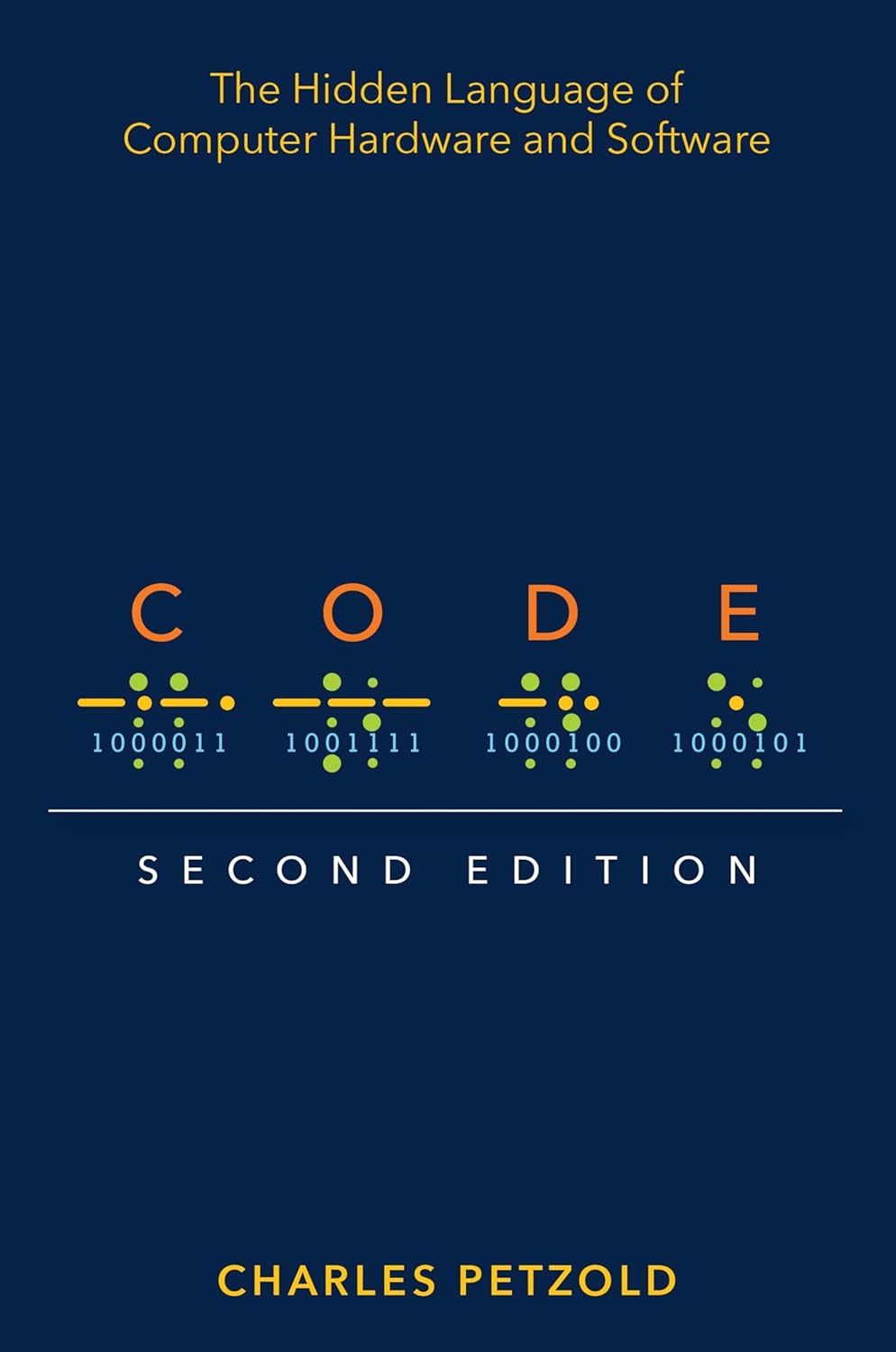
Code
Charles Petzold


 Apple Books


 88 Min Reading Time
 Audio Version Available
About this book
Have you ever wondered what really goes on inside your computer, smartphone, or even your microwave? For over two decades, Charles Petzold's Code has been demystifying the inner workings of the digital world, and now it's been updated for a new generation.
What do flashlights, black cats, and the ride of Paul Revere have to do with computers? Through clever illustrations and engaging explanations, Petzold uses everyday objects and familiar concepts like Braille and Morse code to illuminate the hidden language that drives our technology.
Code isn't just about programming; it's about understanding the ingenuity behind the digital revolution. Journey from the simplest logic gates to the complex architecture of the CPU, and discover how human innovation has shaped every electronic device we use. Whether you're a seasoned techie or just curious about the magic inside the machine, Code will unlock the secrets of computers and awaken the technophile within.
Summary of Key Ideas
- •
Information Encoding: From Morse Code to Binary
The book starts with the fundamentals of representing information using codes, starting with Morse code and Braille. This illustrates how abstract concepts can be translated into tangible signals and symbols. Petzold uses these examples to introduce the basic principles of encoding and decoding, which are fundamental to how computers handle information. By understanding these simple codes, readers can grasp the idea that all data, whether text, images, or instructions, is ultimately represented as a series of binary digits.
- •
Electricity as the Foundation of Computation
The concept of electricity and how it can be used to represent binary information (on or off, 1 or 0) is central to the book. Petzold explains how simple electrical circuits, like switches and relays, can perform logical operations. These circuits are the building blocks of more complex digital systems. Understanding how electricity controls the flow of information is crucial to comprehending the physical layer of computing. The book carefully walks the reader through the transformation of simple circuits to logic gates, laying the foundation for more complex components.
- •
Logic Gates: The Building Blocks of Computation
Logic gates, such as AND, OR, and NOT, are fundamental to digital logic and computer architecture. Petzold meticulously explains how these gates operate using electrical switches and relays. He illustrates how these gates can be combined to perform more complex logical functions. This section provides a clear understanding of how computers make decisions based on logical operations performed on binary data. The reader gains a hands-on appreciation for how simple components can create intricate systems capable of processing information.
- •
Arithmetic Logic: Circuits That Calculate
The book details how basic logic gates can be combined to create circuits that perform arithmetic operations, such as addition and subtraction. These arithmetic circuits are essential components of a computer's central processing unit (CPU). Petzold explains how these circuits work at the electrical level, making complex operations understandable. This section clarifies how computers perform calculations using binary arithmetic, showing the practical application of logic gates in performing mathematical functions.
- •
Memory: Storing and Retrieving Information
Petzold explains how memory works, starting with simple latches and flip-flops built from logic gates. He progresses to more complex memory architectures. This section explains how computers store and retrieve information. Understanding memory is crucial for understanding how computers execute programs and manage data. The book connects the physical components of memory to the abstract concept of storing and retrieving information, bridging the gap between hardware and software.
- •
The Central Processing Unit and Computer Architecture
The book explores the architecture of a basic computer, including the CPU, memory, and input/output devices. It illustrates how these components interact to execute instructions and process data. This section provides a holistic view of how a computer system functions. Petzold simplifies the complexities of computer architecture, making it accessible to a broad audience. He uses clear diagrams and explanations to illustrate the flow of information within the computer.
- •
Assembly Language: Bridging the Gap
The concept of assembly language and how it relates to machine code is crucial. Petzold details how assembly language provides a more human-readable way to write instructions for the computer, which are then translated into machine code that the computer can execute directly. This section explains the relationship between high-level programming languages and the underlying hardware. It highlights the translation process that allows programmers to write code in a more abstract form while still controlling the computer's behavior at a low level.
- •
Input and Output: Interacting with the World
The book discusses how input and output (I/O) devices, such as keyboards, monitors, and storage devices, interact with the computer. Petzold explains how these devices send and receive information, enabling users to interact with the system. Understanding I/O is crucial for understanding how computers interface with the external world. The book provides a clear explanation of the hardware and software mechanisms that facilitate communication between the computer and its peripherals.
Chapter Recap

About The Author
Charles Petzold
Main Quotes
"Code is not like other how-computers-work books."
"Programming in machine code is like eating with a toothpick."
"The most profound technologies are those that disappear. They weave themselves into the fabric of everyday life until they are indistinguishable from it."
"A code is a system of symbols and rules for using these symbols to represent something."
"The binary number system is nothing more than a code."
"It's all just ones and zeros."
"Code is a way of thinking that all humans share."
"Code is our modern Rosetta Stone, our linguistic key to the digital universe."
"The cheapest, fastest, and most reliable components of a computer system are those that aren't there."
"Perspective is worth 80 IQ points."
Who Should Read This Book
Beginner programmers seeking a foundational understanding of computer architecture.
Self-taught programmers wanting to fill gaps in their knowledge.
Students in introductory computer science courses.
Hobbyists interested in the inner workings of computers.
Anyone curious about how computers work at a fundamental level, regardless of technical background.
Readers who enjoy learning through clear explanations and historical context.
Electrical engineers seeking a software perspective.
Software engineers wanting to understand the hardware beneath their code.
Book Summaries Like
Code
FAQ

Free Access to LitNotes