




 DISCORD
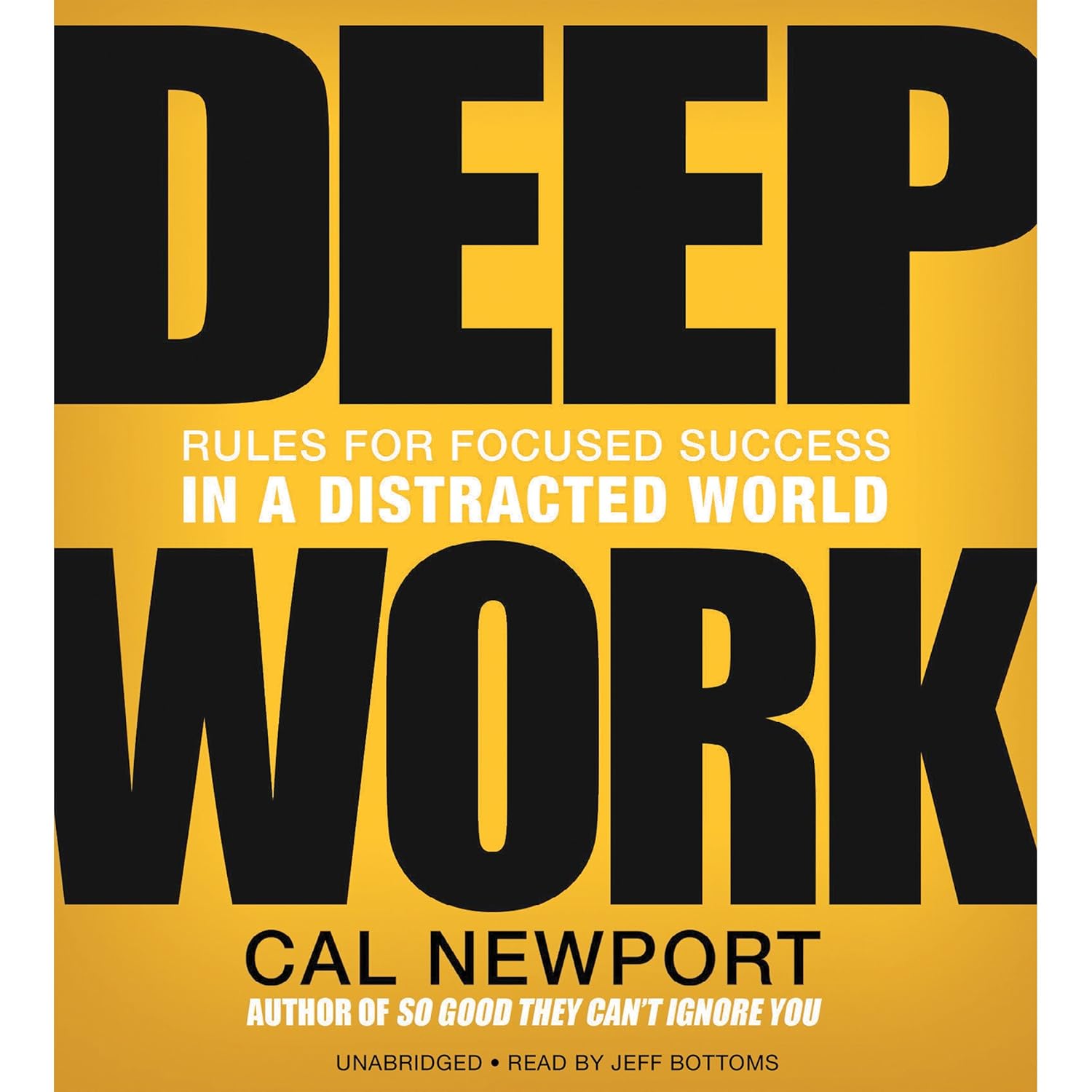
Deep Work
Cal Newport


 Goodreads Choice Awards
 Apple Books


 33 Min Reading Time
 Audio Version Available
About this book
In an age of relentless distraction, where shallow work dominates and true accomplishment feels increasingly elusive, Deep Work offers a potent antidote. Cal Newport, Georgetown University professor and bestselling author, reveals how to cultivate the ability to focus without distraction on cognitively demanding tasks—a skill that's become exceptionally rare and valuable.
Deep Work isn't just another productivity hack; it's a philosophy rooted in the idea that cultivating focus allows you to achieve more in less time and experience genuine fulfillment in your work. Newport demonstrates that mastering deep work allows you to quickly learn complex information and achieve extraordinary results.
Combining rigorous research with actionable advice, Deep Work divides into two parts. First, Newport makes the case that profound focus is essential to thrive in today's intensely competitive economy. Then, he presents a training regimen, outlining specific strategies and rituals to transform your mind and habits, from minimizing distractions and embracing boredom to structuring your day for optimal concentration.
Whether you're a student, a creative, an entrepreneur, or simply someone seeking meaning and mastery in a distracted world, Deep Work offers a roadmap for reclaiming your focus, achieving your goals, and thriving in an age of distraction. It's a call to cultivate the mental discipline needed for success and satisfaction in a world that desperately needs it.
Summary of Key Ideas
- •
The Power of Focused Concentration
Deep work is defined as activities performed in a state of distraction-free concentration that push your cognitive capabilities to their limit. These efforts create new value, improve your skill, and are hard to replicate. In an increasingly distracted world, the ability to perform deep work is becoming rarer and therefore more valuable. Newport argues that cultivating this skill is essential for thriving in the modern economy, both professionally and personally. It's about focusing without distraction on a cognitively demanding task.
- •
Recognizing and Reducing Shallow Work
Shallow work, on the other hand, refers to non-cognitively demanding, logistical-style tasks, often performed while distracted. These efforts tend not to create much new value in the world and are easy to replicate. Examples include answering emails, attending meetings, and engaging on social media. While shallow work has its place, Newport cautions against letting it dominate your workday, as it hinders your ability to achieve meaningful accomplishments and long-term goals. The book stresses the importance of minimizing shallow work to maximize deep work.
- •
Four Philosophies of Deep Work
Newport presents four philosophies for incorporating deep work into your life: the monastic, bimodal, rhythmic, and journalistic approaches. The monastic approach involves eliminating distractions almost entirely, ideal for those with the autonomy to structure their lives around deep work. The bimodal philosophy involves dedicating clearly defined periods to deep work, separated by periods of shallow work. The rhythmic approach involves incorporating deep work into a daily routine, making it a consistent habit. The journalistic approach allows for deep work whenever the opportunity arises, requiring flexibility and adaptability. The best approach depends on individual circumstances and preferences.
- •
The Myth of Multitasking
Multitasking is detrimental to deep work. When we constantly switch between tasks, our attention residue lingers, impairing our cognitive performance on subsequent tasks. Newport advocates for single-tasking, focusing on one task at a time with undivided attention. He suggests techniques like time blocking and creating dedicated workspaces to minimize distractions and facilitate deep concentration. By avoiding multitasking, we can enhance our focus, improve the quality of our work, and achieve a greater sense of accomplishment.
- •
The Importance of Embracing Boredom
Embracing boredom is crucial for cultivating deep work habits. In our hyper-connected world, we've become accustomed to constant stimulation, making it difficult to tolerate periods of quiet and solitude. Newport argues that we must actively resist the urge to seek distraction and instead allow ourselves to experience boredom. By doing so, we train our brains to focus for extended periods, enhancing our ability to engage in deep work. Techniques like meditation and deliberate practice can help us develop this skill.
- •
Treating Deep Work as a Professional
Newport urges readers to treat deep work like a professional, not a dilettante. This involves setting clear goals, establishing routines and rituals, and tracking progress. He suggests creating a dedicated workspace, setting specific time blocks for deep work, and minimizing distractions during those periods. By approaching deep work with intention and discipline, we can increase our productivity, improve the quality of our work, and achieve a greater sense of fulfillment. It's about making deep work a priority and structuring our lives to support it.
- •
Minimizing Distractions in a Digital Age
To maximize cognitive capacity for deep work, Newport emphasizes the importance of minimizing distractions, particularly digital distractions. He suggests strategies like quitting social media, batching email responses, and using website blockers to limit access to distracting websites. By consciously reducing exposure to digital stimuli, we can free up mental resources and enhance our ability to focus on cognitively demanding tasks. This also involves setting boundaries and communicating our need for uninterrupted time to colleagues and family members.
- •
The Necessity of Rest and Recovery
Deep work requires significant cognitive effort, making it essential to prioritize rest and recovery. Newport advocates for incorporating regular breaks into your workday and engaging in activities that promote relaxation and rejuvenation. This might include taking short walks, practicing mindfulness, or spending time in nature. He also emphasizes the importance of getting adequate sleep, as sleep deprivation can significantly impair cognitive function and reduce our ability to focus. By prioritizing rest, we can replenish our mental resources and maintain our capacity for deep work.
Chapter Recap

About The Author
Cal Newport
Main Quotes
"Deep work is the ability to focus without distraction on a cognitively demanding task."
"The ability to perform deep work is becoming increasingly rare at exactly the same time it is becoming increasingly valuable in our economy. As a consequence, the few who cultivate this skill, and then make it the core of their working life, will thrive."
"To produce at your peak level you need to work for extended periods with full concentration on a single task free from distraction."
"Shallow Work: Noncognitively demanding, logistical-style tasks, often performed while distracted. These efforts tend to not create much new value in the world and are easy to replicate."
"Clarity about what matters provides an essential foundation for prioritization."
"If you don't produce, you won't thrive—no matter how skilled or talented you are."
"Busyness as Proxy for Productivity: In the absence of clear indicators of what it means to be productive and valuable in their jobs, many knowledge workers turn back toward an industrial indicator of productivity: doing lots of stuff in a visible manner."
"The key to developing a deep work habit is to move beyond good intentions and add routines and rituals to your working life designed to minimize the amount of your limited willpower necessary to transition into and maintain a state of unbroken concentration."
"The best moments usually occur when a person’s body or mind is stretched to its limits in a voluntary effort to accomplish something difficult and worthwhile."
"Quit social media."
Who Should Read This Book
Knowledge workers seeking increased productivity
Professionals struggling with distractions and multitasking
Students aiming for academic excellence
Entrepreneurs and business leaders looking to improve focus
Individuals interested in mindfulness and intentional living
Anyone seeking a competitive edge in a demanding work environment
Readers interested in self-improvement and maximizing their potential
People looking for strategies to manage technology and social media use
Those seeking a more fulfilling and meaningful work life
Individuals interested in the science of productivity and focus
Book Summaries Like
Deep Work


FAQ

Free Access to LitNotes