




 DISCORD
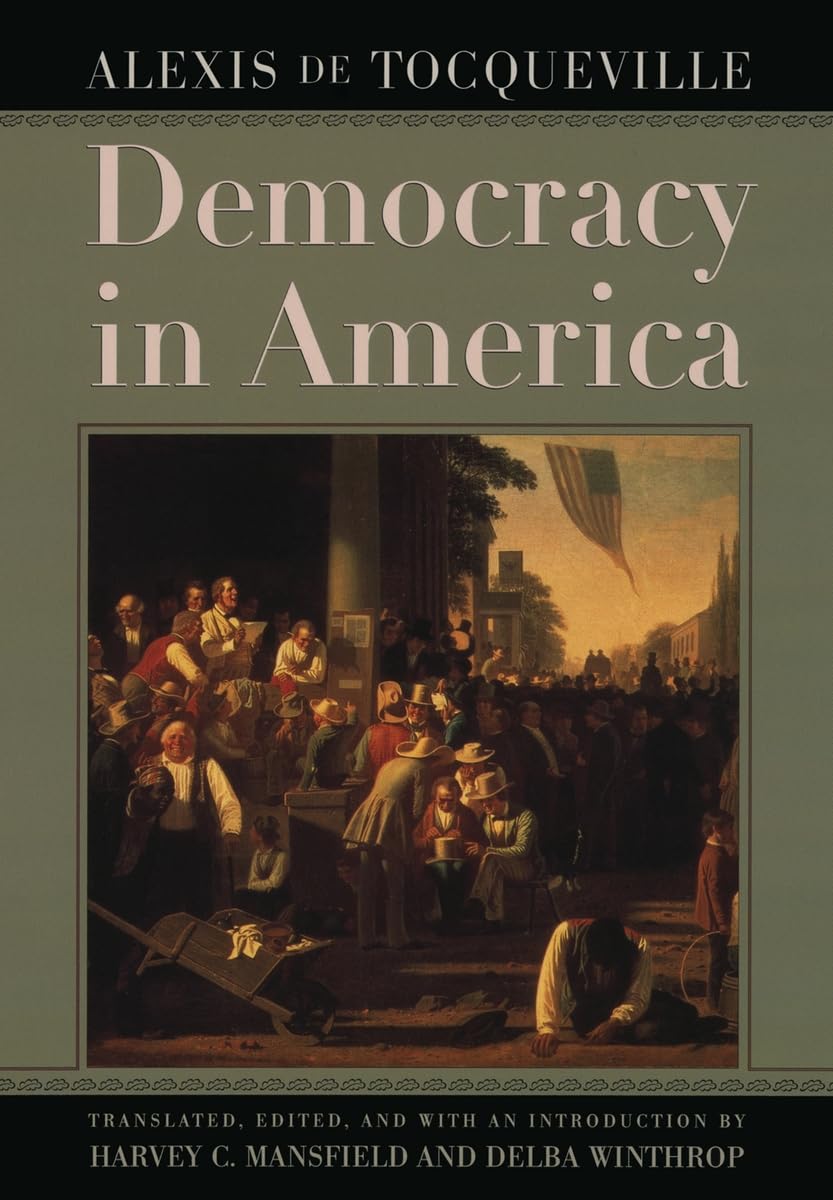
Democracy in America
Alexis de Tocqueville


 Apple Books


 209 Min Reading Time
 Audio Version Available
About this book
A timeless exploration of American society and government, Alexis de Tocqueville's Democracy in America remains a foundational text for understanding the nation's unique character. Written in the 1830s after the author's travels across the young republic, this penetrating study examines the principles, practices, and potential pitfalls of democracy.
Tocqueville delves into the social equality he observed, analyzing its impact on American customs, laws, and beliefs. He explores the role of individualism, the power of public opinion, and the potential dangers of both centralized power and unchecked majority rule. Beyond a mere description, Democracy in America offers a profound reflection on the delicate balance between liberty and equality, and its enduring relevance continues to spark debate and inspire new generations. Discover the insightful observations that have made this book a cornerstone of political thought and a vital resource for anyone seeking to understand the American experiment.
Summary of Key Ideas
- •
The Primacy of Equality
The concept of equality is central to Tocqueville's analysis. He argues that the defining characteristic of American society is its commitment to equality of condition, more so than liberty. This equality fosters a democratic spirit, influencing laws, customs, and social interactions. Tocqueville observes that while not perfectly realized, the striving for equality shapes American identity and distinguishes it from aristocratic European societies. However, he also warns that an excessive focus on equality can lead to a decline in individual excellence and a potential tyranny of the majority.
- •
The Tyranny of the Majority
Tocqueville identifies the 'tyranny of the majority' as a significant danger in democratic societies. This occurs when the majority's will, though democratically established, suppresses the rights and opinions of minorities or individuals. He argues that unchecked majority rule can be as oppressive as the rule of a single tyrant. To mitigate this, Tocqueville emphasizes the importance of protecting individual rights, fostering independent associations, and respecting the role of law as a check on popular opinion.
- •
The Power of Associations
Tocqueville examines the role of associations and civic engagement in American democracy. He notes the American tendency to form groups and associations for various purposes, from charitable work to political advocacy. These associations serve as a vital intermediary between the individual and the state, preventing the government from becoming too powerful and fostering a sense of collective responsibility. Tocqueville sees these associations as schools of citizenship, teaching individuals how to cooperate, compromise, and participate in public life.
- •
Religion's Role in Democracy
Tocqueville explores the influence of religion on American democracy. He observes that, contrary to expectations, religion thrives in the American democratic environment and plays a crucial role in shaping moral values and social norms. While the American Constitution separates church and state, religion provides a moral compass that tempers the excesses of individualism and self-interest. Tocqueville believes that religion helps to maintain social cohesion and provides a foundation for ethical behavior, which is essential for the success of a democratic society.
- •
The Perils of Individualism
Individualism, as defined by Tocqueville, is a tendency for individuals to withdraw into their own private lives and neglect the concerns of the larger community. He sees individualism as a potential threat to democracy because it can lead to apathy, a decline in civic engagement, and an increased reliance on the state. Tocqueville contrasts individualism with egoism, which is a more blatant form of self-interest. He argues that while some level of self-interest is natural, excessive individualism can erode the social fabric and undermine democratic institutions.
- •
Materialism and Practicality
Tocqueville discusses the American emphasis on practicality and material well-being. He observes that Americans are highly focused on improving their material conditions and are less concerned with abstract philosophical or artistic pursuits. While he acknowledges that this focus on practicality can lead to economic prosperity and innovation, he also warns that it can result in a neglect of intellectual and cultural pursuits, potentially diminishing the quality of public discourse and the overall character of the nation.
- •
The Balance of Federalism
Tocqueville analyzes the structure of the American government, particularly the balance of power between the federal government and the states. He praises the American system of federalism for its ability to reconcile national unity with local autonomy. He believes that distributing power among different levels of government prevents any single entity from becoming too dominant, thus safeguarding individual liberties and promoting civic participation at the local level. This balance, in Tocqueville's view, is crucial for maintaining a healthy and vibrant democracy.
- •
Self-Interest Rightly Understood
Tocqueville explores the concept of 'self-interest rightly understood,' which he sees as a uniquely American approach to reconciling individual ambition with the common good. This principle suggests that individuals can best serve their own interests by acting in ways that also benefit society. By recognizing the interconnectedness of individual and collective well-being, Americans are encouraged to engage in civic activities, support public institutions, and contribute to the overall prosperity of the nation. Tocqueville views this enlightened self-interest as a key ingredient in the success of American democracy.
Chapter Recap

About The Author
Alexis de Tocqueville
Main Quotes
"The greatness of America lies not in being more enlightened than any other nation, but rather in her ability to repair her faults."
"In the United States, the majority undertakes to supply a multitude of ready-made opinions for the use of individuals, who are thus relieved from the necessity of forming opinions of their own."
"It is easier for the world to accept a simple lie than a complex truth."
"Despotism often presents itself as the repairer of all the ills suffered, as the support of just rights, as protector of the oppressed, and founder of order."
"The American Republic will endure until the day Congress discovers that it can bribe the public with the public's money."
"Americans of all ages, all conditions, and all dispositions, constantly form associations."
"Liberty cannot be established without morality, nor morality without faith."
"Nothing is more wonderful than the art of being free, but nothing is harder to learn how to use than freedom."
"I do not know if the people of the United States would vote for superior men if they ran for office, but there can be no doubt that such men do not run."
"The most common and natural situation is not always the one most suited to us."
Who Should Read This Book
Political science students and scholars
Historians specializing in American history and political thought
Readers interested in the foundations of American democracy
Individuals studying comparative government and political systems
Those interested in the relationship between democracy and society
French readers seeking to understand American political culture (historical context)
Anyone interested in classic works of political philosophy
Readers interested in social commentary and analysis of societal trends
Individuals involved in public policy and governance
Conservatives interested in Tocqueville's observations on religion and civic engagement in American democracy
Book Summaries Like
Democracy in America


FAQ

Free Access to LitNotes