




 DISCORD
Empire of AI
Karen Hao


 Publisher Weekly


 103 Min Reading Time
 Audio Version Available
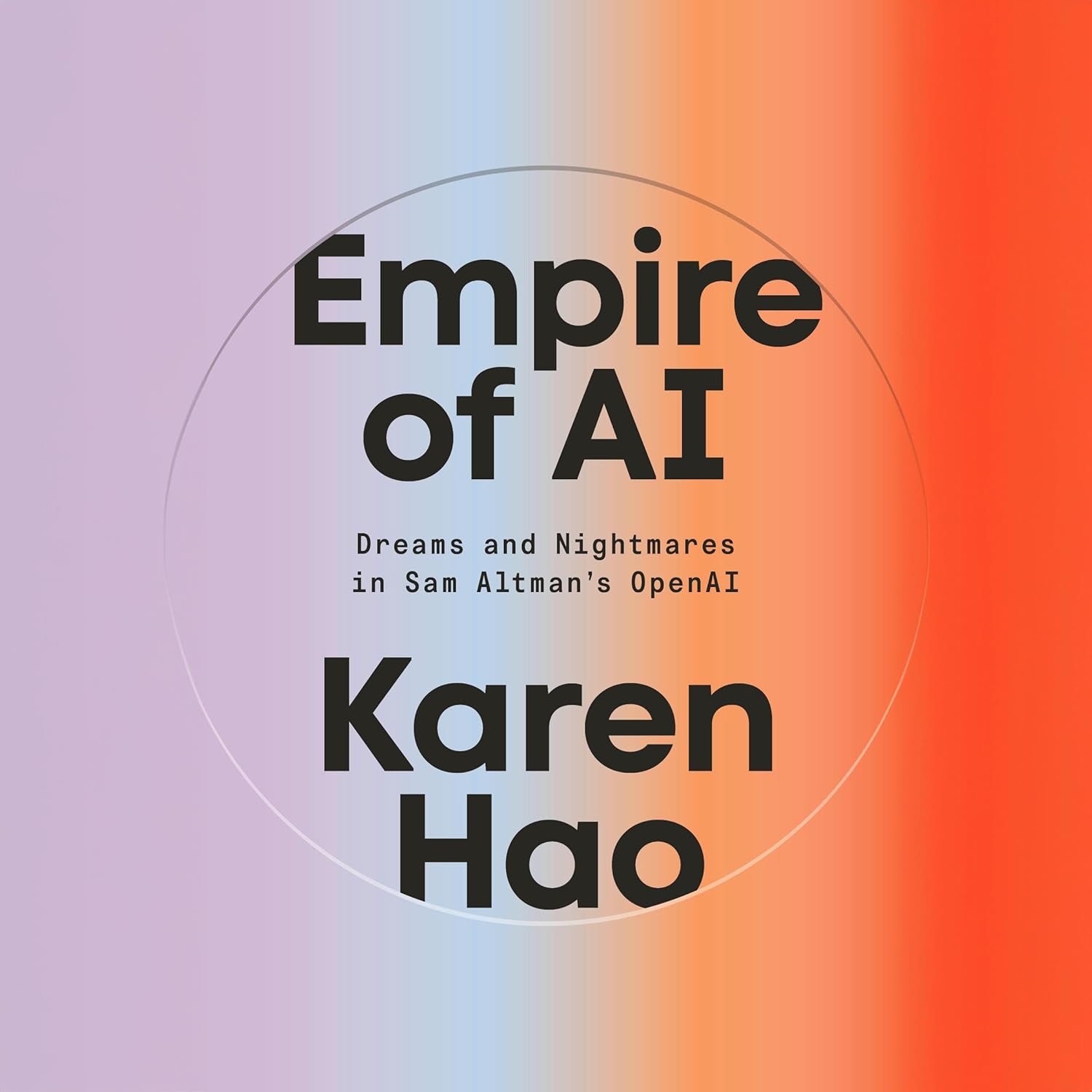
About this book
An Instant New York Times Bestseller “Excellent and deeply reported.”—Tim Wu, The New York Times “Startling and intensely researched . . . an essential account of how OpenAI and ChatGPT came to be and the catastrophic places they will likely take us.”— Vulture “Hao’s reporting inside OpenAI is exceptional, and she’s persuasive in her argument that the public should focus less on A.I.’s putative ‘sentience’ and more on its implications for labor and the environment.”—Benjamin Wallace-Wells, New Yorker From a brilliant longtime AI insider with intimate access to the world of Sam Altman's OpenAI from the beginning, an eye-opening account of arguably the most fateful tech arms race in history, reshaping the planet in real time, from the cockpit of the company that is driving the frenzy When AI expert and investigative journalist Karen Hao first began covering OpenAI in 2019, she thought they were the good guys. Founded as a nonprofit with safety enshrined as its core mission, the organization was meant, its leader Sam Altman told us, to act as a check against more purely mercantile, and potentially dangerous, forces. What could go wrong? Over time, Hao began to wrestle ever more deeply with that question. Increasingly, she realized that the core truth of this massively disruptive sector is that its vision of success requires an almost unprecedented amount of resources: the “compute” power of high-end chips and the processing capacity to create massive large language models, the sheer volume of data that needs to be amassed at scale, the humans “cleaning up” that data for sweatshop wages throughout the Global South, and a truly alarming spike in the usage of energy and water underlying it all. The truth is that we have entered a new and ominous age of empire: only a small handful of globally scaled companies can even enter the field of play. At the head of the pack with its ChatGPT breakthrough, how would OpenAI resist such temptations? Spoiler alert: it didn’t. Armed with Microsoft’s billions, OpenAI is setting a breakneck pace, chased by a small group of the most valuable companies in human history—toward what end, not even they can define. All this time, Hao has maintained her deep sourcing within the company and the industry, and so she was in intimate contact with the story that shocked the entire tech industry—Altman’s sudden firing and triumphant return. The behind-the-scenes story of what happened, told here in full for the first time, is revelatory of who the people controlling this technology really are. But this isn’t just the story of a single company, however fascinating it is. The g forces pressing down on the people of OpenAI are deforming the judgment of everyone else too—as such forces do. Naked power finds the ideology to cloak itself; no one thinks they’re the bad guy. But in the meantime, as Hao shows through intrepid reporting on the ground around the world, the enormous wheels of extraction grind on. By drawing on the viewpoints of Silicon Valley engineers, Kenyan data laborers, and Chilean water activists, Hao presents the fullest picture of AI and its impact we’ve seen to date, alongside a trenchant analysis of where things are headed. An astonishing eyewitness view from both up in the command capsule of the new economy and down where the real suffering happens, Empire of AI pierces the veil of the industry defining our era.
Summary of Key Ideas
- •
AI as the New Colonialism
The Rise of AI Empires: Hao argues that the dominant AI companies are behaving like empires, consolidating power and influence in ways that mirror historical colonial powers. These 'AI empires' seek to control not just technology, but also data, talent, and even the narrative surrounding AI's development and deployment. This concentration of power raises concerns about monopolies, lack of competition, and the potential for misuse of AI technologies.
- •
Data: The Fuel of AI Empires
Data as the New Resource: The book emphasizes that data is the lifeblood of AI, and the control over vast datasets gives immense power to those who possess it. Hao highlights how AI companies are aggressively acquiring and exploiting data, often with little regard for privacy or ethical considerations. This 'data grab' fuels the growth of AI empires and exacerbates existing inequalities, as those with more data gain a significant competitive advantage.
- •
Challenging the Inevitability Narrative
The Myth of AI as Inevitable Progress: Hao challenges the notion that AI development is an unstoppable force for good. She critiques the hype and utopian visions often promoted by AI companies, arguing that they obscure the real-world harms and risks associated with AI. By questioning the inevitability narrative, the book encourages a more critical and nuanced understanding of AI's potential impacts.
- •
The Exploitation Behind AI
Exploitation in the Global South: The book exposes how AI development relies heavily on the exploitation of labor and resources in the Global South. From data annotation to hardware manufacturing, AI companies often outsource tasks to developing countries, where workers face low wages, poor working conditions, and limited rights. This exploitation is a hidden cost of AI progress that needs to be addressed.
- •
The Problem of AI Secrecy
The Secrecy and Lack of Transparency: Hao criticizes the lack of transparency surrounding AI development and deployment. Many AI companies operate in secrecy, withholding information about their algorithms, data practices, and decision-making processes. This lack of transparency makes it difficult to hold them accountable for the impacts of their technologies and undermines public trust in AI.
- •
AI's Threat to Democratic Values
The Threat to Democracy: The book argues that the unchecked power of AI empires poses a threat to democracy. AI technologies can be used to manipulate public opinion, spread disinformation, and suppress dissent. The concentration of AI power in the hands of a few companies raises concerns about the potential for algorithmic bias, censorship, and the erosion of democratic values.
- •
Regulation as a Necessary Counterbalance
The Need for Regulation and Accountability: Hao advocates for stronger regulation and accountability in the AI industry. She argues that governments need to step in to protect privacy, prevent discrimination, and ensure that AI is used in a responsible and ethical manner. This includes establishing clear guidelines for data collection, algorithmic transparency, and human oversight of AI systems.
- •
Empowering Public Discourse on AI
The Importance of Public Discourse and Awareness: Hao emphasizes the need for a broader public discourse about the social, ethical, and political implications of AI. She argues that everyone has a stake in shaping the future of AI and that informed public debate is essential for ensuring that AI benefits society as a whole. By raising awareness and promoting critical thinking, the book empowers individuals to engage in the conversation about AI's future.
Chapter Recap

About The Author
Karen Hao
Karen Hao is an American journalist, best known for her coverage on AI research, technology ethics and the social impact of AI.
Main Quotes
"The empires of AI are not engaged in the same overt violence and brutality that marked this history. But they, too, seize land, extract resources, and exploit labor in service of their own enrichment."
"What OpenAI had stumbled upon was a new method of production. Instead of humans programming computers, humans could now program data, and the computers would program themselves."
"The pursuit of ever-grander AI models is not just a scientific endeavor; it is also a deeply human one, driven by ambition, greed, and a relentless desire to push the boundaries of what is possible."
"The true cost of AI is often hidden, borne by those who are most vulnerable and least able to resist its encroachment."
"The belief that technology can solve all problems, often without addressing the underlying social and political issues, is a dangerous form of magical thinking."
"AI's potential to exacerbate existing inequalities and create new forms of exploitation is a serious threat that must be addressed proactively."
"The development and deployment of AI must be guided by ethical principles and a commitment to human rights."
"We need to ask ourselves: What kind of future do we want to create, and how can we ensure that AI serves humanity rather than the other way around?"
"The story of OpenAI is a cautionary tale about the dangers of unchecked ambition and the seductive power of technological utopianism."
"The future of AI is not predetermined. It is up to us to shape it."
Who Should Read This Book
Individuals interested in the ethics, societal impact, and political implications of AI
Readers interested in the inner workings and leadership of OpenAI
People working in the tech industry, especially those involved in AI development and policy
Those concerned about the concentration of power within AI companies
Readers interested in technology policy and its effects on democracy
Individuals seeking to understand the broader implications of AI beyond the hype
Students and academics studying artificial intelligence, technology ethics, and related fields
Readers interested in investigative journalism and deep dives into complex tech topics
People interested in the impact of AI on labor, particularly data labeling and other often-overlooked roles
Readers concerned about the environmental impact of AI
Book Summaries Like
Empire of AI


FAQ

Free Access to LitNotes