




 DISCORD
God Is Not Great
Christopher Hitchens


 Amazon Best Sellers
 Apple Books


 72 Min Reading Time
 Audio Version Available
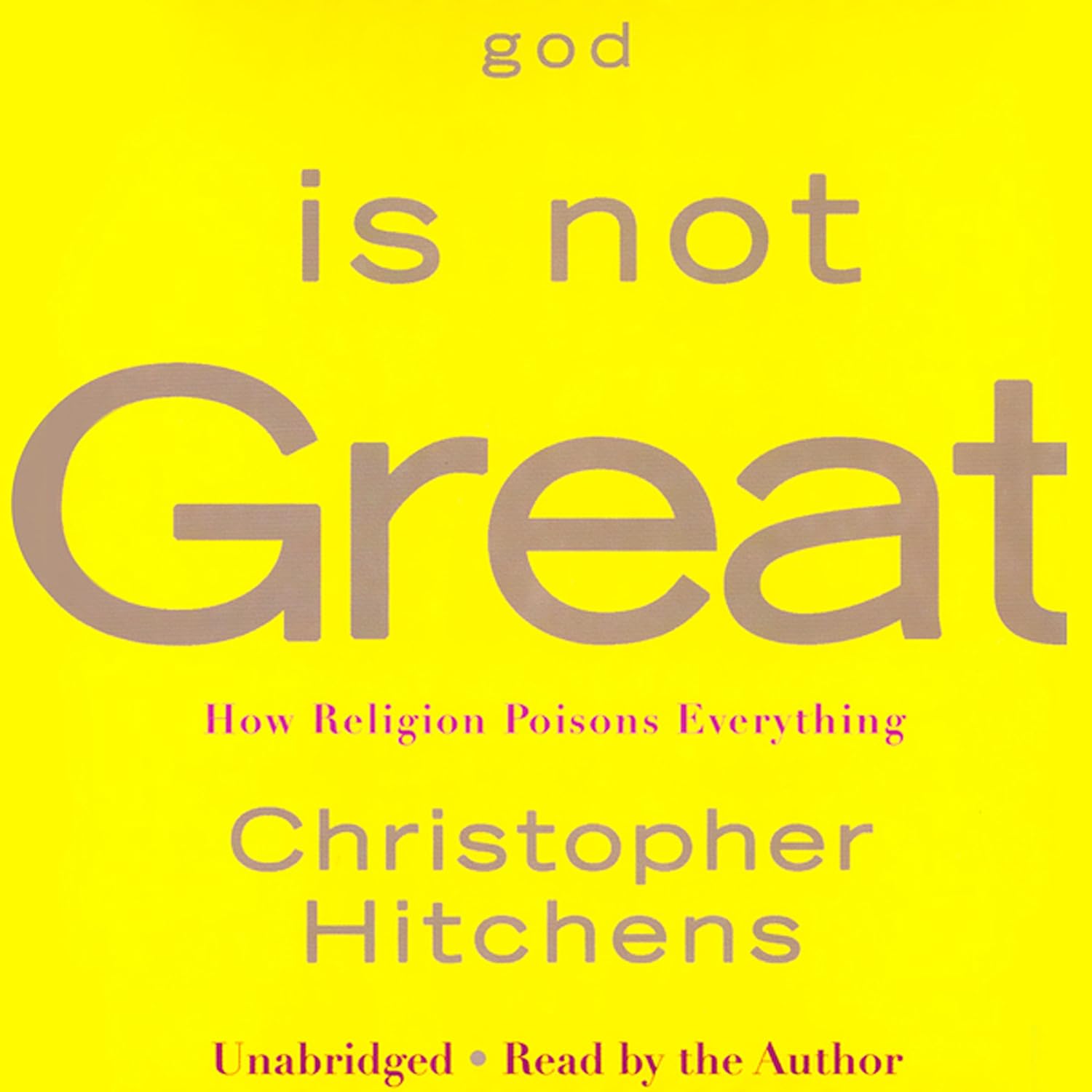
About this book
With the incisive wit and erudite reasoning that defined his career, Christopher Hitchens, "one of the most prolific, as well as brilliant, journalists of our time" (The London Observer), dissects the phenomenon of religion in God Is Not Great. Following in the footsteps of Bertrand Russell's Why I Am Not a Christian, Hitchens delivers a powerful and unflinching critique, arguing that religion is not only man-made but also a dangerous source of sexual repression, historical distortion, and societal harm. Through close readings of religious texts, he champions a secular worldview grounded in science and reason, where the mysteries of the cosmos, revealed by the Hubble Telescope, replace ancient myths, and the elegance of the double helix supersedes the fables of the burning bush. Prepare to be challenged, provoked, and enlightened by Hitchens' uncompromising vision for a world free from the shackles of religious dogma.
Summary of Key Ideas
- •
The Human Authorship of Religious Texts
Religion's Man-Made Origins: Hitchens argues that religious texts are demonstrably human creations, pointing to historical inaccuracies, internal contradictions, and selective narratives within them. He contends that these texts reflect the biases and agendas of their authors rather than divine inspiration. By examining the historical context and textual inconsistencies of various religious scriptures, Hitchens seeks to dismantle the notion of their divine authority, asserting they are products of human culture and power dynamics.
- •
Religion's Role in Violence and Conflict
Religion as a Source of Violence: A central argument of the book is that religion has historically been a significant driver of violence and conflict. Hitchens cites numerous examples, from the Crusades to contemporary religious extremism, to illustrate how religious ideologies have been used to justify wars, persecution, and acts of terrorism. He posits that the dogmatic nature of religious belief can lead to intolerance and the dehumanization of those with differing beliefs, thereby fueling violence.
- •
Critique of Religious Morality
The Immorality of Religious Doctrines: Hitchens critiques specific religious doctrines, arguing that they are often morally reprehensible. He targets concepts such as eternal damnation, divine judgment, and the subjugation of women, arguing that these ideas promote fear, guilt, and inequality. By highlighting what he considers to be the inherent immorality of certain religious teachings, Hitchens challenges the notion that religion provides a sound ethical framework.
- •
Religion's Assault on Reason and Science
Religion's Suppression of Reason: Hitchens asserts that religion actively discourages critical thinking and rational inquiry. He argues that the emphasis on faith and the acceptance of dogma without questioning inhibits intellectual progress and perpetuates ignorance. By demanding unwavering belief in the absence of evidence, Hitchens claims that religion stifles curiosity and hinders the pursuit of knowledge.
- •
Religion and Sexual Repression
The Sexual Repression of Religion: Hitchens dedicates a significant portion of the book to exposing what he sees as the harmful effects of religious teachings on sexuality. He criticizes the condemnation of premarital sex, homosexuality, and contraception, arguing that these restrictions lead to unnecessary suffering and repression. He contends that religion often promotes a distorted and negative view of sexuality, which has detrimental consequences for individuals and society.
- •
The Exploitative Nature of Religion
Religion's Exploitation of Fear and Ignorance: Hitchens argues that religion preys on people's fears and insecurities, offering false comfort and simplistic explanations for complex phenomena. He claims that religious institutions exploit vulnerable individuals by promising salvation or protection in exchange for obedience and financial support. By capitalizing on fear and ignorance, Hitchens believes that religion maintains its power and influence.
- •
The Corrupting Influence of Religious Institutions
The Damage Inflicted by Religious Institutions: Hitchens levels a scathing critique against organized religion, accusing religious institutions of corruption, hypocrisy, and abuse of power. He highlights instances of sexual abuse within the Catholic Church and other scandals involving religious leaders, arguing that these institutions often prioritize their own interests over the well-being of their followers. He suggests that the hierarchical structures of religious organizations enable and protect those who engage in harmful behavior.
- •
The Case for Secular Humanism
The Superiority of Secular Ethics: Hitchens champions secular humanism as a more ethical and rational alternative to religious morality. He argues that a secular ethical framework based on reason, empathy, and human rights provides a better foundation for a just and compassionate society. He maintains that morality does not require a divine source and that ethical principles can be derived from human experience and a commitment to human flourishing.
- •
Religion's Impediment to Progress
Religion as a Hindrance to Progress: Hitchens suggests that religion has historically obstructed social and scientific progress. He argues that religious dogma has often clashed with scientific discoveries and that religious institutions have resisted advancements that challenge their authority. By clinging to outdated beliefs and resisting change, Hitchens believes that religion has slowed down the pace of human progress.
Chapter Recap

About The Author
Christopher Hitchens
CHRISTOPHER HITCHENS was born in 1949 in England and was a graduate of Balliol College at Oxford University. He was the father of three children and the author of more than twenty books and pamphlets, including collections of essays, criticism, and reportage. His book, god Is Not Great: How Religion Poisons Everything, was a finalist for the 2007 National Book Award and an international bestseller. His bestselling memoir, Hitch-22, was a finalist for the 2010 National Book Critics Circle Award for autobiography. A visiting professor of liberal studies at the New School in New York City, he was also the I.F. Stone professor at the Graduate School of Journalism at the University of California, Berkeley. He was a columnist, literary critic, and contributing editor at Vanity Fair, The Atlantic, Slate, Times Literary Supplement, The Nation, New Statesman, World Affairs, Free Inquiry, among other publications. Christopher Hitchens died in December 2011 at the age of 62. [(Source)][1] [1]: http://penguinrandomhouse.ca/authors/43227/christopher-hitchens
Main Quotes
"Religion poisons everything."
"Human decency is not derived from religion. It precedes it."
"Faith is the surrender of the mind; it's the surrender of reason, it's the surrender of the only thing that makes us different from other mammals."
"Owners of dogs will have noticed that, if you provide them with food and water and shelter and affection, they will think you are God. Whereas owners of cats are compelled to realize that, if you provide them with food and water and shelter and affection, they draw the conclusion that they are God."
"The essence of the independent mind lies not in what it thinks, but in how it thinks."
"Take the risk of thinking for yourself. Much more happiness, truth, beauty, and wisdom will come to you that way."
"What is the most unpardonable sin? According to the bible, it is the sin against the Holy Ghost. I could never figure that one out."
"The only position that leaves me with no cognitive dissonance is atheism. It is not a belief. It is a statement of the absence of a belief."
"Violently imposing your will on someone else is the most cowardly thing you can do."
"We are all born as atheists until we are indoctrinated."
Who Should Read This Book
Atheists and agnostics
Skeptics of organized religion
Individuals with a background in or personal experience with religion who have since become disillusioned
Readers interested in philosophical and ethical debates about religion
Those interested in secular humanism
Readers of political and social commentary
People who appreciate intellectual and polemical writing
Fans of Christopher Hitchens's other works
Individuals seeking arguments against religious belief
Book Summaries Like
God Is Not Great
FAQ

Free Access to LitNotes