




 DISCORD
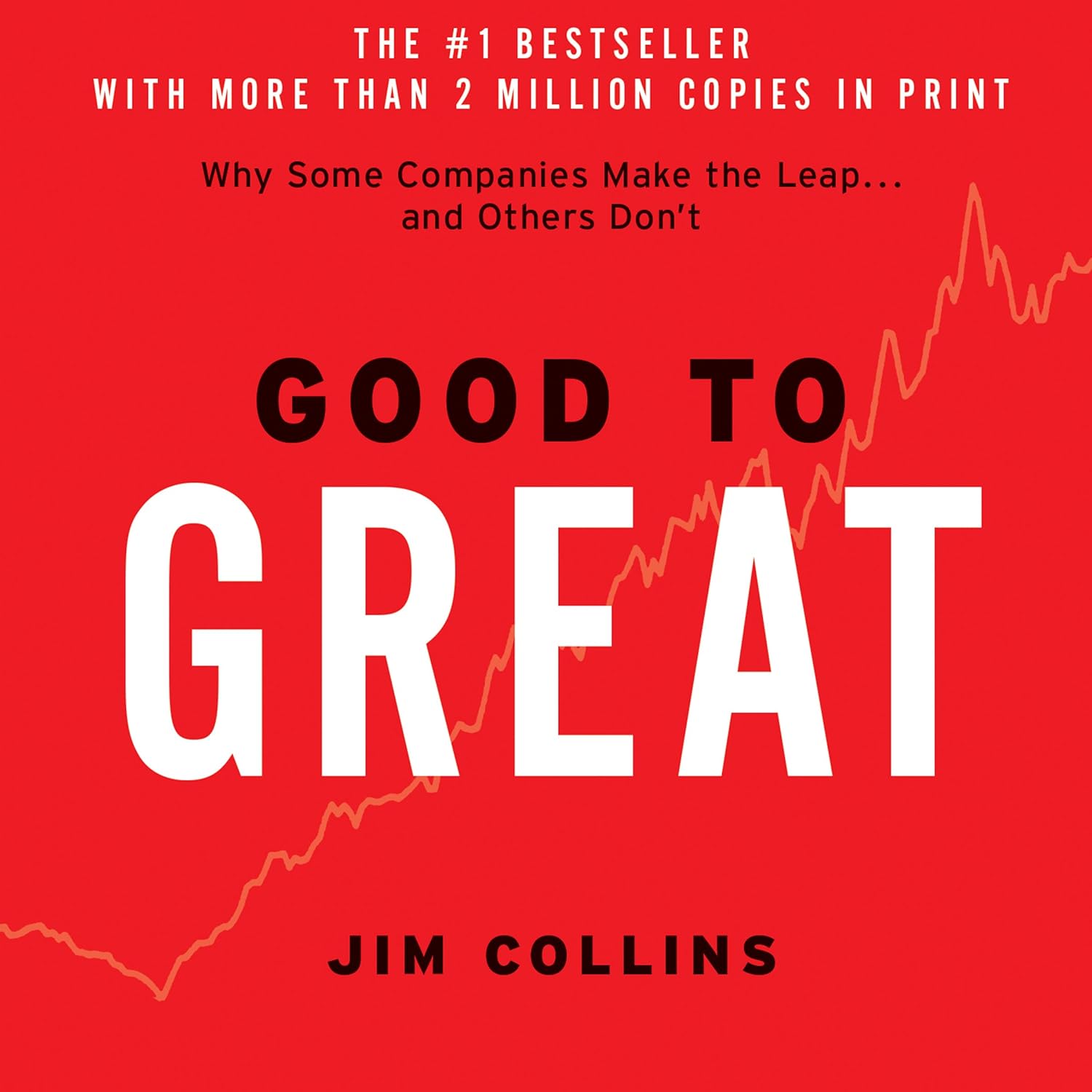
Good to Great
Jim Collins


 Amazon Best Sellers
 Apple Books


 41 Min Reading Time
 Audio Version Available
About this book
What separates truly great companies from merely good ones? Rejecting conventional wisdom, Jim Collins and his research team embarked on a five-year quest to answer this question. They identified a select group of elite companies that not only made the leap to greatness but sustained it for at least fifteen years, outperforming the general stock market by an astounding seven times.
Good to Great challenges established norms and reveals surprising characteristics shared by these exceptional organizations. Discover the power of Level 5 Leadership, the Hedgehog Concept, and a Culture of Discipline. Learn how technology can accelerate success and why radical change initiatives often fail.
Prepare to be surprised, challenged, and inspired by the groundbreaking insights within these pages. Good to Great offers a roadmap for transforming any organization from good to truly great.
Summary of Key Ideas
- •
Level 5 Leadership: Humility and Fierce Resolve
Level 5 Leadership is a cornerstone of companies that transition from good to great. These leaders exhibit a paradoxical combination of profound personal humility and intense professional will. They channel their ego away from themselves and towards the larger goal of building a great company. Level 5 leaders are often unassuming and quiet, yet they possess a fierce resolve to do whatever is needed to achieve lasting results. They credit their teams and external factors for successes, while holding themselves accountable for failures. This leadership style fosters a culture of trust and commitment, essential for driving significant change and achieving sustained excellence. It's not about charisma or personal brand, but about selfless service to the organization's mission.
- •
First Who, Then What: Prioritizing People
The principle of "First Who, Then What" emphasizes the importance of getting the right people on the bus (and the wrong people off the bus) before determining the strategic direction. Great companies prioritize building a strong team with individuals who share the company's core values and possess the necessary skills and drive. Once the right team is in place, the 'what' – the vision and strategy – becomes clearer and easier to execute. This approach contrasts with the conventional wisdom of defining a strategy first and then hiring people to implement it. Collins argues that having the right people is more critical than having a perfect strategy, as the right team can adapt and innovate to overcome challenges and capitalize on opportunities.
- •
Confront the Brutal Facts (Yet Never Lose Faith)
Confronting the Brutal Facts, without losing faith, is crucial for progress. Good-to-great companies foster a culture where people can openly discuss and acknowledge uncomfortable truths about their current situation. This involves creating a safe environment for honest feedback and rigorous debate, encouraging employees to challenge assumptions and question the status quo. While acknowledging these harsh realities, it's equally important to maintain unwavering faith that the company will ultimately prevail. This balance of realism and optimism enables organizations to make informed decisions, address challenges effectively, and stay focused on long-term goals, turning potential setbacks into opportunities for growth and improvement.
- •
The Hedgehog Concept: Simplicity Within the Three Circles
The Hedgehog Concept is about finding the intersection of three circles: what you are deeply passionate about, what you can be the best in the world at, and what drives your economic engine. It's not simply a goal or a strategy, but a deep understanding of what your organization can truly excel at. Companies should strive for simplicity and clarity, focusing on one big thing that they can do better than anyone else. This requires rigorous self-assessment and a willingness to abandon activities that do not align with the Hedgehog Concept. By focusing on their core competency and passion, companies can achieve sustainable competitive advantage and long-term success.
- •
Culture of Discipline: Freedom Within a Framework
A Culture of Discipline combines a disciplined people, disciplined thought, and disciplined action. It's about creating a work environment where employees adhere to a consistent set of values and standards, fostering a sense of responsibility and accountability. This doesn't mean stifling creativity or innovation, but rather channeling individual efforts towards a common goal. Disciplined people are self-motivated and willing to go the extra mile, while disciplined thought involves rigorous analysis and decision-making based on facts. Disciplined action translates plans into concrete steps, ensuring that the company stays on track and consistently executes its strategy. This culture fosters consistency, reliability, and ultimately, superior performance.
- •
The Flywheel Effect: Building Momentum Through Consistency
The Flywheel Effect describes the process of building momentum through consistent effort and incremental improvements. Good-to-great transformations don't happen overnight; they are the result of a series of well-aligned actions that build upon each other over time. Each push on the flywheel contributes to the overall momentum, eventually leading to a breakthrough. This concept emphasizes the importance of patience, perseverance, and a long-term perspective. It also highlights the need to avoid radical changes or quick fixes, focusing instead on making steady progress and building a sustainable foundation for growth. The flywheel effect illustrates that even seemingly small actions can have a significant impact when repeated consistently over time.
Chapter Recap

About The Author
Jim Collins
Main Quotes
"Good is the enemy of great."
"Greatness is not a function of circumstance. Greatness, it turns out, is largely a matter of conscious choice, and discipline."
"Those who build great companies understand that the ultimate throttle on growth for any great company is not markets, or technology, or competition, or products. It is one thing above all others: the ability to get and keep enough of the right people."
"We found that leaders of companies that go from good to great start not with “where” but with “who.” They start by getting the right people on the bus, the wrong people off the bus, and the right people in the right seats."
"The moment you feel the need to tightly manage someone, you’ve made a hiring mistake."
"The good-to-great companies understood a simple truth: The best use of money is to obtain and retain the right people."
"You must maintain unwavering faith that you can and will prevail in the end, regardless of the difficulties, AND at the same time, have the discipline to confront the most brutal facts of your current reality, whatever they might be."
"A company should limit its growth based on its ability to attract enough of the right people."
"The purpose of bureaucracy is to compensate for incompetence and lack of discipline."
"Great vision without great people is irrelevant."
Who Should Read This Book
Business executives
Managers
Entrepreneurs
Organizational leaders
Students of business and management
Individuals interested in corporate strategy and performance
Consultants
Investors
Anyone seeking to improve their organization's performance
Readers of business books focused on long-term growth and success
Leaders in non-profit organizations
Individuals interested in data-driven analysis of business success
Readers looking for a framework for achieving sustainable results
Those interested in leadership principles
People in leadership positions at any level
Anyone who wants to understand how companies transition from average to exceptional
Readers interested in case studies of successful companies
Individuals seeking practical advice on how to improve their own performance or the performance of their team
Book Summaries Like
Good to Great


FAQ

Free Access to LitNotes