




 DISCORD
Hope in the Dark
Rebecca Solnit


 Apple Books


 101 Min Reading Time
 Audio Version Available
About this book
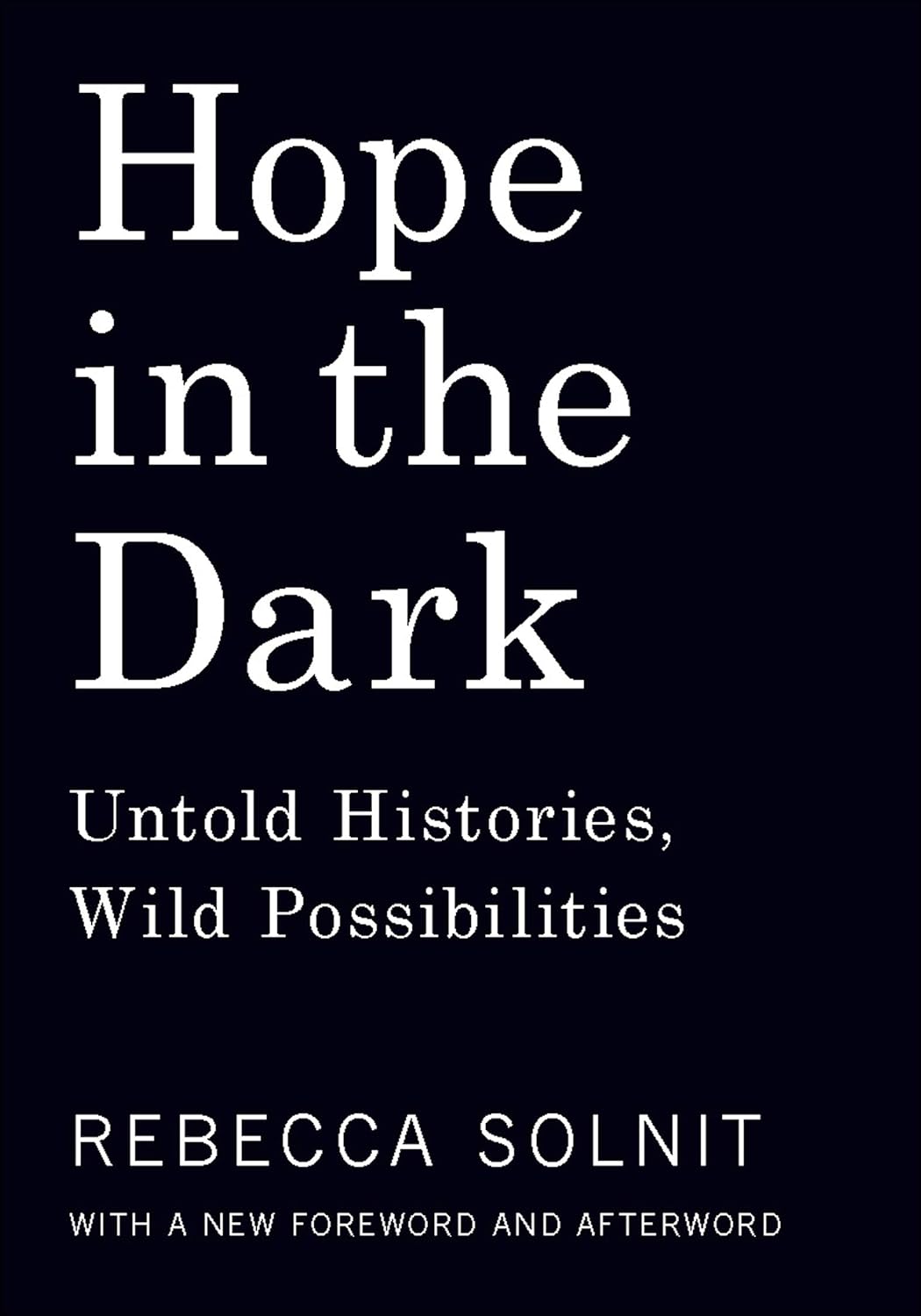
In a world shadowed by uncertainty, where despair often feels like the default, Rebecca Solnit's Hope in the Dark emerges as a powerful antidote. Countering the pessimism that can paralyze activists and dreamers alike, Solnit makes a compelling case for hope as an active commitment, a radical choice to engage with an unknowable future.
Drawing on decades of activism and a deep understanding of history, Solnit reveals a hidden history of transformative victories, demonstrating that the impact of our actions is not always immediate or measurable. From the fall of the Berlin Wall to the Zapatista uprising, she illuminates the surprising ways social change unfolds and reminds us that even in the darkest times, progress is possible.
Hope in the Dark is more than just a book; it's a manifesto for optimists, a call to reclaim our agency, and a guide to finding light in the shadows. It challenges us to resist the easy cynicism of the present and embrace the power of collective action to shape a better world.
Summary of Key Ideas
- •
Embracing Active Hope
Hope as an Active Choice: Solnit argues that hope is not a passive feeling but an active choice and a practice. It's not about believing that everything will be alright, but rather about recognizing the possibilities for change and acting to bring them about, even when the outcome is uncertain. This active hope acknowledges the darkness and challenges while still maintaining a commitment to a better future. It requires engagement, resilience, and a willingness to work towards positive change without guarantees of success.
- •
Untold Histories as Fuel for Hope
The Power of Untold Histories: The book emphasizes the importance of recognizing the "untold histories" of social movements and victories that are often overlooked or forgotten. Solnit highlights examples of past struggles that led to significant positive change, demonstrating that progress is often achieved through incremental steps and unexpected pathways. By understanding these histories, activists can gain inspiration and learn from the successes and failures of those who came before them. This historical awareness provides a foundation for hope and encourages continued engagement in the face of setbacks.
- •
Nonlinear Paths of Progress
Change Happens in Unpredictable Ways: Solnit challenges the notion that change occurs linearly or predictably. She argues that social movements often operate in a non-linear fashion, with long periods of seeming inactivity followed by sudden bursts of progress. This understanding encourages activists to persist even when their efforts don't immediately yield visible results. It acknowledges that the seeds of change may be sown long before the harvest is apparent, and that seemingly small actions can have significant cumulative effects.
- •
Strength in Collective Action
The Importance of Collective Action: "Hope in the Dark" underscores the power of collective action in driving social change. Solnit emphasizes that individual efforts, when combined with the actions of others, can create a powerful force for transformation. She highlights the significance of building communities and networks of support to sustain activism and amplify its impact. Collective action not only increases the likelihood of achieving desired outcomes but also provides a sense of solidarity and shared purpose that can combat feelings of isolation and despair.
- •
Beyond Optimism and Pessimism
Rejecting the Binary of Optimism and Pessimism: Solnit advocates for moving beyond the simplistic dichotomy of optimism and pessimism. She suggests that both perspectives can be limiting, as optimism can lead to complacency and pessimism to inaction. Instead, she proposes a more nuanced approach that acknowledges the complexities and uncertainties of the world while maintaining a commitment to working towards positive change. This involves recognizing both the potential for progress and the risks of regression, and acting accordingly.
- •
The Power of Embracing Uncertainty
Embracing the Unknown: The book emphasizes the importance of embracing uncertainty and the unknown. Solnit argues that true hope lies not in predicting specific outcomes, but in recognizing the inherent possibilities for change and being open to unexpected developments. This requires a willingness to let go of the need for control and to trust in the power of collective action to shape the future, even when the path forward is unclear. Embracing the unknown allows for creativity, adaptability, and a more profound sense of hope.
- •
The Ripple Effect of Small Actions
Small Actions, Large Impacts: Solnit argues that even small, seemingly insignificant actions can have profound and far-reaching consequences. She encourages readers to recognize the potential impact of their daily choices and to engage in acts of resistance and change, no matter how small they may seem. These actions, when multiplied across a community or society, can create a ripple effect that leads to significant transformations. This perspective empowers individuals to take initiative and contribute to a better world, even in the face of seemingly insurmountable challenges.
- •
Radical Hope as Resistance
Hope as a Radical Stance: Solnit reframes hope as a radical and subversive force. In a world often characterized by cynicism and despair, choosing to maintain hope and to act on that hope becomes an act of resistance. It challenges the dominant narratives of powerlessness and inevitability, and affirms the possibility of creating a more just and sustainable world. This radical hope is not naive or Pollyannaish, but rather a conscious and deliberate choice to defy the forces of oppression and to work towards a brighter future.
Chapter Recap

About The Author
Rebecca Solnit
Main Quotes
"Hope is not a lottery ticket you can sit on the sofa and clutch, feeling lucky. It is an axe you break down doors with in an emergency."
"Hope locates itself in the premises that we don't know what will happen and that in the spaciousness of uncertainty is room to act."
"Hope is a gift you don't have to surrender, a power you don't have to throw away."
"It’s important to say what hope is not: it is not the belief that everything was, is, or will be fine."
"Amnesia leads to despair in many ways."
"To hope is to gamble. It's to bet on the future, on your desires, on the possibility that an open heart and uncertainty is better than gloom and safety."
"We may be living through times of unprecedented change, but in uncertainty lies the power to influence the future. Now is not the time to despair, but to act."
"Hope is an embrace of the unknown."
"Hope should shove you out the door, because it will take everything you have to steer the future away from endless war, from the annihilation of the earth's treasures and the grinding down of the poor and marginal."
"In order to love who you are, you must not hate the experiences that shaped you."
Who Should Read This Book
Political activists
Social justice advocates
Environmentalists
Readers interested in social and political theory
Individuals seeking hope and inspiration during uncertain times
Those interested in the history of social movements
Readers of feminist literature
People looking for alternative perspectives on progress and change
Individuals interested in the power of collective action
Readers who appreciate thoughtful and nuanced writing on complex issues
Book Summaries Like
Hope in the Dark


FAQ

Free Access to LitNotes