




 DISCORD
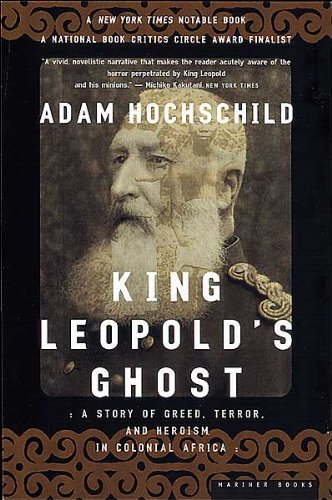
King Leopold's Ghost
Adam Hochschild


 Apple Books


 69 Min Reading Time
 Audio Version Available
About this book
In the heart of Africa, a dark secret lay hidden. As European powers scrambled for territory in the late 19th century, King Leopold II of Belgium cunningly seized the Congo River basin, a land teeming with resources and promise. But behind his philanthropic facade lurked a brutal regime of forced labor, plunder, and unimaginable cruelty.
Adam Hochschild's King Leopold's Ghost unveils this horrifying true story, where ten million Congolese people perished under Leopold's insatiable greed for rubber and wealth. Yet, amidst the darkness, courageous individuals emerged: missionaries, travelers, and ordinary people who witnessed the atrocities and risked everything to expose them.
Meet Edmund Morel, the sharp-eyed shipping agent who uncovered the truth, and follow the harrowing journeys of George Washington Williams, Roger Casement, and William Sheppard as they fought for justice against overwhelming odds. Even Joseph Conrad, a young steamboat officer, found himself forever marked by the horrors he witnessed on the Congo River.
More than just a historical account, King Leopold's Ghost is a chilling exposé of unchecked power, a testament to the resilience of the human spirit, and a haunting reminder of a tragedy that must never be forgotten. Prepare to be captivated by this enthralling narrative that reads like a novel, as it brings to light the first great human rights movement of the 20th century and its enduring relevance today.
Summary of Key Ideas
- •
The Ruthless Pursuit of Profit and Power
King Leopold's relentless pursuit of wealth and power in the Congo Free State led to the exploitation and enslavement of the Congolese people. Driven by a desire to elevate Belgium's status on the world stage, Leopold masked his greed with humanitarian rhetoric, claiming his goal was to civilize and Christianize the region. However, his true objective was to extract vast quantities of ivory and, later, rubber, using forced labor and brutal methods. This insatiable appetite for resources resulted in widespread suffering, starvation, and death, leaving a lasting scar on the Congolese population and landscape. The book exposes the stark contrast between Leopold's public image and the horrific reality of his actions in the Congo.
- •
Systematic Violence and Terror as Tools of Control
The systematic violence and terror employed by Leopold's regime in the Congo were integral to maintaining control and maximizing resource extraction. The Force Publique, a private army composed of European officers and African soldiers, enforced rubber quotas through intimidation, mutilation, and the destruction of villages. These atrocities were not isolated incidents but rather a deliberate strategy to instill fear and suppress resistance among the Congolese population. Hochschild meticulously documents the horrific acts of violence, providing accounts of severed hands, mass killings, and the destruction of Congolese culture and social structures. This systematic terror served as the foundation for Leopold's exploitative economic system.
- •
The Power of Investigative Journalism and Activism
The story of Edmund Morel's awakening to the horrors in the Congo and his subsequent campaign to expose Leopold's atrocities is a central theme. Morel, a shipping clerk, noticed discrepancies in cargo manifests, revealing that the Congo was exporting vast quantities of valuable resources while receiving little in return. This realization sparked his moral outrage and led him to dedicate his life to uncovering the truth and galvanizing international opposition to Leopold's rule. Morel's tireless efforts, including investigative journalism, public speaking, and coalition building, played a crucial role in raising awareness and ultimately forcing Leopold to relinquish control of the Congo.
- •
Acts of Resistance and Moral Courage
Hochschild emphasizes the role of individuals, both European and African, who resisted Leopold's regime and fought for justice in the Congo. From missionaries who documented and publicized the atrocities to Congolese individuals who organized resistance movements, these acts of courage and defiance challenged Leopold's authority and inspired others to join the cause. The book highlights the bravery and resilience of these individuals, demonstrating that even in the face of overwhelming oppression, resistance is possible. Their stories serve as a reminder of the importance of moral courage and the potential for individuals to make a difference in the fight against injustice.
- •
The Intertwined Nature of Racism, Imperialism, and Exploitation
The book explores the complex interplay of racism, imperialism, and economic exploitation in the Congo. Leopold's regime justified its actions through racist ideologies that dehumanized the Congolese people, portraying them as primitive and incapable of self-governance. This racist worldview enabled the brutal exploitation of Congolese labor and resources, as European colonizers viewed the Congo as their rightful possession. Hochschild argues that the atrocities in the Congo were not simply the result of one man's greed but were also deeply rooted in the racist and imperialist attitudes prevalent in Europe at the time.
- •
The Enduring Legacy of Colonialism in the Congo
Hochschild examines the legacy of Leopold's rule in the Congo, highlighting the long-term consequences of colonial exploitation on the Congolese people and their society. The demographic devastation, economic disruption, and political instability caused by Leopold's regime continue to affect the Congo today. The book emphasizes the importance of understanding this history in order to address the ongoing challenges facing the Congo and to prevent similar atrocities from occurring in the future. By confronting the legacy of colonialism, Hochschild calls for a more just and equitable world order.
Chapter Recap

About The Author
Adam Hochschild
Main Quotes
"This is the story of that movement, of the savage crime that was its target, of the long period of exploration and conquest that preceded it."
"There was no written language in the Congo when Europeans first arrived, and this inevitably skewed the way that history was recorded."
"For Europeans, Africa remained the supplier of valuable raw materials—human bodies and elephant tusks."
"Sometimes the period of terror is stamped into the language itself. In the Mongo tongue, “to send someone to harvest rubber” is an idiom meaning “to tyrannize.""
"The thin-skinned Stanley was remarkably frank about his tendency to take any show of hostility as a deadly insult. It is almost as if vengeance were the force that propelled him."
"Casement quoted an African proverb: "A man doesn't go among thorns unless a snake's after him—or he's after a snake." He added, "I'm after a snake and please God I'll scotch it.""
"Wherever he is, be sure I shall not give up the chase. If alive, you shall hear what he has to say; if dead I will find and bring his bones to you."
"Past the Canary Islands you would enter the tropics and wear lighter clothing, but the atmosphere itself would become heavy, saturated with greed and cruelty."
"The railway will kill the slave trade...It is a work for civilization and the future."
"I do not wish to paint the present in roseate hues. The wounds of the Congo will take generations to heal. But . . . the atrocities have disappeared. . . . The situation is good."
Who Should Read This Book
Readers interested in African history
Individuals interested in colonialism and its consequences
Readers of non-fiction books about historical atrocities and human rights abuses
Those interested in the history of the Congo Free State
Readers interested in the history of Belgium
Individuals interested in political history
Readers interested in biographies and stories of individuals who fought against injustice
Those interested in the history of humanitarian movements
Readers of investigative journalism
Individuals seeking to understand the roots of contemporary issues in Africa
Book Summaries Like
King Leopold's Ghost

FAQ

Free Access to LitNotes