




 DISCORD
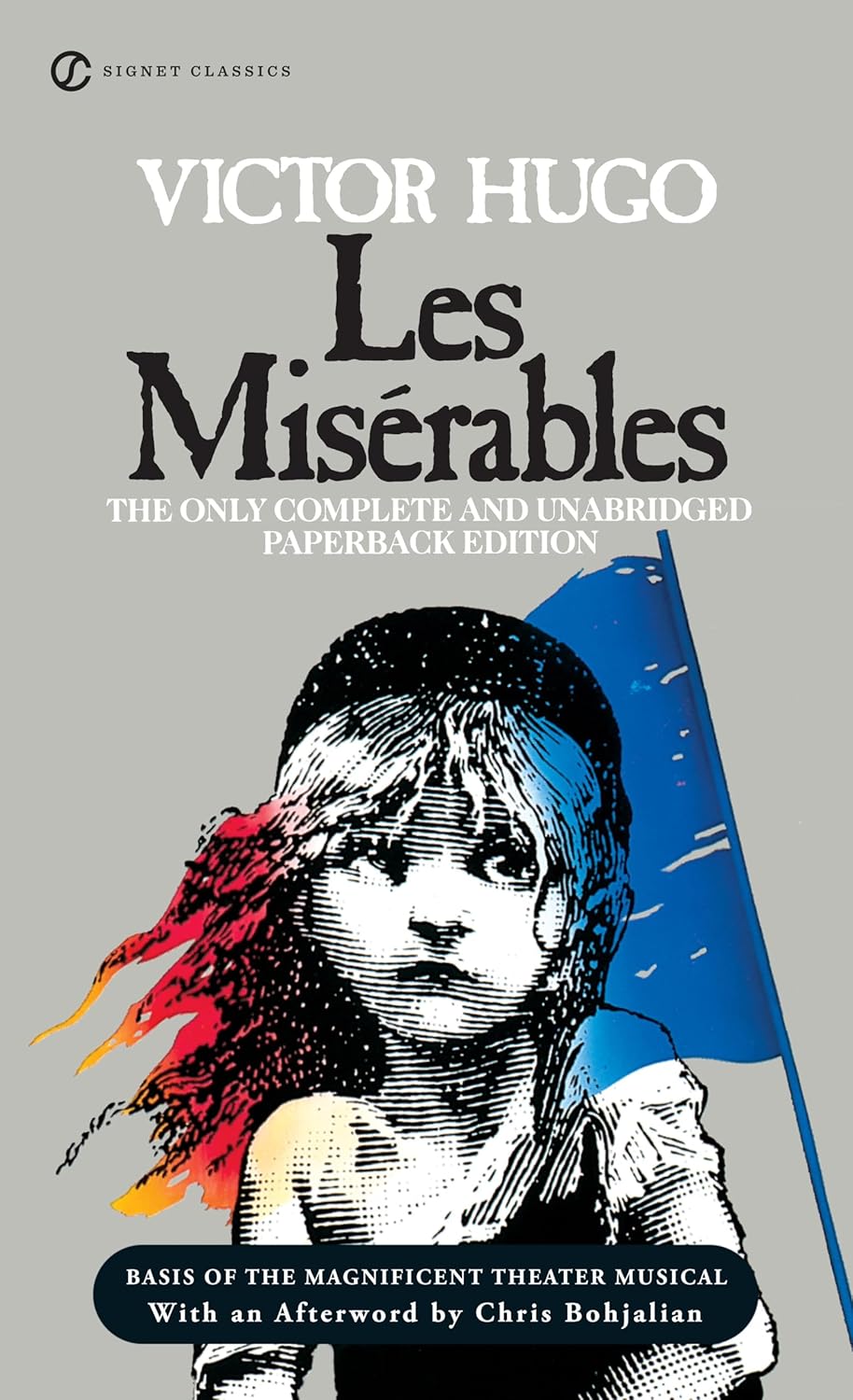
Les Misérables
Victor Hugo


 Apple Books


 357 Min Reading Time
 Audio Version Available
About this book
In the tempestuous years following Napoleon's fall, Jean Valjean, a man imprisoned for stealing a loaf of bread, emerges from captivity yearning for redemption. But his past, and the shadow of the relentless Inspector Javert, conspire to condemn him.
Victor Hugo's Les Misérables is a sweeping epic of love, sacrifice, and the resilience of the human spirit. Journey into the heart of 19th-century France, where revolution simmers and the lives of ordinary people intertwine in extraordinary ways. Experience the desperation of Fantine, the courage of the revolutionaries, and the unwavering hope that flickers even in the darkest corners of Parisian society.
More than a story, Les Misérables is an exploration of justice, mercy, and the enduring quest for a better world. It is a timeless masterpiece that continues to resonate with readers, inspiring empathy and igniting the imagination.
Summary of Key Ideas
- •
The Power of Compassion and Forgiveness
The transformative power of compassion and forgiveness is a central theme. Bishop Myriel's act of mercy towards Jean Valjean, after Valjean steals silver from him, is pivotal. Instead of turning Valjean in, the Bishop claims he gave the silver to Valjean and urges him to use it to become an honest man. This act of unexpected grace profoundly impacts Valjean, setting him on a path of redemption and demonstrating how compassion can break cycles of despair and criminality. This initial act resonates throughout the novel, influencing Valjean's subsequent actions and his commitment to helping others, illustrating that even small acts of kindness can have far-reaching, life-altering consequences.
- •
Social Injustice and Inequality
Social injustice and inequality are pervasive throughout the novel. Hugo portrays the grim realities faced by the poor and marginalized in 19th-century France, including poverty, hunger, and exploitation. Fantine's tragic downfall exemplifies the vulnerability of women in a patriarchal society, forced into desperate measures to provide for her child. The Thénardiers represent the cruelty and moral bankruptcy that can arise from extreme poverty. Hugo critiques a society that perpetuates these inequalities, highlighting the systemic failures that condemn individuals to lives of misery and hardship. He advocates for social reform and a more equitable distribution of resources and opportunities.
- •
Redemption and Moral Rehabilitation
Redemption and moral rehabilitation are major themes explored through Jean Valjean's journey. Initially imprisoned for stealing a loaf of bread, Valjean emerges hardened and embittered. However, Bishop Myriel's act of kindness sparks a profound change, inspiring Valjean to strive for moral betterment. He constantly grapples with his past, seeking to reconcile his former identity as a convict with his desire to live a virtuous life. His commitment to protecting Cosette and helping others demonstrates his ongoing pursuit of redemption, illustrating that transformation is possible even after significant transgressions. Valjean's struggle highlights the complexities of moral choice and the enduring capacity for human goodness.
- •
Divine Grace vs. Human Law
The contrast between divine grace and human law is a recurring motif. Bishop Myriel embodies divine grace, offering unconditional compassion and forgiveness. Javert, on the other hand, represents the rigid and unforgiving nature of human law, fixated on justice and punishment. Their conflict highlights the tension between these two opposing forces. Javert's unwavering commitment to the law, even when it leads to injustice, ultimately clashes with Valjean's embodiment of grace and compassion. This conflict culminates in Javert's moral crisis and eventual suicide, underscoring the limitations of a purely legalistic approach to morality and the importance of considering individual circumstances and human empathy.
- •
The Power of Love
Love, in its various forms, serves as a powerful force for good. Romantic love is portrayed through Marius and Cosette's relationship, offering hope and renewal amidst the social turmoil. Parental love is exemplified by Jean Valjean's unwavering devotion to Cosette, whom he raises as his own daughter, providing her with a secure and loving home. Familial love is twisted in the Thénardiers' household, highlighting the destructive consequences of greed and neglect. Ultimately, Hugo suggests that love, in its purest form, can transcend social barriers and inspire acts of selflessness and sacrifice. It is a source of strength and resilience, enabling individuals to overcome adversity and find meaning in a world marked by suffering.
- •
Sacrifice and Selflessness
Sacrifice and selflessness are recurring themes, demonstrated through various characters' actions. Jean Valjean repeatedly sacrifices his own well-being for the sake of others, most notably Cosette. Fantine sacrifices her dignity and health to provide for her daughter. Marius risks his life during the student uprising. These acts of selflessness highlight the capacity for human beings to prioritize the needs of others above their own, even in the face of great hardship. Hugo suggests that true virtue lies in the willingness to make sacrifices for the greater good, contributing to a more just and compassionate society. These sacrifices often lead to redemption and ultimately define the characters' moral compass.
- •
Revolution and Social Change
Revolution and social change are explored through the backdrop of the June Rebellion. Hugo depicts the fervor and idealism of the student revolutionaries, who believe in fighting for a more just and equitable society. However, he also portrays the chaos and violence that often accompany revolution, highlighting the complexities and potential pitfalls of radical social change. While sympathetic to the revolutionaries' cause, Hugo also acknowledges the importance of stability and order. The failed rebellion serves as a cautionary tale, suggesting that true progress requires more than just violent upheaval; it also demands thoughtful reform and a commitment to addressing the root causes of social injustice. He uses this event to emphasize the need for compassion and understanding in the pursuit of a better world.
- •
Justice and Its Interpretations
Justice and its many interpretations form a core theme, as illustrated by the contrasting figures of Jean Valjean and Inspector Javert. Valjean, an ex-convict, seeks redemption and strives for moral uprightness, challenging the notion of a life sentence for a minor crime. Javert, embodying the letter of the law, relentlessly pursues Valjean, symbolizing an inflexible and unforgiving justice system. The novel questions whether true justice lies in strict adherence to the law or in considering mitigating circumstances and offering compassion. Javert's eventual suicide underscores the limitations of a purely legalistic approach, suggesting that true justice must be tempered with mercy and an understanding of human fallibility. The conflict between these two characters invites readers to contemplate the complexities of justice and its application in society.
Chapter Recap

About The Author
Victor Hugo
Victor-Marie Hugo was a French poet, playwright, novelist, essayist, visual artist, statesman, human rights activist and exponent of the Romantic movement in France. In France, Hugo's literary fame comes first from his poetry but also rests upon his novels and his dramatic achievements. Among many volumes of poetry, Les Contemplations and La Légende des siècles stand particularly high in critical esteem, and Hugo is sometimes identified as the greatest French poet. Outside France, his best-known works are the novels Les Misérables and Notre-Dame de Paris (known in English also as The Hunchback of Notre-Dame). Though a committed conservative royalist when he was young, Hugo grew more liberal as the decades passed; he became a passionate supporter of republicanism, and his work touches upon most of the political and social issues and artistic trends of his time. He is buried in the Panthéon. ([Source][1]) [1]: http://en.wikipedia.org/wiki/Victor_Hugo
Main Quotes
"Even the darkest night will end and the sun will rise."
"To love or have loved, that is enough. Ask nothing further. There is no other pearl to be found in the dark folds of life."
"You can give without loving, but you can never love without giving."
"The greatest happiness of life is the conviction that we are loved; loved for ourselves, or rather, loved in spite of ourselves."
"It is nothing to die. It is frightful not to live."
"There is always more misery among the lower classes than there is humanity in the higher."
"To love another person is to see the face of God."
"Change your opinions, keep to your principles; change your leaves, keep intact your roots."
"The judge speaks in the name of justice; the priest speaks in the name of pity, which is only a more sublime justice."
"Our mind is enriched by what we receive, our heart by what we give."
Who Should Read This Book
Readers interested in 19th-century French history and society
Readers interested in social justice and political themes
Readers who enjoy epic, character-driven narratives
Readers interested in philosophical and moral questions
Students and academics studying French literature
Fans of historical fiction
Readers who appreciate detailed and descriptive writing
Individuals interested in stories of redemption and transformation
Readers who enjoy classic literature
Theatergoers interested in the musical adaptation
Book Summaries Like
Les Misérables


FAQ

Free Access to LitNotes