




 DISCORD
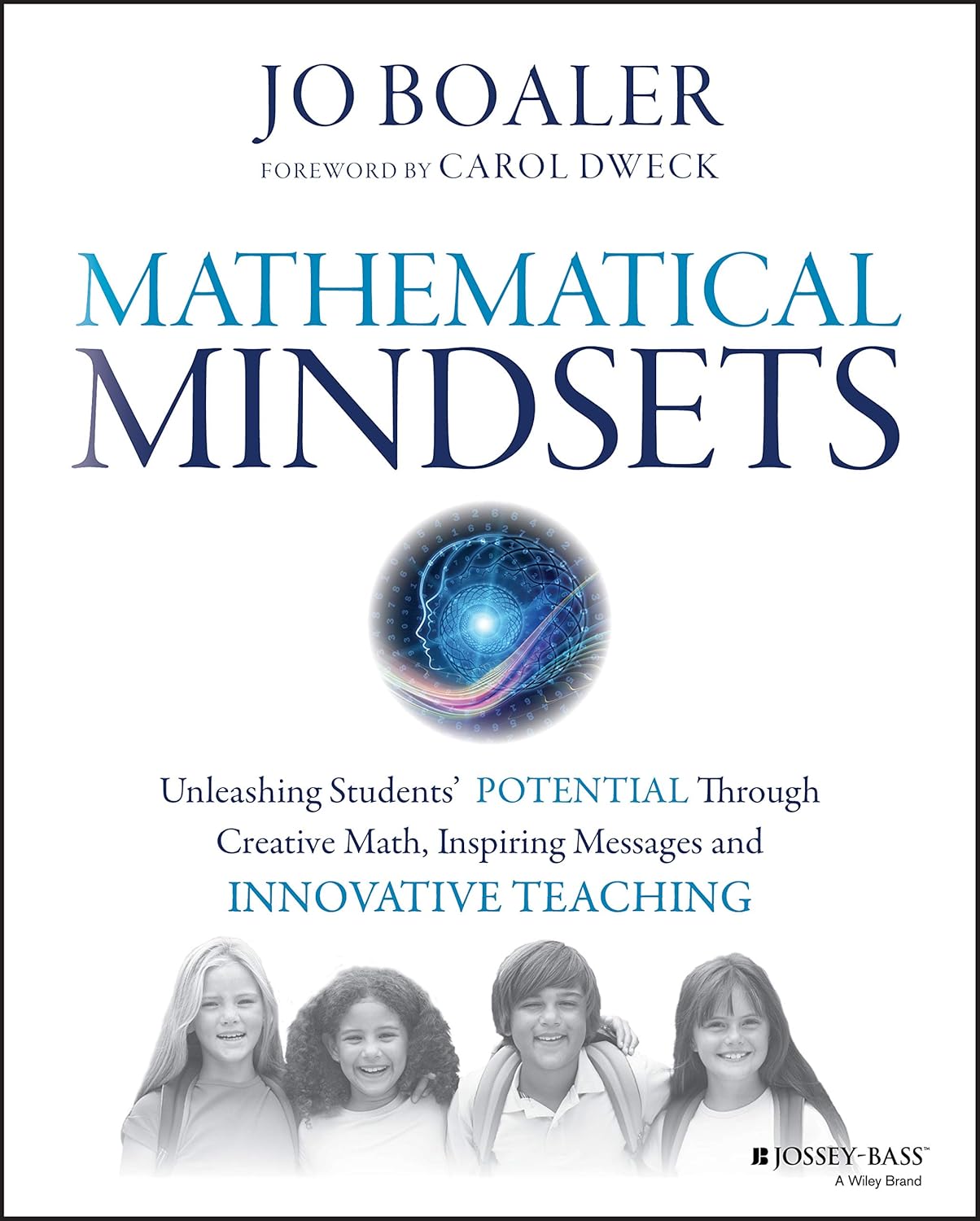
Mathematical Mindsets
Jo Boaler, Carol S. Dweck


 Amazon Best Sellers
 Apple Books


 43 Min Reading Time
 Audio Version Available
About this book
Is math a source of anxiety for you, your students, or your children? Unlock the math potential in learners of all ages with Mathematical Mindsets.
Renowned Stanford researcher and math education expert Jo Boaler unveils the transformative power of mindset in math learning. Based on years of research, this book bridges the gap between research and practice, providing practical strategies and activities to foster a growth mindset and banish math anxiety.
Discover how to:
- Turn mistakes and struggles into valuable learning experiences.
- Replace rote learning with rich, engaging mathematical activities.
- Cultivate a positive math mindset for students.
- Transform assessment and grading policies to support genuine understanding.
Whether you're an educator, parent, or student, Mathematical Mindsets offers a proven roadmap to mathematical success, empowering you to overcome self-doubt and embrace the beauty and potential of mathematics.
Summary of Key Ideas
- •
Embrace a Growth Mindset
The core principle of a growth mindset is the belief that intelligence is not fixed but can be developed through dedication and hard work. This contrasts with a fixed mindset, where individuals believe their abilities are innate and unchangeable. In mathematics, embracing a growth mindset means believing that anyone can improve their mathematical abilities, regardless of their current skill level. Boaler emphasizes that teachers and parents should encourage students to view challenges as opportunities for growth, effort as a path to mastery, and failures as learning experiences. By fostering a growth mindset, students are more likely to persevere through difficult problems, embrace new concepts, and develop a lifelong love of learning mathematics.
- •
Focus on Conceptual Understanding
Traditional math education often emphasizes rote memorization of formulas and procedures, leading to a superficial understanding of mathematical concepts. Boaler argues for a shift towards conceptual understanding, where students grasp the underlying principles and connections within mathematics. This involves engaging students in rich, open-ended tasks that encourage exploration, discussion, and justification of their reasoning. By focusing on conceptual understanding, students develop a deeper and more flexible understanding of mathematics, enabling them to apply their knowledge to novel situations and real-world problems. This approach fosters critical thinking, problem-solving skills, and a genuine appreciation for the beauty and power of mathematics.
- •
Create a Positive Learning Environment
Many students develop math anxiety due to negative experiences in the classroom, such as timed tests and public shaming. Boaler advocates for creating a positive and supportive learning environment where students feel safe to take risks, make mistakes, and ask questions. This involves de-emphasizing grades and competition, and instead focusing on effort, progress, and collaboration. Teachers can create a culture of respect and empathy by valuing diverse perspectives, celebrating different approaches to problem-solving, and providing constructive feedback that encourages growth. By reducing math anxiety, students are more likely to engage with the material, persevere through challenges, and develop a positive attitude towards mathematics.
- •
Connect Math to the Real World
Traditional math instruction often presents mathematics as a set of isolated facts and procedures, disconnected from real-world applications. Boaler emphasizes the importance of connecting mathematics to students' lives and interests, demonstrating its relevance and practicality. This can involve using real-world examples, engaging in project-based learning, and exploring the connections between mathematics and other disciplines, such as art, music, and science. By making mathematics more relevant and engaging, students are more likely to see its value, develop a deeper understanding of its concepts, and become motivated to learn more.
- •
Promote Collaboration and Discussion
Collaboration is a powerful tool for learning mathematics, as it allows students to share ideas, discuss different approaches, and learn from each other. Boaler encourages teachers to incorporate collaborative activities into their lessons, such as group problem-solving, peer teaching, and mathematical discussions. By working together, students can develop a deeper understanding of mathematical concepts, improve their communication skills, and build confidence in their abilities. Collaboration also fosters a sense of community and shared purpose, creating a more supportive and engaging learning environment.
- •
Use Assessment for Learning
Assessment should be viewed as an opportunity for learning and growth, rather than a measure of innate ability. Boaler advocates for using formative assessment techniques, such as questioning, observation, and self-assessment, to provide students with ongoing feedback and support. She also emphasizes the importance of designing assessments that measure conceptual understanding, problem-solving skills, and mathematical reasoning, rather than rote memorization. By using assessment as a tool for learning, teachers can help students identify their strengths and weaknesses, track their progress, and develop a deeper understanding of mathematics.
- •
Incorporate Visual Mathematics
Visual representations, such as diagrams, graphs, and manipulatives, can be powerful tools for understanding mathematical concepts. Boaler encourages teachers to use visual aids to help students make connections between abstract ideas and concrete representations. By visualizing mathematics, students can develop a deeper and more intuitive understanding of its principles, improve their problem-solving skills, and make mathematics more accessible and engaging. Visual representations can also help students communicate their mathematical thinking more effectively and develop a greater appreciation for the beauty and elegance of mathematics.
- •
Value Mistakes as Learning Opportunities
Mistakes are an essential part of the learning process, providing valuable opportunities for growth and understanding. Boaler encourages teachers to create a classroom culture where mistakes are seen as positive and valuable, rather than something to be avoided. This involves celebrating mistakes, analyzing them to identify misconceptions, and using them as a springboard for further learning. By embracing mistakes, students become more resilient, willing to take risks, and develop a deeper understanding of mathematics. Teachers can also model this mindset by openly acknowledging their own mistakes and demonstrating how they learn from them.
Chapter Recap

About The Author
Jo Boaler
Main Quotes
"The mathematics classroom should be a place where students feel comfortable taking risks and where mistakes are valued."
"When students believe they can learn anything, they achieve at higher levels."
"A ‘mathematical mindset’ is needed in classrooms – one that values mistakes, questions, and depth of understanding."
"Believing in students’ potential is the first step to unlocking it."
"The single most damaging belief in mathematics, the one that sits at the root of math anxiety and math failure, is the idea that math is a gift, that some people can do math and some cannot."
"When we teach mathematics, we are not only teaching content, we are teaching students how to think, reason, and solve problems."
"Mistakes are not only opportunities for learning; they are essential for brain growth and deep understanding."
"Encourage students to see math as a subject of growth and exploration rather than a performance to be judged."
"The brain grows most when you make mistakes."
"Ask more open questions that allow for multiple pathways and encourage deeper thinking."
Who Should Read This Book
K-12 math teachers
Math coaches and specialists
School administrators
Parents of students struggling with math
Homeschooling parents
Teacher educators
Anyone interested in growth mindset and math education
Undergraduate education students
Researchers in mathematics education
Professional development providers in education
Book Summaries Like
Mathematical Mindsets

FAQ

Free Access to LitNotes