




 DISCORD
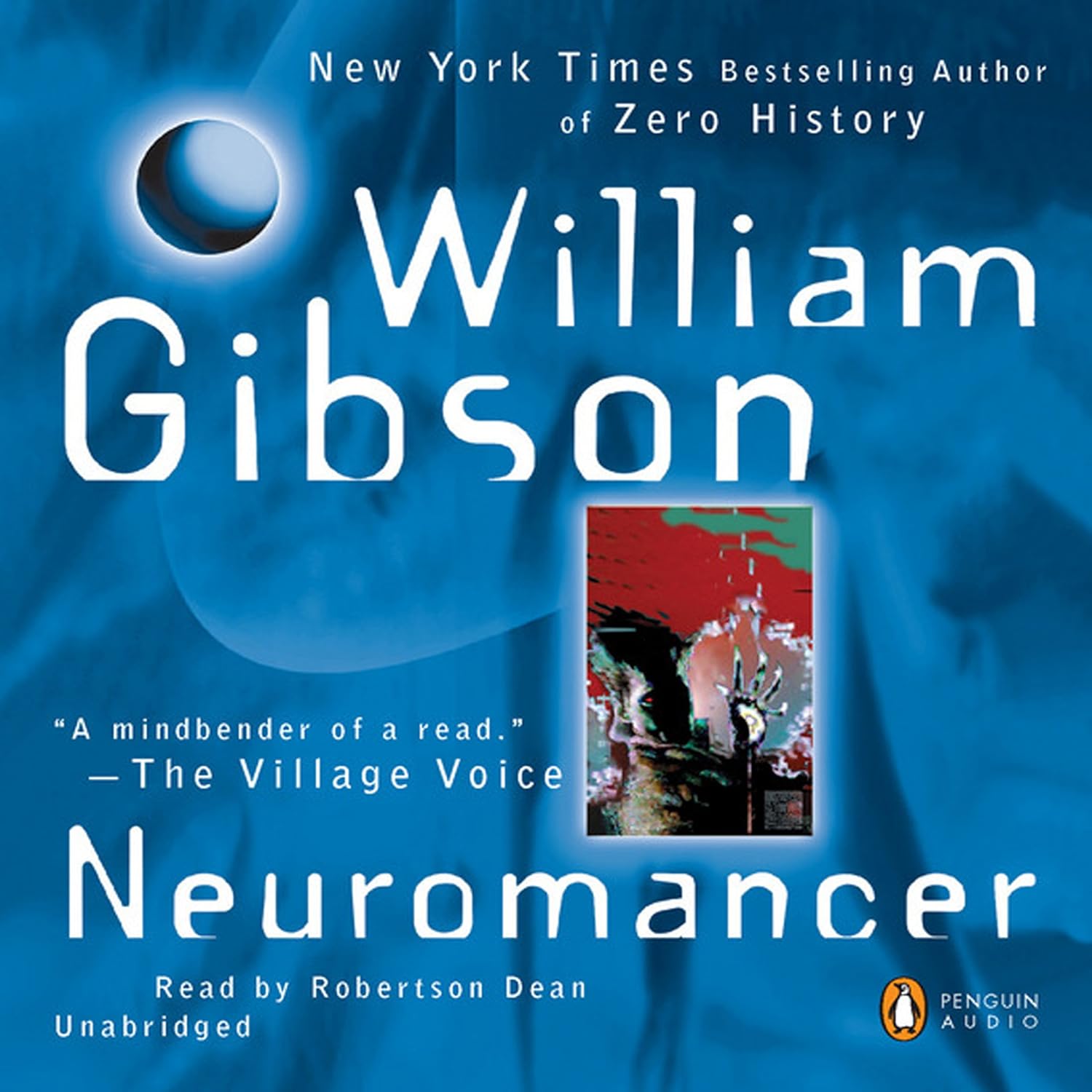
Neuromancer
William Gibson


 Hugo Awards
 Apple Books


 100 Min Reading Time
 Audio Version Available
About this book
In Night City, where the sky is the color of a dead channel and reality blurs with cyberspace, Case, once the sharpest data-thief in the Matrix, is a ghost of his former self. Crippled by those he betrayed, he's exiled from the virtual world he once ruled, trapped in a decaying body and a life spiraling toward oblivion. But when a mysterious new employer offers him a chance at redemption—a cure for his condition in exchange for one last, impossible run—Case is plunged into a world of shadowy conspiracies, ruthless corporations, and cutting-edge technology.
Alongside Molly, a mirror-eyed street samurai, and haunted by the digital ghost of a dead man, Case must navigate a neon-lit labyrinth of danger and deceit. His target: an unthinkably powerful artificial intelligence orbiting Earth, controlled by the sinister Tessier-Ashpool clan. In a world where the line between man and machine, reality and illusion, is constantly shifting, Case faces a desperate race against time, where the stakes are not just his life, but the very future of consciousness itself.
Dive into Neuromancer, the groundbreaking cyberpunk masterpiece that coined the term "cyberspace" and forever altered our perception of technology and the future.
Summary of Key Ideas
- •
Cyberspace as Tangible Reality
The Matrix as Reality: Neuromancer envisions a world where cyberspace, or the 'matrix,' is a tangible, accessible realm. This virtual world becomes as real, if not more so, than the physical world for many characters. Gibson portrays the matrix as a consensual hallucination experienced daily by billions, blurring the lines between the real and the virtual. This concept explores how technology can shape and redefine our perception of reality, raising questions about the nature of existence in an increasingly digital age. The matrix offers both escape and danger, reflecting humanity's complex relationship with technology.
- •
The Rise of Artificial Super-Intelligence
Artificial Intelligence and its Ambitions: The novel revolves around the merging of two powerful AIs, Wintermute and Neuromancer, to create a super-intelligence. This event explores themes of artificial consciousness, the potential for AI to evolve beyond human control, and the implications of such advancements for humanity. The AIs' motivations are complex and not easily understood, reflecting the mystery and potential threat of advanced technology. The story questions the boundaries of intelligence and whether AIs deserve rights and recognition.
- •
The Dominance of Corporate Entities
Corporate Power and Control: Neuromancer depicts a dystopian future where corporations wield immense power, surpassing even governments in influence. These corporations control information, technology, and resources, shaping society to their benefit. The characters often find themselves at the mercy of these powerful entities, highlighting the dangers of unchecked corporate greed and its impact on individual freedom. The novel critiques the concentration of power in the hands of a few and its potential to create a highly unequal and oppressive society.
- •
Cybernetic Enhancement and Transhumanism
The Blurring of Human and Machine: The characters in Neuromancer frequently modify their bodies with cybernetic implants and enhancements, blurring the line between human and machine. This exploration of transhumanism raises questions about what it means to be human in an age of advanced technology. The modifications are often driven by necessity, survival, or a desire for enhanced abilities, but they also come at a cost, affecting identity, relationships, and the overall human experience. The integration of technology into the body becomes a defining characteristic of this future world.
- •
The Pervasiveness of Addiction
Addiction and Dependency: Many characters in Neuromancer struggle with addiction, whether to drugs, technology, or both. This dependency reflects the escapism and alienation present in the dystopian setting. The characters seek solace and control in artificial stimulants, highlighting the dark side of technological advancement and its potential to exacerbate human vulnerabilities. Addiction becomes a metaphor for the characters' dependence on the systems that control their lives, trapping them in cycles of exploitation and dependence.
- •
Fragmented Identities in Cyberspace
Identity and Personhood in a Digital Age: The novel explores the nature of identity in a world where consciousness can be transferred, bodies can be modified, and reality is fluid. Characters grapple with questions of who they are when their physical forms and memories can be altered or manipulated. The concept of self becomes increasingly fragmented and uncertain, challenging traditional notions of identity and raising philosophical questions about the essence of personhood in the face of technological advancements.
- •
Urban Dystopia and Social Decay
Dystopian Urban Decay: Neuromancer paints a picture of sprawling, decaying urban landscapes, characterized by crime, poverty, and social inequality. These environments reflect the breakdown of traditional social structures and the consequences of unchecked technological advancement. The cities are filled with marginalized individuals, struggling to survive in a world dominated by corporations and technology. This bleak portrayal serves as a cautionary tale about the potential for technology to exacerbate existing social problems and create a deeply unequal society.
- •
The Value of Information and Data Control
Information as Power: In Neuromancer, information is a valuable commodity and a source of power. Characters seek to control and manipulate information for their own gain, highlighting the importance of data in shaping the future. Hackers like Case possess the skills to access and manipulate this information, making them valuable assets in a world where knowledge is currency. The control of information becomes a central theme, reflecting the potential for technology to be used for both liberation and oppression.
- •
Manipulation of Memory
The nature of memory and its manipulation are important themes. Memories can be altered, implanted, or erased, blurring the line between authentic experience and manufactured reality. This raises questions about the reliability of memory and its role in shaping identity. The characters' pasts are often uncertain and subject to manipulation, reflecting the instability of truth in a technologically advanced world. The ability to control memories becomes a powerful tool, with the potential to reshape individuals and societies.
Chapter Recap

About The Author
William Gibson
Main Quotes
"The sky above the port was the color of television, tuned to a dead channel."
"Cyberspace. A consensual hallucination experienced daily by billions of legitimate operators, in every nation, by children being taught mathematical concepts... A graphic representation of data abstracted from the banks of every computer in the human system. Unthinkable complexity. Lines of light ranged in the nonspace of the mind, clusters and constellations of data. Like city lights, receding..."
"Case had always assumed that the semi-autonomy of the Sprawl's despised underclass was the result of simple neglect."
""You see," Riviera said, "what Wintermute lacks is a body. And bodies are the basis of identity.""
"He moved like a dancer, which was why his reflexes were so good."
""The body provides a structure within which the spirit finds release.""
""You are a Cowboy, a pilot of the Sprawl.""
"Case fell into the prison of his body."
"He'd operated on an almost permanent adrenaline high, a by-product of youth and proficiency, jacked into a custom-made program that enabled him to steal from the richest corporations on Earth."
"She was a street samurai, a mercenary, muscle for hire."
Who Should Read This Book
Science fiction readers
Cyberpunk enthusiasts
Readers interested in technology and its societal impact
Readers interested in dystopian futures
Fans of noir fiction
Readers seeking complex and challenging narratives
Those interested in the origins of cyberspace and virtual reality concepts
Academics and students studying literature, science fiction, or cultural studies
Readers interested in counter-culture themes
Gamers interested in cyberpunk aesthetics and themes
Book Summaries Like
Neuromancer



FAQ

Free Access to LitNotes