




 DISCORD
Nuclear War
Annie Jacobsen


 Goodreads Choice Awards
 Apple Books


 67 Min Reading Time
 Audio Version Available
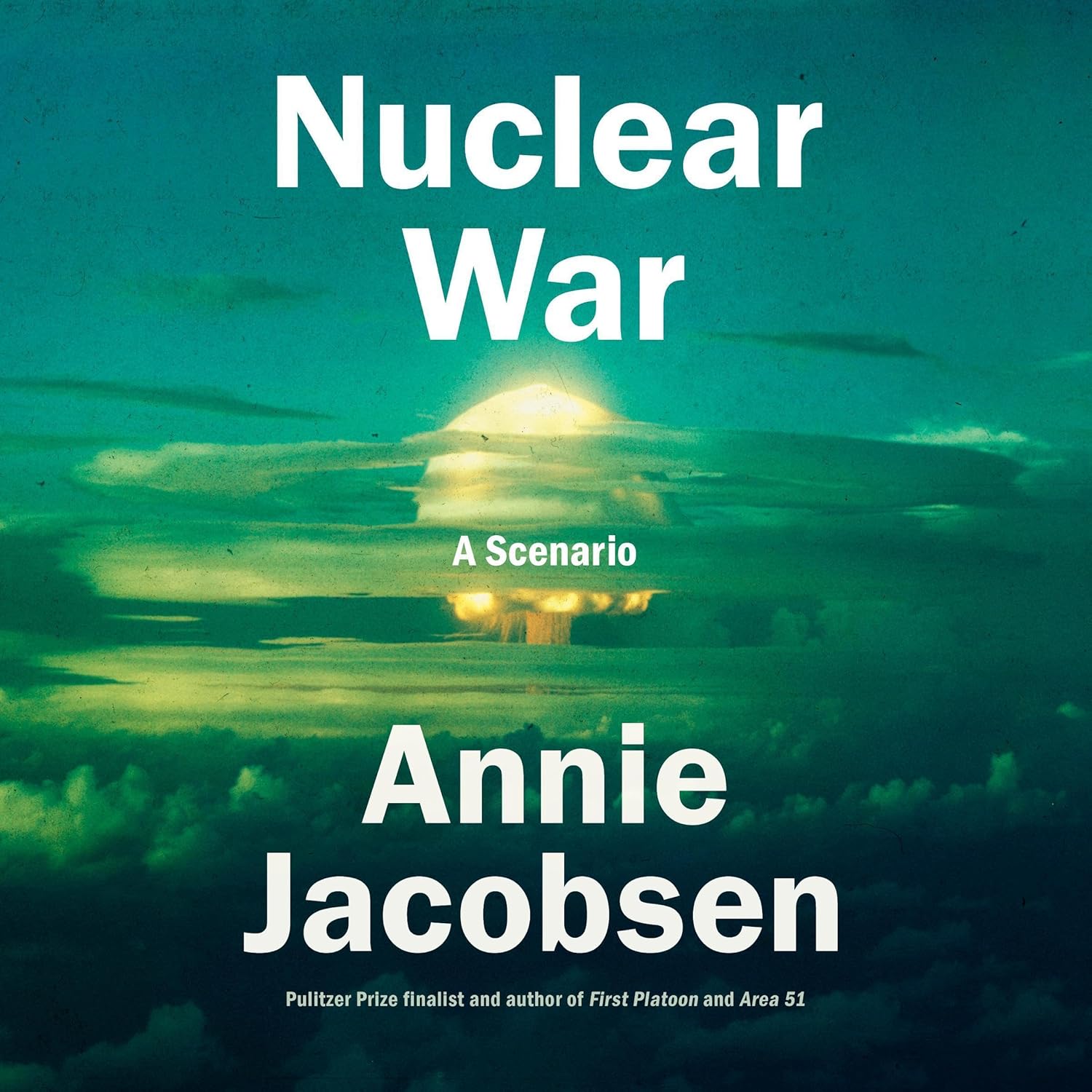
About this book
Imagine a world on the brink. Beyond a cataclysmic asteroid strike, only one event could obliterate civilization in a matter of hours: nuclear war. In Nuclear War: A Scenario, Pulitzer Prize finalist Annie Jacobsen explores this terrifying reality, plunging readers into the heart of a ticking-clock scenario where decisions made in mere minutes determine the fate of humanity.
Based on exclusive interviews with military and civilian experts—those who built the weapons, designed the response plans, and bear the weight of unimaginable choices—Jacobsen unveils the protocols that would unfold second by second if a nuclear missile were launched at the United States. What happens inside the Pentagon? How quickly must world leaders react? And what are the real-life consequences of a war no one can truly win?
Nuclear War: A Scenario is more than just a book; it's a chillingly real account of the unthinkable, a vital warning, and a call to action to dismantle these world-ending weapons before it's too late.
Summary of Key Ideas
- •
A Minute-by-Minute Nuclear War Scenario
The book presents a chillingly realistic scenario of nuclear war, departing from abstract discussions to provide a minute-by-minute account of how such a conflict could unfold. It details the procedures, protocols, and decision-making processes within the military and government, offering readers a tangible understanding of the mechanics of nuclear war. This includes the chain of command, communication systems, and the roles of various individuals involved, from the President to military personnel in silos. The scenario aims to strip away the layers of abstraction and reveal the raw, terrifying reality of what would happen in the event of a nuclear attack, emphasizing the speed and chaos that would ensue.
- •
The Danger of Human Error
Jacobsen underscores the critical role of human fallibility in a nuclear crisis. The book highlights how miscalculations, communication breakdowns, and flawed decision-making by individuals can significantly escalate the danger and lead to unintended consequences. It suggests that technology and protocols alone cannot safeguard against nuclear war because human error remains a persistent and unpredictable variable. This exploration of human fallibility serves as a cautionary reminder that even with advanced systems and strategies, the risk of catastrophic mistakes remains ever-present, emphasizing the need for constant vigilance and careful consideration in moments of crisis.
- •
Immediate and Short-Term Devastation
A key idea is the exploration of the devastating immediate and short-term consequences of nuclear war. The book vividly describes the effects of nuclear blasts on urban centers, detailing the widespread destruction, fires, and immediate loss of life. It also addresses the less immediate, but equally catastrophic, effects of radiation exposure, the collapse of infrastructure, and the breakdown of societal order. This stark portrayal of the aftermath serves to illustrate the immense scale of human suffering and environmental damage that would result from nuclear conflict, emphasizing the urgency of preventing such a catastrophe.
- •
The Uncontrollable Nature of Nuclear War
The book challenges the notion that a nuclear war can be controlled or limited once it begins. Jacobsen argues that the dynamics of escalation, retaliation, and miscalculation make it exceedingly difficult, if not impossible, to prevent a limited exchange from spiraling into a full-scale nuclear conflict. The inherent instability of the situation, combined with the speed at which decisions must be made, significantly reduces the prospects for de-escalation and increases the likelihood of widespread destruction. This perspective challenges the assumptions underlying some nuclear deterrence theories and highlights the extreme danger of any use of nuclear weapons.
- •
Vulnerabilities in Defense Systems
Jacobsen explores the vulnerabilities in the United States' defense systems against nuclear attack. The book reveals limitations in missile defense capabilities, early warning systems, and communication networks. These vulnerabilities raise questions about the effectiveness of existing strategies for deterring and responding to a nuclear attack, suggesting that the country may be more exposed than is commonly understood. By highlighting these weaknesses, Jacobsen underscores the need for continuous improvement and reassessment of defense strategies to enhance national security and reduce the risk of a successful attack.
- •
Psychological Impact of Nuclear War
A significant theme is the examination of the psychological impact of nuclear war on decision-makers and the general population. The book delves into the immense stress, fear, and uncertainty that would accompany a nuclear crisis, and how these factors could affect judgment and decision-making under immense pressure. It also touches on the potential for widespread panic, social unrest, and psychological trauma in the aftermath of an attack. Understanding these psychological dimensions is crucial for preparing for and mitigating the consequences of nuclear war, as well as for promoting mental health and resilience in the face of such a threat.
Chapter Recap

About The Author
Annie Jacobsen
Main Quotes
"Nuclear war zeros it all out. Nuclear weapons reduce human brilliance and ingenuity, love and desire, empathy and intellect, to ash."
"With time, after a nuclear war, all present-day knowledge will be gone. Including the knowledge that the enemy was not North Korea, Russia, America, China, but nuclear weapons themselves."
"The idea that nuclear war is winnable is an insane idea."
"A certainty: After a nuclear war there will be no government coming to help you."
"The purpose of DEFCON is to convey the risk of nuclear war, but also to ensure the survivability of the chain of command in order to retaliate."
"The idea that any human being can maintain complete control in the face of a nuclear attack is ludicrous."
"Fail-Safe is not fail-safe."
"The system is designed for speed, not necessarily for accuracy."
"There’s no such thing as a limited nuclear war."
"The world has survived by luck."
Who Should Read This Book
Readers interested in military history and strategy
Individuals concerned about global security and nuclear proliferation
Those interested in political science and international relations
Readers of non-fiction thrillers and investigative journalism
People seeking to understand potential nuclear war scenarios
Professionals in national security, defense, and policymaking
Readers of Annie Jacobsen's previous books
Individuals interested in contemporary geopolitical issues
Readers looking for fact-based, researched analysis of complex topics
Book Summaries Like
Nuclear War
FAQ

Free Access to LitNotes