




 DISCORD
Orthodoxy
Gilbert Keith Chesterton


 Apple Books


 38 Min Reading Time
 Audio Version Available
About this book
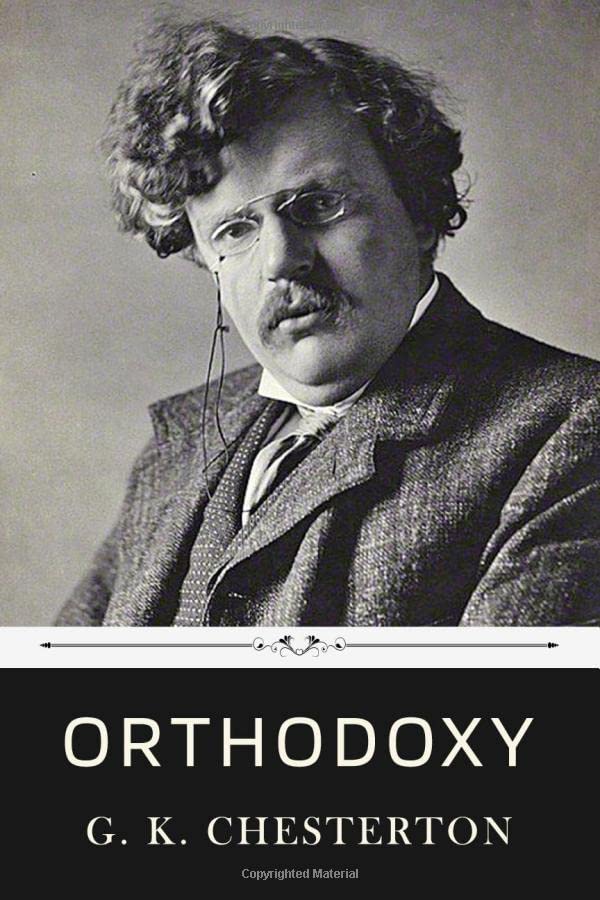
In a world adrift in uncertainty, G.K. Chesterton's Orthodoxy stands as a beacon of clarity and conviction. More than a defense of Christianity, it's a captivating account of a personal quest for truth. With characteristic wit and disarming sincerity, Chesterton recounts his journey to create a philosophy that embraces the entirety of human experience, only to discover that it already exists in the tenets of Christian belief.
Far from a dry theological treatise, Orthodoxy is a vibrant exploration of faith, reason, and the sheer joy of existence. Chesterton dismantles modern skepticism with thought-provoking analogies and gleeful paradoxes, revealing the profound beauty and enduring relevance of traditional Christian thought. This is not a faith imposed from without, but an answer to the deepest riddles of the human heart.
Embark on an intellectual adventure that challenges assumptions and celebrates the wonder of the world. Orthodoxy invites readers to rediscover the magic of belief and embrace the exhilarating quest for truth.
Summary of Key Ideas
- •
A Personal Journey to Faith
Chesterton presents "Orthodoxy" as an explanation of his personal philosophical journey to Christian faith. Rather than a theological treatise, it is a spiritual autobiography detailing his intellectual discoveries. He argues that he independently arrived at a set of core beliefs that, to his surprise, turned out to be consistent with traditional Christian orthodoxy. The book aims to demonstrate the reasonableness and practicality of Christian doctrines, challenging the common perception of them as restrictive or outdated. Chesterton invites readers to reconsider orthodoxy not as a constraint, but as a liberating and enlivening framework for understanding the world.
- •
The Value of Paradox
A central theme in "Orthodoxy" is the idea that Christianity embraces paradox rather than shying away from it. Chesterton posits that life itself is filled with contradictions and mysteries, and that a true and complete worldview must account for this inherent paradox. He argues that Christianity, unlike many philosophies, does not attempt to smooth over these contradictions with simplistic explanations. Instead, it acknowledges and incorporates them, providing a richer and more nuanced understanding of reality. This embrace of paradox is, according to Chesterton, a sign of Christianity's intellectual strength and its ability to capture the complexity of human experience.
- •
The Importance of Wonder
Chesterton champions the idea that the world is a wonderful and miraculous place, a gift to be appreciated with childlike wonder. He critiques the modern tendency to take the world for granted, arguing that scientific and philosophical advancements have, paradoxically, led to a diminished sense of awe. Chesterton suggests that orthodoxy, with its emphasis on creation and divine purpose, can restore this lost sense of wonder. By recognizing the extraordinary nature of ordinary things, individuals can cultivate a deeper appreciation for life and its inherent beauty. This sense of wonder, he argues, is not naive but rather a profound form of wisdom.
- •
The Freedom of Dogma
Chesterton emphasizes the importance of dogma, arguing that it provides a necessary framework for thought and action. He contends that dogma, often perceived as restrictive, actually liberates the mind by providing a solid foundation upon which to build. Without dogma, thought becomes aimless and easily swayed by fleeting trends and ideologies. Orthodoxy, in Chesterton's view, offers a coherent and enduring set of principles that can guide individuals through the complexities of life. By adhering to these principles, individuals can avoid the pitfalls of relativism and maintain a firm sense of purpose and direction.
- •
The Reasonableness of Faith
Against the backdrop of modern skepticism, Chesterton defends the rationality of Christian belief. He argues that Christianity is not merely a matter of blind faith but is, in fact, deeply reasonable. He suggests that Christian doctrines provide coherent answers to fundamental questions about human existence, morality, and purpose. Chesterton employs wit and logic to dismantle common objections to Christianity, demonstrating that its core tenets are not only compatible with reason but also offer a more satisfying explanation of the world than many alternative philosophies. He invites readers to engage with Christian thought critically and discover its inherent rationality.
- •
Tradition as a Living Force
Chesterton explores the concept of tradition as a dynamic and living force, rather than a static relic of the past. He argues that tradition represents the accumulated wisdom of generations, offering valuable insights into the human condition. Rather than blindly adhering to tradition, Chesterton advocates for a critical engagement with it, discerning the enduring truths from the outdated customs. He sees orthodoxy as a living tradition, constantly adapting to new challenges while remaining rooted in its core principles. This dynamic view of tradition allows for progress and innovation without sacrificing the wisdom of the past.
Chapter Recap

About The Author
Gilbert Keith Chesterton
Main Quotes
"The only way to enjoy even one yard of dirt is to enjoy the enjoyment of dirt in general."
"The special mark of the modern sceptic is that he does not doubt the dogmas really worth doubting, but doubts only those which ought to be believed."
"The poet only asks to get his head into the heavens. It is the logician who seeks to get the heavens into his head. And it is his head that splits."
"Fairy tales do not tell children the dragons exist. Children already know that dragons exist. Fairy tales tell children the dragons can be killed."
"The madman is not the man who has lost his reason. The madman is the man who has lost everything except his reason."
"There are no words to express the abyss between dependence and independence."
"The Catholic Church is the only thing which saves man from being degraded by being a child of his age."
"The Christian ideal has not been tried and found wanting. It has been found difficult; and left untried."
"What we want is not a religion that is right where we are right. What we want is a religion that is right where we are wrong."
"An open mind is really a stupid thing, unless it means a mind that is open to new things, but closed to nonsense."
Who Should Read This Book
Christians (Catholic and Protestant)
Readers interested in Christian apologetics
Individuals exploring philosophical and theological questions
Conservatives interested in traditional values
Those familiar with and appreciative of G.K. Chesterton's writing style
Readers interested in early 20th-century thought and social commentary
Skeptics open to considering arguments for religious belief
Individuals seeking a defense of traditional Christian beliefs against modern criticisms
Readers interested in essays and intellectual arguments
Book Summaries Like
Orthodoxy
FAQ

Free Access to LitNotes