




 DISCORD
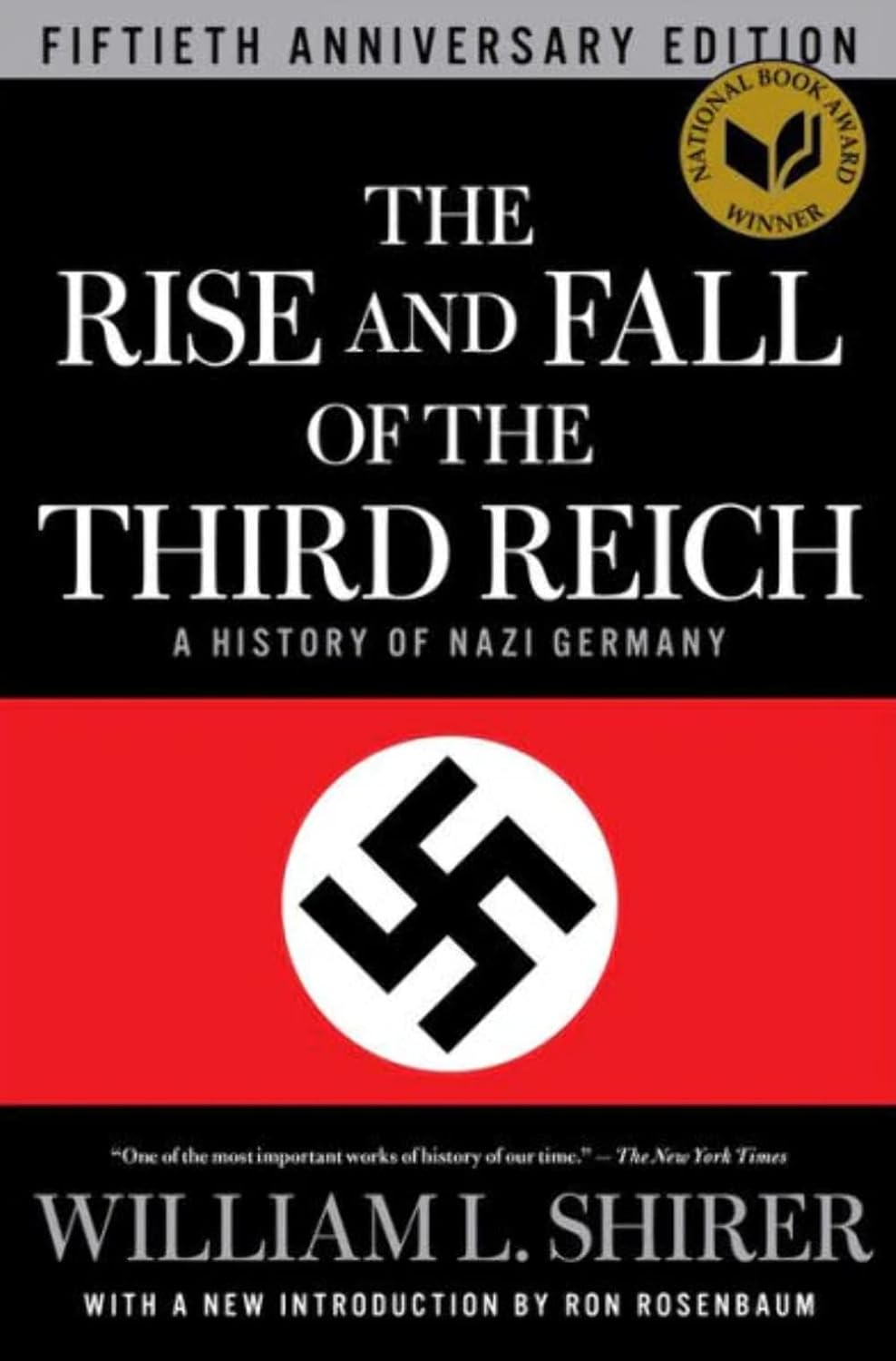
Rise And Fall Of The Third Reich
WILLIAM L. SHIRER


 Amazon Charts


 408 Min Reading Time
 Audio Version Available
About this book
A chilling and definitive account of Nazi Germany, William L. Shirer's The Rise and Fall of the Third Reich meticulously chronicles Adolf Hitler's ascent to power, his relentless conquest of Europe, and the Third Reich's swift and devastating collapse. Drawing upon captured Nazi documents, diaries, and testimonies uncovered at the Nuremberg Trials, Shirer, a seasoned foreign correspondent who witnessed the Reich firsthand, constructs an unparalleled portrait of one of history's darkest chapters. This National Book Award-winning bestseller explores the inner workings of Hitler's regime, revealing the horrifying extent of their ambition and the devastating consequences of their actions, including the Holocaust. A classic of historical literature, this monumental work remains essential reading for understanding the forces that shaped the 20th century and continue to resonate today.
Summary of Key Ideas
- •
Democracy's Delicate Balance
The Fragility of Democracy: Shirer meticulously details how the Weimar Republic's weaknesses—economic instability, political fragmentation, and deep social divisions—created an environment ripe for extremist ideologies. He emphasizes that democracy is not a given, but a system that requires constant vigilance, compromise, and a commitment to its core principles. The book serves as a cautionary tale, illustrating how easily democratic institutions can be subverted when citizens become disillusioned and lose faith in the system's ability to address their needs and concerns, paving the way for authoritarian rule.
- •
The Weaponization of Information
The Power of Propaganda and Deceit: Shirer exposes the insidious ways in which the Nazi regime employed propaganda, misinformation, and outright lies to manipulate public opinion, consolidate power, and justify its actions. He highlights how effective propaganda can be in shaping perceptions, exploiting fears, and creating a distorted reality that serves the interests of those in power. This key idea underscores the importance of critical thinking, media literacy, and a healthy skepticism towards official narratives, particularly in times of political upheaval and social unrest.
- •
The Allure of the Strongman
The Appeal of Charismatic Leadership: Hitler's rise to power is attributed, in part, to his charismatic leadership style, his ability to connect with the German people's emotions and aspirations, and his promise of national renewal and greatness. Shirer examines how Hitler skillfully exploited the widespread discontent and resentment following World War I, presenting himself as a strongman who could restore Germany's pride and solve its problems. This highlights the dangers of blindly following charismatic leaders without critically evaluating their policies and motives.
- •
The Corrosive Nature of Power
The Perils of Unchecked Ambition: The book vividly portrays how the insatiable ambition and ruthlessness of Hitler and his inner circle fueled the Nazi regime's expansionist policies and its descent into barbarity. Shirer demonstrates how a lust for power, coupled with a complete disregard for moral principles, can lead to catastrophic consequences, not only for the perpetrators but also for the entire world. This serves as a stark reminder of the importance of ethical leadership and the need to hold those in power accountable for their actions.
- •
The Complicity of the Ordinary
The Banality of Evil: Shirer emphasizes that the horrors of the Holocaust and other Nazi atrocities were not solely the work of psychopathic individuals, but also of ordinary people who were willing to follow orders, conform to social norms, and turn a blind eye to injustice. He argues that the most terrifying aspect of the Nazi regime was its ability to normalize evil, transforming seemingly decent individuals into accomplices to unspeakable crimes. This highlights the importance of individual responsibility, moral courage, and the willingness to challenge authority, even in the face of social pressure.
- •
The Price of Appeasement
The Consequences of Appeasement: Shirer criticizes the policy of appeasement adopted by Britain and France towards Nazi Germany in the years leading up to World War II. He argues that this policy, driven by a desire to avoid war, emboldened Hitler, allowed him to expand his power and influence, and ultimately made war inevitable. This serves as a cautionary tale about the dangers of appeasing aggressors and the importance of standing up to tyranny early on, even at the risk of conflict.
- •
The Self-Destructive Nature of Tyranny
The Inevitability of Failure for Immoral Regimes: Despite its initial successes, the Third Reich was ultimately doomed to failure due to its inherent contradictions, its reliance on violence and oppression, and its disregard for fundamental human values. Shirer argues that regimes built on lies, hatred, and aggression cannot sustain themselves in the long run, as they inevitably sow the seeds of their own destruction. This offers a message of hope, suggesting that even the most powerful and seemingly invincible dictatorships are ultimately vulnerable to collapse.
- •
The Power of Witnessing History
The Importance of Bearing Witness: As a journalist stationed in Germany during the rise of the Nazi regime, Shirer provides a firsthand account of the events that led to World War II and the Holocaust. His book serves as a powerful testament to the importance of bearing witness to history, documenting the truth, and ensuring that such atrocities are never forgotten. It underscores the role of journalism, historical analysis, and collective memory in preventing future acts of genocide and oppression.
Chapter Recap

About The Author
WILLIAM L. SHIRER
Main Quotes
"The German people lacked the humaneness, the love of their fellow man, that is the mark of the Western Christian civilization."
"The Third Reich was a tragic chapter in the history of Germany, a period of unprecedented evil and destruction."
"The Nazi leaders were men of low character and base instincts, driven by a lust for power and a hatred of their fellow man."
"The German people were not entirely blameless for the crimes of the Third Reich."
"Adolf Hitler was a gifted demagogue, but he was also a man of profound ignorance and prejudice."
"The Nazi regime was built on a foundation of lies and propaganda."
"The German people were willing to believe the lies because they wanted to believe them."
"The Third Reich was a house built on sand, and it was destined to collapse."
"The war was a disaster for Germany, and it led to the deaths of millions of people."
"The legacy of the Third Reich is a warning to the world about the dangers of totalitarianism and hatred."
Who Should Read This Book
Readers interested in World War II history
History enthusiasts
Readers interested in Nazi Germany
Students of history and political science
Academics and researchers
Readers seeking a comprehensive account of the Third Reich
Readers interested in political science and the rise of totalitarian regimes
Readers looking for detailed historical analysis
General audience interested in 20th-century history
Book Summaries Like
Rise And Fall Of The Third Reich



FAQ

Free Access to LitNotes