




 DISCORD
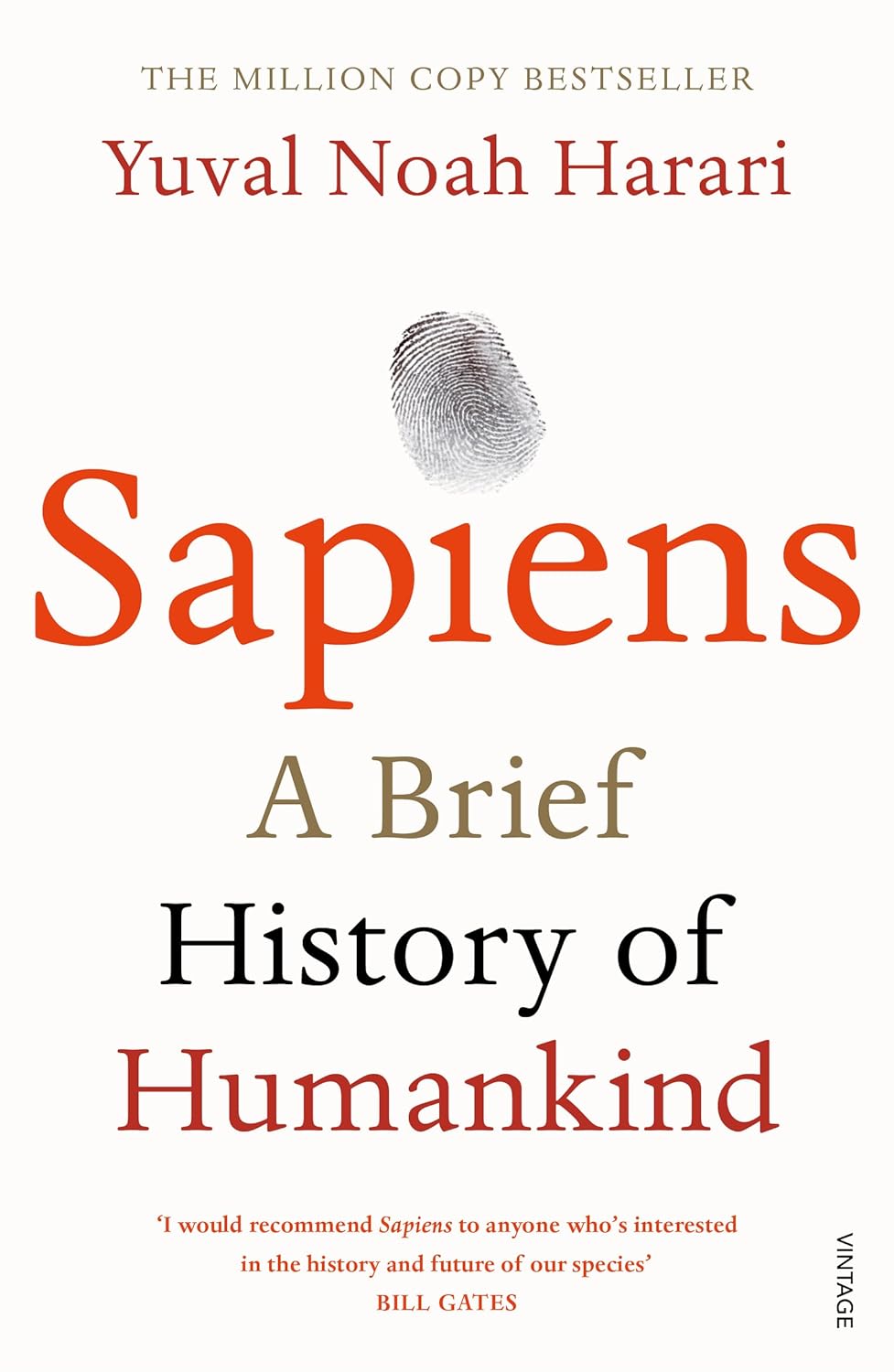
Sapiens
Yuval Noah Harari, Daniel Casanave


 Amazon Best Sellers
 Amazon Charts


 80 Min Reading Time
 Audio Version Available
About this book
From the Stone Age to Silicon Valley, Sapiens: A Graphic History is a breathtaking visual journey through the story of humankind. Yuval Noah Harari teams up with comics creators David Vandermeulen and Daniel Casanave to present his globally acclaimed bestseller in an exciting new format.
This graphic adaptation explores how Homo sapiens came to dominate the Earth, delving into the unique factors that set us apart from other animals. Discover how our ancestors gathered around campfires, what led to the agricultural revolution, and the profound impact of language, myth, and storytelling on our societies.
Engage with history like never before as complex ideas are brought to life through vibrant illustrations and witty storytelling. Sapiens: A Graphic History challenges us to reconsider everything we thought we knew about being human, prompting a crucial conversation about our past, present, and future. Prepare to be enlightened, provoked, and entertained on this epic quest to understand humankind's place in the world.
Summary of Key Ideas
- •
The Power of Shared Fictions
The Cognitive Revolution marks a pivotal moment when Homo sapiens developed unique cognitive abilities, approximately 70,000 years ago. This revolution allowed for complex communication, the creation of shared myths and beliefs, and large-scale cooperation. The development of language enabled humans to transmit information about the world and, more importantly, to create and share fictional stories. These shared fictions, such as religions, nations, and corporations, allowed Sapiens to cooperate flexibly in large numbers, giving them a significant advantage over other human species like Neanderthals. This ability to believe in and act upon shared fictions is a cornerstone of human dominance.
- •
The Agricultural Revolution: A Trap?
The Agricultural Revolution, beginning around 12,000 years ago, is often viewed as a significant advancement, but Harari argues it was a trap. While it allowed for larger populations and settled lifestyles, it also led to increased workload, a less varied diet, and greater vulnerability to disease and famine. Early farmers worked harder and ate less diverse foods compared to hunter-gatherers. The surplus created by agriculture fueled population growth, which in turn necessitated more agriculture, creating a cycle of increasing dependence and hardship. The revolution fundamentally altered human society, creating the conditions for social hierarchies and inequality.
- •
The Construction of Imagined Orders
Harari explores the role of imagined orders in shaping human societies. These orders, such as laws, social norms, and economic systems, are not based on objective reality but are collectively believed and enforced. They are essential for maintaining social stability and cooperation in large groups. Examples include the Code of Hammurabi, the American Declaration of Independence, and modern capitalist ideologies. These imagined orders are often presented as natural or inevitable, but they are human constructs that can be changed. Understanding the constructed nature of these orders is crucial for critically evaluating and potentially reshaping our societies.
- •
The Unification of Humankind
The unification of humankind is a recurring theme, with Harari highlighting the gradual merging of smaller human societies into larger, more interconnected global networks. This process has been driven by various factors, including the spread of universal religions like Christianity and Islam, the rise of empires, and, most recently, the forces of globalization. The increasing interconnectedness has led to the homogenization of cultures, economies, and political systems. While this unification has brought many benefits, such as increased trade, cultural exchange, and technological progress, it also poses challenges, including the loss of cultural diversity and the potential for global crises.
- •
The Power of Science and Technology
Science and the Scientific Revolution have fundamentally transformed human understanding of the world and our ability to manipulate it. The scientific revolution marked a shift from relying on tradition and religious dogma to seeking knowledge through observation, experimentation, and mathematical reasoning. This new approach led to unprecedented technological advancements, from the printing press to the internet. Science, coupled with capitalism and imperialism, has fueled exponential growth in human power and wealth. However, Harari cautions that this power must be wielded responsibly, as it also carries the potential for environmental destruction and social disruption.
- •
Capitalism's Transformative Influence
Harari explores the relationship between capitalism and its profound impact on the modern world. Capitalism, with its emphasis on economic growth and free markets, has been a driving force behind technological innovation, increased productivity, and rising living standards for many. However, it has also contributed to significant inequalities, environmental degradation, and the commodification of human relationships. The pursuit of profit often overshadows other values, leading to ethical dilemmas and social challenges. Harari encourages readers to critically examine the long-term consequences of capitalism and consider alternative economic models that prioritize sustainability and social well-being.
- •
The Legacy of Imperialism
The book delves into the pervasive influence of imperialism throughout history, focusing on how European powers expanded their dominance across the globe. Imperialism not only reshaped political boundaries and economic systems but also had a profound impact on cultures, beliefs, and social structures. The spread of European languages, laws, and institutions has left a lasting legacy in many parts of the world. Harari emphasizes that imperialism was not solely driven by economic motives but also by ideological beliefs about racial and cultural superiority. Understanding the history of imperialism is crucial for comprehending contemporary global inequalities and power dynamics.
- •
The Future of Humanity: A Question Mark
Sapiens prompts readers to contemplate the future of humanity, especially in light of rapid technological advancements. The development of artificial intelligence, biotechnology, and other transformative technologies raises profound ethical and existential questions. Will these technologies enhance human well-being, or will they lead to new forms of inequality and control? Will humans be able to retain control over their own evolution, or will they be overtaken by increasingly intelligent machines? Harari urges us to consider the long-term implications of our choices and to strive for a future that aligns with our values and aspirations.
Chapter Recap

About The Author
Yuval Noah Harari
Main Quotes
"You could never convince a monkey to give you a banana by promising him limitless bananas after death in monkey heaven."
"History is rarely decided by clear-cut battles. More often it blurs into a frustrating murk."
"Culture tends to argue that it forbids only that which is unnatural. But from a biological perspective, nothing is unnatural."
"One of history’s few iron laws is that luxuries tend to become necessities and to spawn new obligations."
"We study history not to know the future but to widen our horizons, to understand that our present situation is neither natural nor inevitable."
"There are no gods in the universe, no nations, no money, no human rights, no laws, and no justice outside the common imagination of human beings."
"How do you cause people to believe in an imagined order such as Christianity, democracy or capitalism? First, you never admit that the order is imagined."
"Ever since the Cognitive Revolution, Sapiens have been living in a dual reality. On the one hand, the objective reality of rivers, trees and lions; and on the other hand, the imagined reality of gods, nations and corporations."
"Money is accordingly a system of mutual trust, and not just any system of mutual trust: it is the most universal and most efficient system of mutual trust ever devised."
"The most important thing to know about prehistoric humans is that they were insignificant."
Who Should Read This Book
Readers interested in history, science, and the future of humanity
Individuals seeking a broad overview of human history from a multidisciplinary perspective
Readers interested in philosophical discussions about the human condition
Those who enjoy accessible non-fiction that challenges conventional thinking
Individuals looking for a book that explores big questions about life, the universe, and everything
Readers of popular science and intellectual bestsellers
People interested in anthropology, sociology, and evolutionary biology
Readers who appreciate a global perspective on history
Visually oriented readers interested in graphic novel adaptations of complex topics
Young adults and teens interested in an accessible introduction to human history
Book Summaries Like
Sapiens




FAQ

Free Access to LitNotes