




 DISCORD
Say Nothing
Patrick Radden Keefe, Ariel Font Prades


 Goodreads Choice Awards
 Apple Books


 112 Min Reading Time
 Audio Version Available
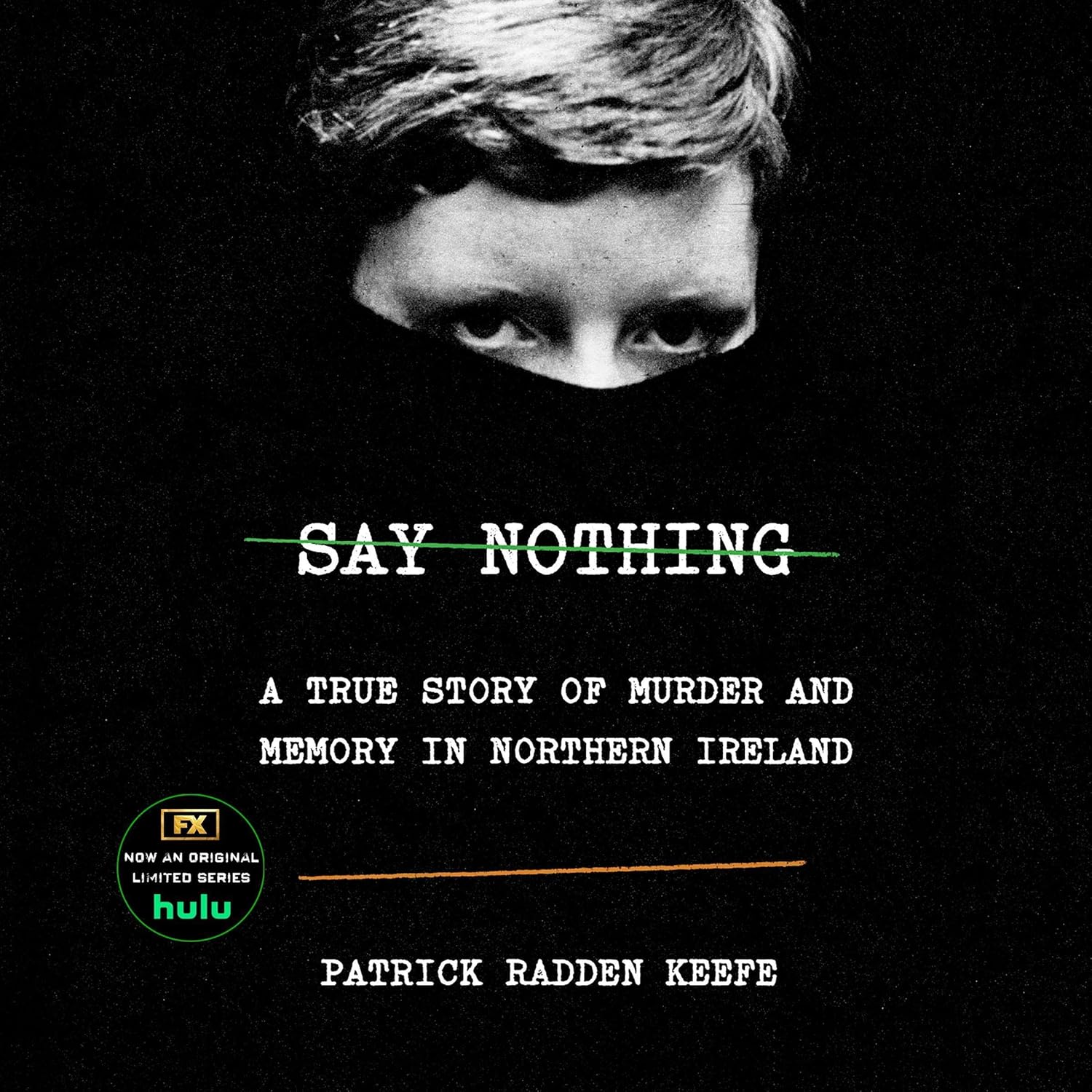
About this book
In December 1972, Jean McConville, a mother of ten, was abducted from her Belfast home, her children left clinging to her legs. They never saw her again. In a city silenced by fear, everyone knew the I.R.A. was responsible, but no one dared speak.
Years later, the discovery of a body on a remote beach reopens the cold case, pulling back the layers of a society scarred by the Troubles. Patrick Radden Keefe masterfully uses McConville's disappearance as a prism to explore the dark heart of the conflict, from the brutal lives of I.R.A. volunteers like Dolours Price, who planted bombs in London as a teenager, to the shadowy figures in the British Army, and Gerry Adams, who brokered peace while burying his own past.
Say Nothing is a searing and unforgettable account of passion, betrayal, and the devastating cost of a war that refuses to be silenced. It's a haunting exploration of how societies fracture, the agonizing choices individuals make, and the long shadows cast by violence, as some seek redemption while others remain captive to the ideals that ignited the conflict.
Summary of Key Ideas
- •
The Complex Roots of the Troubles
The Troubles in Northern Ireland were a complex and brutal conflict, deeply rooted in historical grievances and sectarian divisions. The book meticulously explores the origins and escalation of the conflict, highlighting the roles of various paramilitary groups, political actors, and the British government. It emphasizes the cyclical nature of violence and retaliation that characterized the era, illustrating how deeply ingrained historical narratives fueled ongoing animosity and mistrust between communities.
- •
Dolours Price: A Life of Radicalization and Disillusionment
Dolours Price, a prominent figure in the IRA, serves as a central character through whom the narrative unfolds. Her life story exemplifies the radicalization process many young people underwent, driven by political convictions and a desire to fight for Irish unity. The book delves into her participation in violent acts, including bombings and assassinations, and her subsequent disillusionment with the movement. Price's story highlights the psychological toll of political violence and the challenges of reconciling with a violent past.
- •
The Disappearance of Jean McConville: A Symbol of Brutality
The disappearance of Jean McConville, a widowed mother of ten, is a pivotal event that underscores the ruthlessness of the IRA and the enduring trauma inflicted on families. McConville's abduction and murder, based on suspicions of her being an informant, illustrate the brutal tactics employed by paramilitary groups and the climate of fear that pervaded communities. The search for McConville's remains and the subsequent investigations expose the difficulties in uncovering the truth and achieving justice in the aftermath of conflict.
- •
The Elusive Pursuit of Reconciliation
The book highlights the challenges of achieving reconciliation in the aftermath of political violence. The Good Friday Agreement, while a significant step towards peace, left many issues unresolved, including the accountability for past crimes. The pursuit of justice for victims often clashed with the desire to move forward and avoid reigniting sectarian tensions. The book examines the complexities of balancing truth, justice, and reconciliation in a deeply divided society.
- •
The Battle for Memory and Narrative
Memory plays a crucial role in shaping individual and collective identities in Northern Ireland. The book explores how different communities remember and interpret the past, often through conflicting narratives. These competing memories contribute to ongoing divisions and hinder the process of reconciliation. The act of remembering, forgetting, and selectively remembering becomes a battleground in itself, influencing political attitudes and shaping the future.
- •
The Enduring Legacy of Trauma and Loss
The book emphasizes the profound and lasting impact of the Troubles on individuals, families, and communities. The legacy of violence, trauma, and loss continues to shape social and political life in Northern Ireland. The psychological scars of the conflict run deep, affecting generations and perpetuating cycles of distrust and division. The book underscores the importance of addressing the psychological and social needs of those affected by the Troubles in order to foster healing and reconciliation.
- •
The Silence and Secrets of a Community
The title
- •
Moral Ambiguity in Times of Conflict
The book underscores the moral ambiguities inherent in political conflict, where individuals often make difficult choices with far-reaching consequences. It explores the justifications offered for violence, the compromises made in the name of political goals, and the blurred lines between right and wrong. The narrative challenges readers to confront the complexities of morality in the context of armed conflict and to question the justifications for political violence.
Chapter Recap

About The Author
Patrick Radden Keefe
Patrick Radden Keefe is an award-winning staff writer at The New Yorker magazine and the author of the New York Times bestseller Say Nothing: A True Story of Murder and Memory in Northern Ireland, as well as two other books: The Snakehead: An Epic Tale of the Chinatown Underworld and the American Dream, and Chatter: Dispatches from the Secret World of Global Eavesdropping. He started contributing to The New Yorker in 2006 and has written articles about the chef and TV host Anthony Bourdain, the hunt for the drug lord Chapo Guzman, the tragic personal history of the mass shooter Amy Bishop, and the role that the Sackler family and their company Purdue Pharma played in sparking the opioid crisis. He received the National Magazine Award for Feature Writing in 2014, and was a finalist for the National Magazine Award for Reporting in 2015 and 2016. Say Nothing received the Orwell Prize for Political Writing in 2019 and was named one of Literary Hub’s “20 Best Nonfiction Books of the Decade.” Patrick grew up in Dorchester, Massachusetts and went to college at Columbia. He received masters degrees from Cambridge University and the London School of Economics, and a JD from Yale Law School. In addition to The New Yorker, his work has appeared in The New York Review of Books, The New York Times Magazine, Slate, and other publications. He is the recipient of fellowships from the Guggenheim Foundation, the Rockefeller Foundation, the New America Foundation, the Woodrow Wilson International Center for Scholars, and the Cullman Center for Scholars and Writers at the New York Public Library. Photograph by Philip Montgomery ([source](https://www.patrickraddenkeefe.com/bio-new))
Main Quotes
"“Whatever you say, say nothing.”"
"“In Northern Ireland, the past is not dead. It is not even past.”"
"“The cruelest feature of forced disappearance as an instrument of war is that it denies the bereaved any such closure, relegating them to a permanent limbo of uncertainty.”"
"“There is no such thing as ‘the truth.’ There are only points of view.”"
"“Memory is a haunted house.”"
"“The past was a war zone.”"
"“The Troubles were like a cancer that had metastasized, spreading its poison to every corner of society.”"
"“How do you solve a problem like the past?”"
"“If you confess, you’re dead.”"
"“Who should be held accountable for a shared history of violence? It was a question that was dogging Northern Ireland as a whole.”"
Who Should Read This Book
Readers interested in true crime
Readers interested in Irish history and the Troubles in Northern Ireland
Readers of political thrillers
Readers of in-depth investigative journalism
Readers interested in the history of terrorism and political conflict
Military personnel and those interested in military history
Readers who enjoy books that explore themes of memory, silence, and complicity
Book Summaries Like
Say Nothing
FAQ

Free Access to LitNotes