




 DISCORD
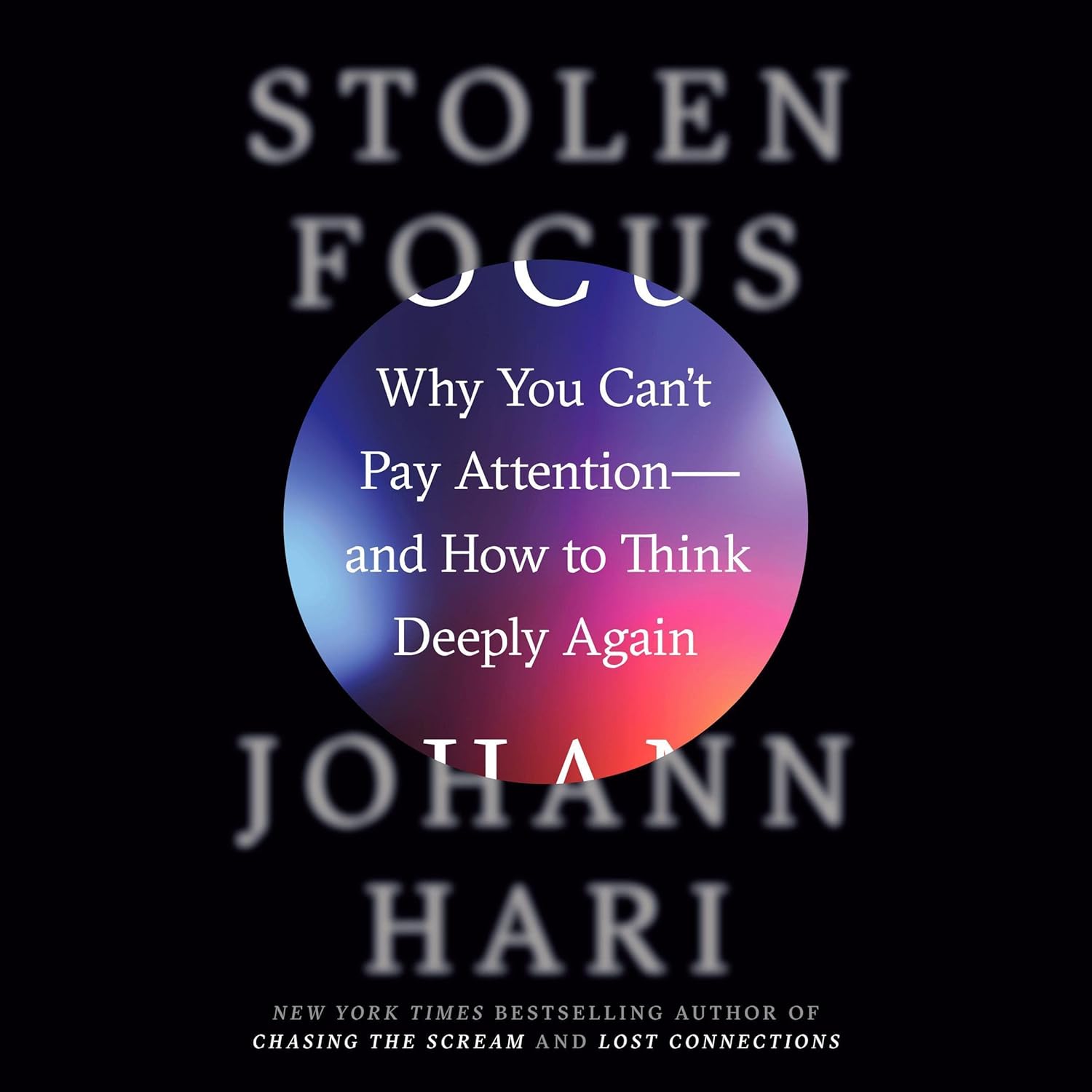
Stolen Focus
Johann Hari


 Goodreads Choice Awards
 Apple Books


 67 Min Reading Time
 Audio Version Available
About this book
Is your attention span shrinking? Are you finding it harder to concentrate in a world of constant distractions? From the bestselling author of Chasing the Scream and Lost Connections comes a groundbreaking investigation into why we're losing our focus—and, crucially, how we can get it back.
Johann Hari's Stolen Focus reveals that our inability to pay attention isn't a personal failing, but the result of powerful external forces. Embark on a thrilling journey with Hari as he uncovers the twelve hidden causes of this crisis, from the decline of mind-wandering to the rise of pollution. Meet Silicon Valley insiders who understand how technology hijacks our minds, witness the impact of lost focus in a Rio de Janeiro favela, and discover innovative solutions in a New Zealand office.
Stolen Focus is a call to arms, offering individuals and society a path to reclaim our attention and build a more focused, fulfilling future. Discover how to fight back against the forces stealing your focus and begin your own attention rebellion today.
Summary of Key Ideas
- •
The Systemic Erosion of Attention
Attention Crisis: Hari argues that we are in the midst of an attention crisis, not due to individual failings, but systemic issues. This crisis is characterized by a significant decline in our ability to focus deeply and sustain attention, impacting our cognitive abilities, mental health, and overall quality of life. The book posits that this erosion of attention is not accidental but a consequence of specific forces shaping our modern environment.
- •
The Attention-Hacking Industry
Technological Manipulation: A central theme is the intentional design of technology to capture and hold our attention. Social media platforms, apps, and websites are engineered to be addictive, exploiting psychological vulnerabilities to maximize user engagement. Hari reveals how features like infinite scrolling, notifications, and personalized content feeds hijack our attention spans, making it increasingly difficult to disengage and focus on other tasks.
- •
The Illusion of Multitasking
Multitasking Myth: Hari debunks the myth of multitasking, presenting scientific evidence that it impairs cognitive performance and reduces productivity. He explains that attempting to do multiple things simultaneously divides our attention, leading to decreased efficiency, increased errors, and heightened stress levels. The book emphasizes the importance of single-tasking and deep work for optimal cognitive function.
- •
The Environmental Assault on Focus
Environmental Factors: The book explores how various environmental factors, such as pollution, noise, and poor diet, contribute to attention deficits. Hari cites research linking air pollution to cognitive decline and ADHD symptoms, highlighting the impact of our physical surroundings on our ability to focus. He also discusses the role of processed foods and nutrient deficiencies in impairing brain function and attention spans.
- •
The Sleep-Attention Connection
Sleep Deprivation: Hari emphasizes the critical role of sleep in maintaining attention and cognitive function. He argues that widespread sleep deprivation, driven by work pressures and technology use, significantly impairs our ability to focus, learn, and regulate emotions. The book stresses the importance of prioritizing sleep and establishing healthy sleep habits to restore and enhance attention spans.
- •
Reclaiming Focus Through Flow
The Importance of Flow States: Hari advocates for cultivating "flow states" – moments of deep immersion and absorption in a task – as a way to reclaim our attention and enhance our cognitive abilities. He explains how flow states promote a sense of fulfillment, creativity, and productivity, and offers practical strategies for creating environments and activities that facilitate these experiences. By actively seeking flow, we can counteract the distractions of modern life.
- •
The Lost Art of Mind-Wandering
The Decline of Mind-Wandering: The book addresses the diminishing capacity for mind-wandering, which Hari argues is essential for creativity, problem-solving, and self-reflection. He explains that constant stimulation and external distractions inhibit our ability to engage in spontaneous, unstructured thought, hindering our capacity for innovative thinking and personal insight. Hari suggests carving out time for solitude and unstructured activities to allow the mind to wander freely.
- •
Attention as a Public Good
Social and Political Implications: Hari connects the attention crisis to broader social and political issues, arguing that a distracted populace is more susceptible to manipulation, misinformation, and political polarization. He suggests that reclaiming our attention is not just a personal imperative but a collective one, essential for informed decision-making, critical thinking, and democratic participation. A society capable of deep focus is better equipped to address complex challenges and build a more just and equitable world.
- •
Practical Steps to Reclaim Attention
Restoring Our Focus: The book provides actionable strategies for individuals and communities to reclaim their attention and create a more focused world. These include limiting technology use, prioritizing sleep and healthy eating, spending time in nature, practicing mindfulness, and advocating for policies that promote attention-friendly environments. Hari empowers readers to take control of their attention and resist the forces that seek to capture it.
Chapter Recap

About The Author
Johann Hari
Main Quotes
"We have to think of attention as a muscle that can be strengthened – or weakened."
"If you are struggling to focus, he said, just try monotasking for ten minutes, and then allow yourself to be distracted for a minute, then go back."
"For years, whenever I couldn’t focus, I would angrily blame myself. I would say: You’re lazy, you’re undisciplined, you need to pull yourself together."
"The truth is that you are living in a system that is constantly conspiring to steal your focus."
"People who can't focus will be more drawn to simplistic authoritarian solutions--and less likely to see clearly when they fail."
"That’s why those disciplines make you smarter. It’s not about humming or wearing orange robes.” Slowness, he explained, nurtures attention, and speed shatters it."
"Where you are is a result of who you were, but where you end up depends entirely on who you choose to be from this moment forward."
"If you go too fast, you overload your abilities and they degrade. But when you practice moving at a speed that is compatible with human nature—"
"It’s not your fault you can’t focus. It’s by design."
"maybe the opposite of addiction isn't sobriety… it's connection."
Who Should Read This Book
Individuals concerned about their declining attention spans
Parents worried about their children's screen time and focus
Educators seeking to understand and address attention challenges in students
Professionals looking to improve productivity and focus in the workplace
Anyone interested in the impact of technology and social media on society
Readers of non-fiction books on social issues and psychology
Individuals seeking strategies for reclaiming their attention and improving their mental well-being
Fans of Johann Hari's previous works
People interested in the science of attention and cognitive function
Those concerned about the influence of Big Tech on our lives
Book Summaries Like
Stolen Focus



FAQ

Free Access to LitNotes