




 DISCORD
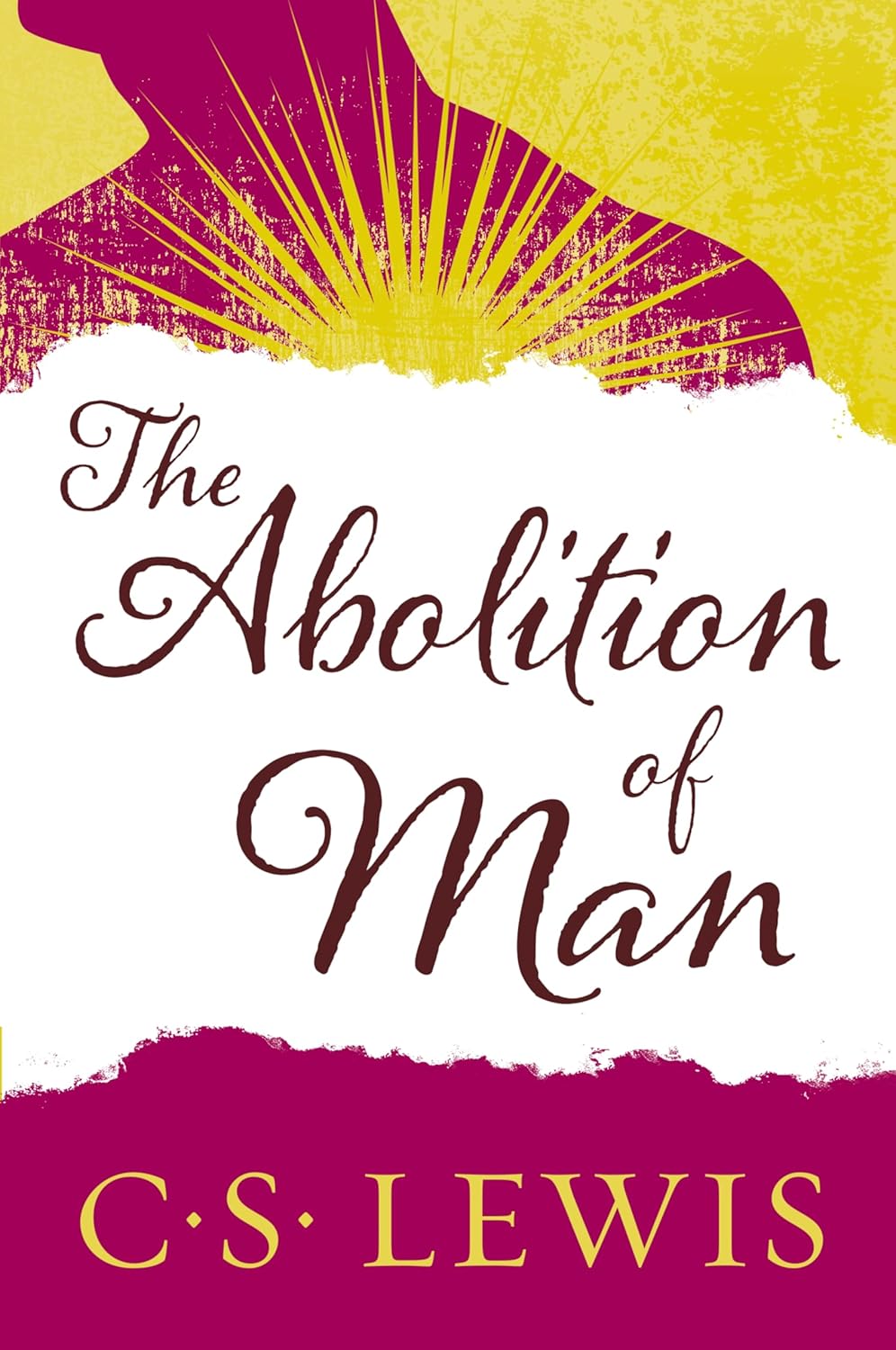
The Abolition of Man
C. S. Lewis


 Apple Books


 13 Min Reading Time
 Audio Version Available
About this book
In The Abolition of Man, C.S. Lewis presents a powerful and unsettling vision of humanity's future. With prophetic insight, Lewis argues that the relentless pursuit of scientific mastery and the erosion of objective values threaten to dismantle the very essence of what it means to be human.
Beginning with a seemingly innocuous critique of a grammar textbook, Lewis unveils a profound philosophical crisis. He contends that by dismissing traditional morality and sentiment as mere subjective feelings, modern education undermines the "Tao," the universal natural law that has guided human civilization for centuries.
Lewis warns that this rejection of objective value leads to the "abolition of man" – not his physical annihilation, but the destruction of his moral compass, his capacity for reason, and his ability to appreciate truth, goodness, and beauty. In a world devoid of inherent value, humanity is reduced to raw material, ripe for manipulation by those who wield the power of science and technology.
A startlingly relevant work for our time, The Abolition of Man challenges readers to confront the consequences of moral relativism and to reclaim the enduring principles that safeguard our humanity. It is a passionate defense of objective truth, a stirring call to moral responsibility, and a timeless warning against the dangers of a world without values.
Summary of Key Ideas
- •
The Enduring Relevance of Objective Morality (The Tao)
The Tao, or objective morality, serves as the foundation for Lewis's arguments. He posits that there exists a universal set of values and moral principles that have been recognized across cultures and throughout history. This Tao is not merely a human construct but reflects a deeper reality about the nature of good and evil. Lewis emphasizes that true progress and human flourishing depend on adhering to these objective values, rather than attempting to redefine or discard them based on subjective preferences or utilitarian considerations. The rejection of the Tao, he argues, leads to the erosion of morality and ultimately to the dehumanization of society.
- •
The Dangers of Subjectivism in Education
Lewis critiques a trend in modern education, exemplified by the textbook authors 'Gaius and Titius,' who undermine traditional values by reducing them to mere subjective feelings. He argues that by dissecting noble sentiments and portraying them as nothing more than emotional responses, these educators strip away the very basis for moral judgment and cultivate a generation incapable of appreciating or upholding virtue. This 'debunking' approach, Lewis warns, has far-reaching consequences, as it erodes the foundation of society's shared values and leaves individuals vulnerable to manipulation and moral relativism. Education, according to Lewis, should aim to cultivate proper sentiments and instill a love for the good, the true, and the beautiful, rather than merely dissecting and deconstructing them.
- •
The Rise of the Conditioners and the Abolition of Man
Lewis argues that the rejection of objective values, particularly through a flawed educational system, leads to the rise of the 'Conditioners'—a group of individuals who, having abandoned the Tao, seek to manipulate and control society based on their own subjective whims and desires. These Conditioners, often driven by a desire for power or a misguided sense of progress, impose their own values on others, effectively shaping society in their image. This process, Lewis warns, results in the abolition of man, as individuals are reduced to mere objects of manipulation, stripped of their inherent dignity and moral agency. True freedom and autonomy, Lewis insists, can only be found in adherence to the Tao, which provides a framework for moral reasoning and responsible action.
- •
The Perils of Unfettered Technological Advancement
Lewis challenges the notion that humanity's conquest of nature is inherently good. He argues that while scientific advancements can bring benefits, they also carry the risk of dehumanization if not guided by a strong moral compass. The pursuit of power over nature, without a corresponding commitment to objective values, can lead to the exploitation and manipulation of both the natural world and human beings themselves. Lewis emphasizes that true progress requires not only technological innovation but also moral and spiritual development, ensuring that our power over nature is used for the common good and in accordance with the principles of the Tao.
- •
The Harmony of Reason, Emotion, and Morality
Lewis explores the interconnectedness of reason, emotion, and morality. He argues that genuine moral judgment requires the cultivation of proper sentiments, which are informed by reason and grounded in objective values. By dismissing emotions as irrational or irrelevant, modern society risks losing its capacity for moral discernment. Lewis advocates for an integrated approach that recognizes the importance of both reason and emotion in shaping our moral character and guiding our actions. This integrated approach allows us to cultivate a love for the good and a hatred for the evil, which are essential for living a virtuous and fulfilling life.
- •
The Importance of Traditional Values
Lewis argues for the preservation of traditional values as a safeguard against moral relativism and social decay. He contends that these values, which have been passed down through generations and are rooted in the Tao, represent a storehouse of wisdom and experience that should not be lightly discarded. While acknowledging the need for adaptation and change, Lewis emphasizes the importance of maintaining a connection to our moral heritage, ensuring that progress is guided by enduring principles of justice, compassion, and respect for human dignity. Abandoning traditional values, he warns, leaves society adrift in a sea of subjectivity, vulnerable to the whims of power and the erosion of moral standards.
Chapter Recap

About The Author
C. S. Lewis
Main Quotes
"The right defence against false sentiments is to inculcate just sentiments."
"The task of the modern educator is not to cut down jungles but to irrigate deserts."
"The heart never takes the place of the head: but it can, and should, obey it."
"For every one pupil who needs to be guarded from a weak excess of sensibility there are three who need to be awakened from the slumber of cold vulgarity."
"The rebellion of new ideologies against the Tao is a rebellion of the branches against the tree: if the rebels could succeed they would find that they had destroyed themselves."
"We make men without chests and expect of them virtue and enterprise. We laugh at honour and are shocked to find traitors in our midst."
"Only those who are masters of the Tao can be completely spontaneous; and not till then."
"For the power of Man to make himself what he pleases means, as we have seen, the power of some men to make other men what they please."
"The process which, if not checked, will abolish Man, goes on apace among Communists and Democrats no less than among Fascists."
"My own idea is that the clean break, the emancipation from tradition, the opening up of entirely new avenues of thought and action, have all been very much exaggerated."
Who Should Read This Book
Readers interested in philosophy and ethics
Academics and students in the humanities
Conservative and Christian intellectuals
Individuals concerned with the decline of objective morality
Educators and those interested in educational philosophy
Readers of C.S. Lewis's other works, particularly those interested in his non-fiction
Individuals interested in social commentary and cultural criticism
Those interested in the intersection of faith and reason
Readers concerned about the impact of scientism and subjectivism on society
People involved in debates about moral relativism
Book Summaries Like
The Abolition of Man

FAQ

Free Access to LitNotes