




 DISCORD
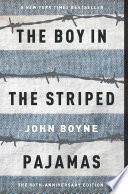
The Boy in the Striped Pajamas
John Boyne

 Barnes & Noble Bestsellers


 57 Min Reading Time
 Audio Version Available
About this book
Nine-year-old Bruno knows nothing of the Final Solution. When his family abruptly moves from Berlin to a desolate new house, he's left with nothing to do and no one to play with. Behind a tall, barbed-wire fence, Bruno sees people in strange striped pajamas, but he doesn't understand who they are or why they're there. Then he meets Shmuel, a boy who lives on the other side of the fence, and an unlikely friendship blossoms. As Bruno and Shmuel grow closer, Bruno begins to glimpse the terrible reality beyond the fence, a reality that will lead to devastating consequences. "The Boy in the Striped Pajamas" is a heartbreaking story about innocence, friendship, and the horrors of war, seen through the eyes of a child.
Summary of Key Ideas
- •
The Perils of Innocence and Ignorance
The novel explores the dangerous consequences of innocence and ignorance, particularly in the face of profound evil. Bruno's childlike naivete prevents him from understanding the true nature of Auschwitz and the atrocities committed there. His inability to grasp the reality of the concentration camp leads him to form a friendship with Shmuel, a Jewish boy imprisoned there, and ultimately contributes to his tragic demise. This theme highlights how a lack of awareness and understanding can have devastating repercussions, both for individuals and society as a whole. Boyne uses Bruno's perspective to critique the willful blindness that allowed the Holocaust to occur.
- •
The Power and Limits of Friendship
Friendship is portrayed as a powerful force that transcends boundaries and adversity. Despite their vastly different circumstances, Bruno and Shmuel forge a deep connection based on shared loneliness and a longing for companionship. Their friendship offers a glimmer of hope amidst the darkness of Auschwitz, demonstrating the human capacity for empathy and connection even in the most inhumane conditions. However, the novel also reveals the limitations of their friendship, as Bruno's privileged position and naivete prevent him from fully understanding Shmuel's suffering and the true nature of his plight. This highlights the complexities of friendship in the context of extreme inequality and injustice.
- •
The Dangers of Blind Obedience
The novel critiques the dangers of blind obedience and conformity to authority, particularly within the context of Nazi Germany. Bruno's father, a high-ranking SS officer, embodies this theme, as he unquestioningly follows orders and participates in the atrocities of the Holocaust. The novel suggests that such obedience, without critical thought or moral consideration, can lead to unspeakable acts of cruelty and inhumanity. Furthermore, the other characters in the novel, such as Bruno's mother and sister, also demonstrate varying degrees of conformity to the prevailing ideology, highlighting the pervasive influence of Nazi propaganda and the pressure to conform in a totalitarian society.
- •
The Devastating Impact of War and Prejudice
Boyne's narrative underscores the devastating impact of war and prejudice, particularly on innocent children. Bruno and Shmuel become victims of the Holocaust due to their respective identities and circumstances. The novel exposes the senselessness and brutality of war, highlighting how it disrupts and destroys the lives of individuals and families. Moreover, it reveals the insidious nature of prejudice, which dehumanizes individuals and justifies their persecution. By focusing on the experiences of children, Boyne amplifies the tragedy of the Holocaust and emphasizes the importance of empathy and understanding in preventing future atrocities.
- •
Responsibility and Complicity
The story explores the theme of responsibility and complicity in the face of evil. While Bruno's father is directly responsible for the atrocities committed at Auschwitz, the novel also raises questions about the complicity of others, including Bruno's mother and the other members of the household. Their silence and inaction in the face of injustice suggest that even those who are not directly involved in perpetrating evil can be complicit through their indifference or unwillingness to challenge the status quo. This theme encourages readers to reflect on their own responsibilities in confronting injustice and standing up for what is right.
- •
Inequality and Social Injustice
The stark contrast between Bruno's comfortable life and Shmuel's suffering in Auschwitz highlights the theme of inequality and social injustice. Bruno lives in a spacious house with servants and enjoys a privileged existence, while Shmuel is confined to a concentration camp where he experiences hunger, deprivation, and abuse. This disparity underscores the inherent unfairness of the Nazi regime and the profound inequalities that existed within society. The novel challenges readers to consider the ethical implications of such inequalities and to work towards a more just and equitable world.
Chapter Recap

About The Author
John Boyne
Main Quotes
""We're not supposed to be friends, you and me. We're meant to be enemies.""
"“You’re my best friend, Shmuel,” he said. “My best friend for life.”"
""It's a very important job," said Mother, hesitating for a moment. "A job that needs a very special man to do it. You can understand that, can't you?""
"“What exactly was the difference? He wondered to himself. And who decided which people wore the striped pyjamas and which people wore the uniforms?”"
"“Bruno found that he was still holding Shmuel's hand in his own and nothing in the world would have persuaded him to let go.”"
"“Sitting around miserable all day won't make you any happier.”"
"“We must all just keep ourselves safe until this is all over. That's what I intend to do anyway. What more can we do than that after all? It's not up to us to…”"
"“If I were you,” said Bruno, “I wouldn't be so sure that I had all the answers.”"
"“He was an explorer, not like those people you read about in books, but a proper one.”"
"“But you’re not German,” said Bruno. Shmuel frowned. “Yes, I am,” he said. “Well, you don’t sound like a German,” said Bruno."
Who Should Read This Book
Young adults (grades 9-12)
Readers interested in historical fiction, particularly about the Holocaust
Individuals seeking thought-provoking stories about innocence, perspective, and the impact of prejudice
Educators looking for literature to teach about World War II and the Holocaust
Parents seeking books to discuss difficult topics with their children
Readers who appreciate simple yet powerful narratives
Those interested in books adapted into films
Book Summaries Like
The Boy in the Striped Pajamas

FAQ

Free Access to LitNotes