




 DISCORD
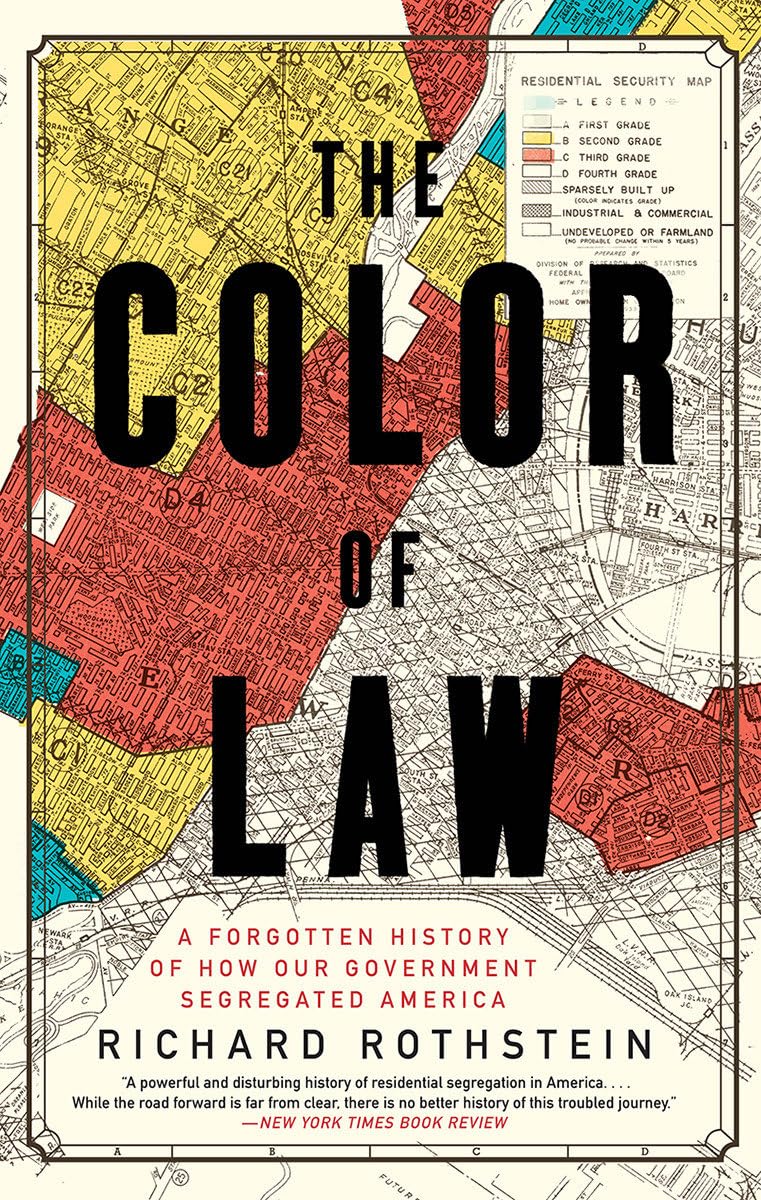
The Color of Law: A Forgotten History of How Our Government Segregated America
Richard Rothstein


 The New York Times Best Sellers


 52 Min Reading Time
 Audio Version Available
About this book
In The Color of Law, Richard Rothstein dismantles the myth of de facto segregation, revealing the explicit government policies that shaped America's racial landscape. Through meticulous research, Rothstein exposes how federal, state, and local laws deliberately created segregated communities, from racial zoning and discriminatory public housing to subsidies for whites-only suburbs and active suppression of Black families integrating white neighborhoods. This "powerful and disturbing history" ( New York Times Book Review) uncovers the hidden origins of racial inequality, forcing a reckoning with our nation's unconstitutional past and challenging us to confront its enduring consequences.
Summary of Key Ideas
- •
Segregation as a Product of Law
De Jure vs. De Facto Segregation: Rothstein challenges the conventional understanding of segregation as a de facto phenomenon resulting from private prejudice and market forces. He argues that segregation in America was primarily de jure, meaning it was enforced by law and government policy. This distinction is crucial because de jure segregation implies a constitutional obligation to remedy the effects of past discriminatory policies, whereas de facto segregation is often seen as outside the purview of legal intervention.
- •
The FHA's Role in Redlining
Federal Housing Administration (FHA) Policies: The FHA played a significant role in promoting segregation by refusing to insure mortgages in racially mixed neighborhoods. This policy, known as redlining, effectively prevented African Americans from purchasing homes in white neighborhoods and contributed to the creation of segregated communities. The FHA's policies also subsidized suburban development, which was largely restricted to white families, further exacerbating racial disparities in housing.
- •
Public Housing as a Tool of Segregation
Public Housing and Segregation: Government-sponsored public housing projects were often deliberately located in segregated areas, reinforcing existing patterns of racial separation. These projects were frequently built in predominantly African American neighborhoods, further concentrating poverty and limiting opportunities for residents. The placement of public housing was a deliberate policy choice that contributed to the entrenchment of segregation.
- •
Zoning Laws and Racial Exclusion
Zoning Laws and Exclusionary Practices: Local zoning ordinances were used to exclude African Americans from white neighborhoods. These laws often restricted the construction of multi-family housing or imposed minimum lot size requirements, making it difficult for lower-income families, disproportionately African American, to afford housing in certain areas. These exclusionary zoning practices effectively maintained racial boundaries and limited housing options for minorities.
- •
The Impact of Racial Steering
Racial Steering by Real Estate Agents: Real estate agents actively participated in maintaining segregation by steering white buyers away from integrated or predominantly African American neighborhoods and directing African American buyers towards specific areas. This practice, though illegal, was widespread and contributed to the perpetuation of residential segregation. Steering reinforced the perception of certain neighborhoods as being designated for specific racial groups.
- •
Challenging the Myth of Natural Segregation
The Myth of 'Natural' Segregation: Rothstein dismantles the notion that segregation occurred naturally due to personal preferences or economic factors. He demonstrates that government policies actively shaped residential patterns, overriding individual choices and market dynamics. By exposing the deliberate nature of segregation, Rothstein challenges the narrative that it was an unintended consequence of benign policies.
- •
Highways and Community Displacement
Interstate Highway System and Displacement: The construction of the interstate highway system often resulted in the displacement of African American communities. Highways were frequently routed through established black neighborhoods, dividing communities and displacing residents. This infrastructure development further contributed to the destruction of black wealth and the reinforcement of segregation.
- •
Education and the Perpetuation of Segregation
Tax Policies and School Funding: Unequal funding for public schools, tied to local property taxes, perpetuated segregation in education. Because housing segregation concentrated wealth in white areas and poverty in Black areas, schools in predominantly white districts received significantly more funding than those in predominantly Black districts, creating unequal educational opportunities and reinforcing the cycle of segregation.
- •
The Enduring Legacy of Segregation
Ongoing Effects and the Wealth Gap: The cumulative effect of these policies has created a significant wealth gap between white and Black families. Because homeownership is a primary means of wealth accumulation, the denial of housing opportunities to African Americans has had lasting economic consequences, contributing to disparities in income, education, and overall well-being. The legacy of segregation continues to shape American society today.
Chapter Recap

About The Author
Richard Rothstein
American Historian and education columnist.
Main Quotes
"In every American city, certain neighborhoods are all (or nearly all) African American and others are all (or nearly all) white, not because of “individual choices” or “private prejudices” but because of racially explicit government policies."
"We have created a caste system in this country, with African Americans kept exploited and geographically separate by racially explicit government policies."
"Few of us may be the direct descendants of those who perpetuated a segregated system or those who were its most exploited victims . African Americans cannot await rectification of past wrongs as a gift, and white Americans collectively do not owe it to African Americans to rectify them."
"If you try to force the mingling of people who are not yet ready to mingle, and don't want to mingle, development cannot succeed economically."
"The Color of Law is not a tale of Red versus Blue states. It is sadly the story of America in all of its municipalities, large and small, liberal and ..."
"We came to understand that racial segregation was wrong, that it was immoral, that it was harmful both to blacks and to whites, that it was ..."
"If federal programs were not, even to this day, reinforcing racial isolation by disproportionately directing low-income African Americans ..."
"Government-sponsored segregation: A deliberate policy"
"Public Housing as a Tool for Segregation"
"Racial Zoning: Legally Sanctioned"
Who Should Read This Book
Readers interested in American history, particularly the history of housing policy and racial segregation
Individuals involved in urban planning, public policy, and community development
Students and academics in fields such as sociology, political science, African American studies, and law
Social justice advocates and activists working to address systemic racism and inequality
Readers seeking to understand the historical roots of contemporary social problems
Those interested in learning about the role of government in shaping social outcomes
Individuals concerned with issues of housing affordability and access
Readers of non-fiction books that explore complex social issues with historical evidence
Book Summaries Like
The Color of Law: A Forgotten History of How Our Government Segregated America



FAQ

Free Access to LitNotes