




 DISCORD
The Communist Manifesto
Karl Marx


 Apple Books


 15 Min Reading Time
 Audio Version Available
About this book
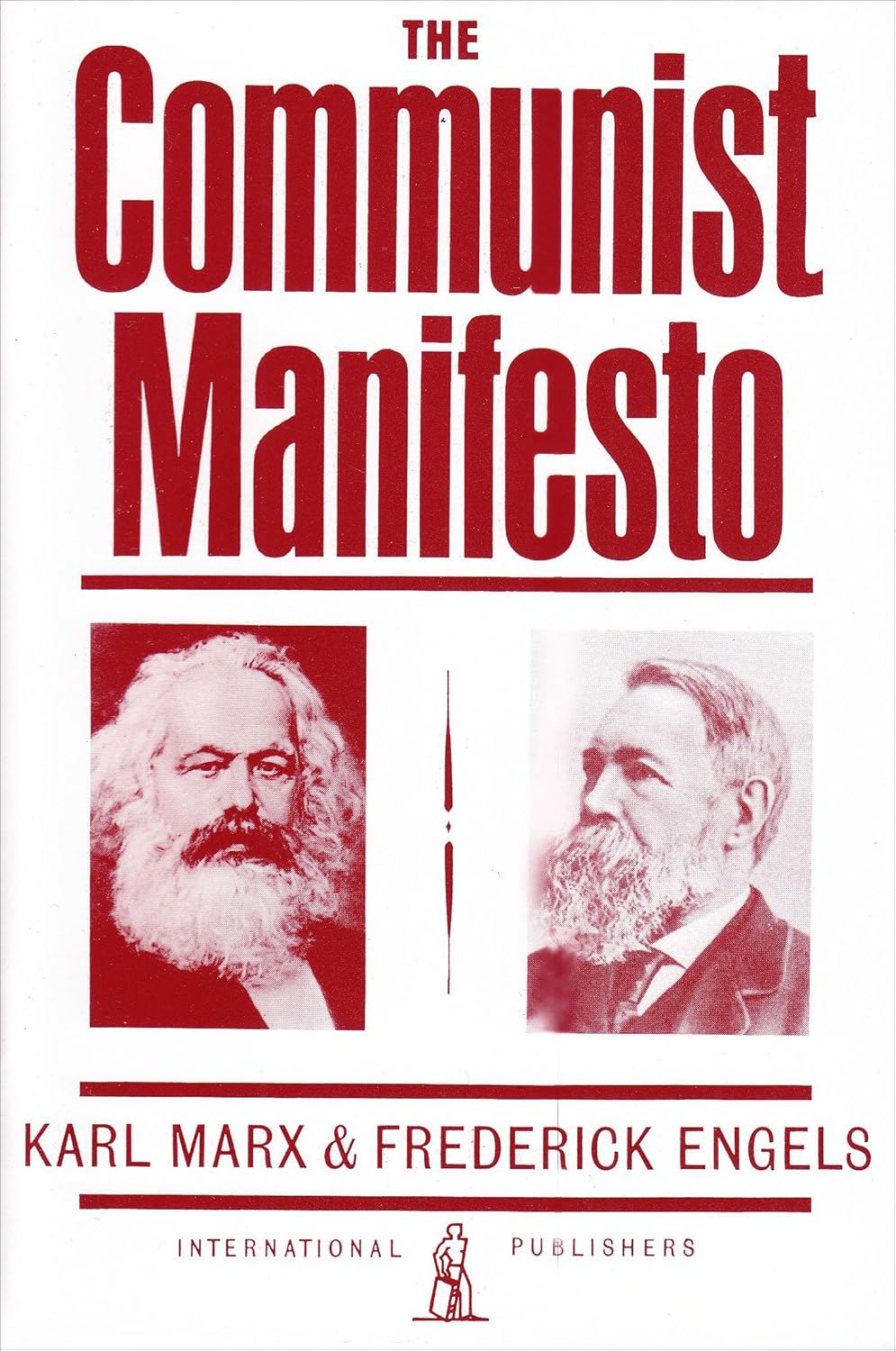
In The Communist Manifesto, Karl Marx and Friedrich Engels ignite a revolutionary call to arms. This landmark 1848 publication dissects the brutal realities of capitalism and envisions a radical alternative: a society free from class divisions, private property, and oppressive state control. With incisive prose, Marx and Engels expose the inherent contradictions of a system that enriches a few while exploiting the many, foretelling its inevitable overthrow by the working class. More than a historical document, The Communist Manifesto remains a potent and controversial analysis of power, class struggle, and the enduring quest for a more equitable world.
Summary of Key Ideas
- •
The Engine of History: Class Struggle
Historical Materialism: This is the foundational concept that history is driven by class struggles arising from the evolving modes of production and economic structures. Marx argued that societal development progresses through distinct stages (e.g., feudalism, capitalism), each characterized by specific class relations and inherent contradictions. This perspective views economic systems as the base upon which legal, political, and ideological superstructures are built, shaping social consciousness and institutions. Understanding historical materialism is crucial for grasping Marx's analysis of capitalism and its inevitable overthrow by the proletariat.
- •
The Dichotomy of Capital
Bourgeoisie vs. Proletariat: The Manifesto identifies two primary classes in capitalist society: the bourgeoisie (the owners of capital and the means of production) and the proletariat (the working class who must sell their labor for wages). Marx argues that these classes are inherently antagonistic due to their conflicting economic interests. The bourgeoisie seeks to maximize profit by exploiting the proletariat, while the proletariat seeks to improve their working conditions and wages. This fundamental conflict drives the historical process towards revolution.
- •
The Source of Profit: Exploitation
Exploitation of Labor: Marx contends that capitalism is inherently exploitative because the value produced by workers exceeds the wages they receive. This 'surplus value' is appropriated by the bourgeoisie as profit, leading to the alienation of workers from their labor, the products they create, and each other. This exploitation is not merely an ethical issue but a structural feature of capitalism that generates inequality and social unrest. Recognizing this exploitation is key to understanding the proletariat's revolutionary potential.
- •
Capitalism's Demise: Revolution Inevitable
The Inevitable Revolution: The Manifesto predicts that capitalism, due to its internal contradictions (such as overproduction, economic crises, and the increasing concentration of wealth), will inevitably be overthrown by the proletariat. As capitalism develops, it creates its own 'gravediggers' in the form of a growing and increasingly organized working class. The revolution is not presented as a matter of chance but as a historical necessity arising from the logic of capitalist development.
- •
The End of Ownership: Abolition of Private Property
Abolition of Private Property: Central to the Communist vision is the abolition of private property, specifically the private ownership of the means of production (land, factories, etc.). This does not refer to personal possessions but to the capital used to exploit labor. By socializing the means of production, the Communists aim to eliminate the basis of class exploitation and create a more equitable society where the fruits of labor are distributed according to need, not ownership.
- •
Workers in Charge: Proletarian Rule
The Dictatorship of the Proletariat: As a transitional phase after the revolution, Marx envisions a 'dictatorship of the proletariat,' where the working class seizes political power and uses the state to suppress the resistance of the bourgeoisie and to reorganize society along socialist lines. This is not a dictatorship in the conventional sense but rather the rule of the working class, representing the interests of the vast majority against the former ruling class. This phase is considered necessary to consolidate the gains of the revolution and prevent counter-revolution.
- •
Awakening the Workers: Class Consciousness
Class Consciousness: The Manifesto emphasizes the importance of the proletariat developing class consciousness – an awareness of their shared interests and their common exploitation by the bourgeoisie. This consciousness is not spontaneous but develops through collective action and political organization. The Communist Party plays a crucial role in fostering class consciousness and uniting the proletariat across national boundaries to fight for their common goals.
- •
Global Unity: Workers of the World, Unite!
Internationalism: Marx and Engels call for the 'Workers of all countries, Unite!' recognizing that capitalism is a global system and that the struggle against it requires international solidarity. They argue that the proletariat has no nation and that their interests transcend national boundaries. Internationalism is essential for preventing the bourgeoisie from dividing workers along national lines and for coordinating the global revolutionary movement.
Chapter Recap

About The Author
Karl Marx
Main Quotes
"A spectre is haunting Europe—the spectre of communism."
"The history of all hitherto existing society is the history of class struggles."
"The bourgeoisie cannot exist without constantly revolutionising the instruments of production, and thereby the relations of production, and with them the whole relations of society."
"All that is solid melts into air, all that is holy is profaned, and man is at last compelled to face with sober senses his real conditions of life, and his relations with his kind."
"The proletarians have nothing to lose but their chains. They have a world to win."
"Working men of all countries, unite!"
"Let the ruling classes tremble at a communist revolution. The proletarians have nothing to lose but their chains. They have a world to win."
"In place of the old bourgeois society, with its classes and class antagonisms, there shall be an association, in which the free development of each is the condition for the free development of all."
"The executive of the modern state is but a committee for managing the common affairs of the whole bourgeoisie."
"The Communists disdain to conceal their views and aims. They openly declare that their ends can be attained only by the forcible overthrow of all existing social conditions."
Who Should Read This Book
Urban workers and the proletariat
Socialists and communists
Political activists and revolutionaries
Students of political science and economics
Academics and intellectuals interested in Marxism
Individuals interested in understanding the history of socialist thought
Those critical of capitalism and seeking alternative economic systems
Readers interested in social justice and equality
Historians studying 19th-century European history
General readers interested in influential political documents
Book Summaries Like
The Communist Manifesto

FAQ

Free Access to LitNotes