




 DISCORD
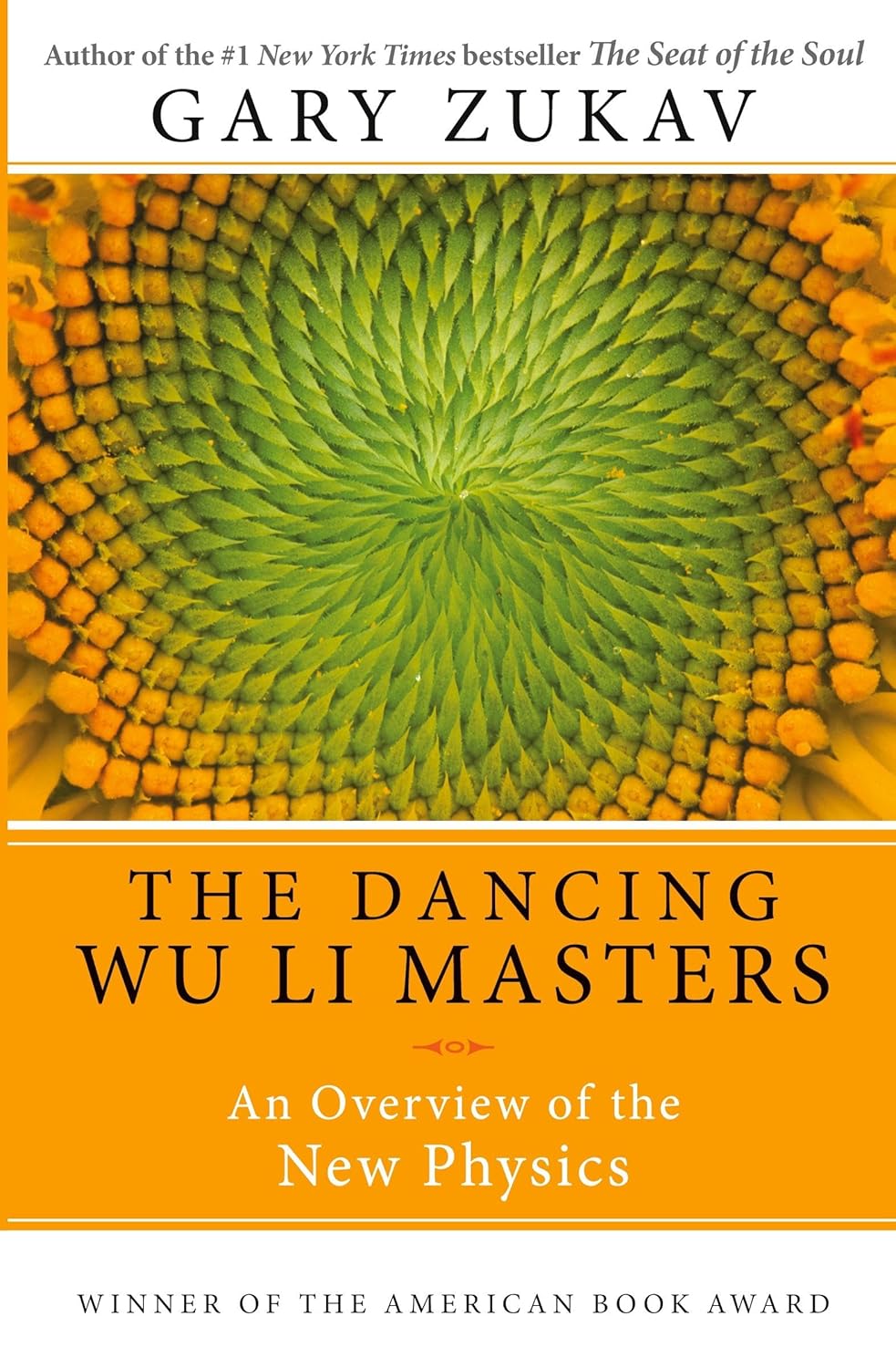
The Dancing Wu Li Masters
Gary Zukav


 Apple Books


 50 Min Reading Time
 Audio Version Available
About this book
Journey into the heart of quantum physics with Gary Zukav's The Dancing Wu Li Masters, a mind-bending exploration of the universe that bridges the gap between science and spirituality. This isn't just a physics book; it's an intellectual adventure, demystifying complex concepts like wave-particle duality, quantum entanglement, and the uncertainty principle for the layperson.
Zukav uses humor and clear prose to reveal the profound connections between modern physics and Eastern philosophies, challenging our fundamental assumptions about reality. Discover how the Wu Li Masters (physicists) dance with the subatomic world, uncovering a reality far stranger and more wondrous than we ever imagined. Prepare to have your perceptions shattered and your understanding of the cosmos transformed in this accessible, engaging, and enduring classic that earned the American Book Award for Science.
Summary of Key Ideas
- •
Physics as 'Wu Li': A playful approach
Wu Li as a Metaphor: The book introduces 'Wu Li' as a playful metaphor for physics, highlighting its paradoxical and often nonsensical nature from a common-sense perspective. Zukav uses this term to encourage readers to approach physics with openness and curiosity, shedding preconceived notions. Wu Li, meaning 'patterns of organic energy' and also 'nonsense,' invites a sense of wonder and playfulness into the exploration of complex scientific concepts, making them more accessible to a general audience. It sets the tone for a journey that blends scientific inquiry with philosophical exploration.
- •
The Observer's Role in Shaping Reality
The Observer Effect: A cornerstone of quantum mechanics, the observer effect emphasizes that the act of observing a quantum system inevitably alters it. Zukav explains how, unlike classical physics where observation is considered neutral, quantum physics reveals an interconnectedness between the observer and the observed. This challenges the traditional scientific notion of objective reality, suggesting that reality is, to some extent, shaped by our interaction with it. This concept blurs the line between subject and object, leading to profound philosophical implications about the nature of reality and consciousness.
- •
Beyond Classical Physics: Wave-Particle Duality
Wave-Particle Duality: This key idea delves into the perplexing nature of quantum entities, which can exhibit properties of both waves and particles. Zukav elucidates how this duality challenges classical physics' rigid categories. Light, for example, can behave as a wave when propagating, demonstrating interference and diffraction, yet it acts as a particle (photon) when interacting with matter, as seen in the photoelectric effect. This duality underscores the limitations of classical descriptions in the quantum realm and points to a deeper, more unified reality beyond our everyday experience.
- •
Entanglement: A Universe of Interconnectedness
Quantum Interconnectedness: Quantum entanglement, a phenomenon where two or more particles become linked in such a way that they share the same fate, no matter how far apart they are, is explored. Zukav highlights how this challenges our classical understanding of space and time. When one entangled particle's state is measured, the state of the other is instantly determined, even if they are light-years away. This 'spooky action at a distance,' as Einstein called it, suggests a fundamental interconnectedness in the universe that transcends spatial separation.
- •
Challenging Locality: Bell's Theorem
Bell’s Theorem and Non-Locality: Zukav discusses Bell’s Theorem, a crucial theoretical result that demonstrated the incompatibility of quantum mechanics with local realism. Local realism posits that objects have definite properties independent of observation and that influences cannot travel faster than light. Bell's Theorem, confirmed by experiments, shows that quantum mechanics violates local realism, implying that either objects do not have definite properties prior to measurement or that influences can indeed travel faster than light (non-locality). This concept deepens the understanding of quantum interconnectedness and challenges classical intuitions about causality and locality.
- •
Beyond Words: The Limits of Language in Quantum Physics
The Limitations of Language: Throughout the book, Zukav emphasizes how human language, rooted in classical and deterministic thinking, struggles to adequately describe the quantum realm. He argues that our language imposes a framework that forces us to conceptualize quantum phenomena in terms of familiar, macroscopic concepts, leading to paradoxes and misunderstandings. This limitation calls for a new way of thinking and communicating about the quantum world, one that transcends the constraints of everyday language and embraces ambiguity and uncertainty.
- •
Science Meets Spirituality: Echoes of Eastern Thought
Eastern Mysticism and Quantum Physics: Zukav draws parallels between the concepts of quantum physics and Eastern mystical traditions, such as Buddhism and Taoism. He suggests that ideas like interconnectedness, the illusion of separateness, and the role of consciousness in shaping reality, which are central to quantum mechanics, resonate with the core tenets of Eastern spiritual philosophies. This comparison aims to bridge the gap between science and spirituality, suggesting that both offer complementary perspectives on the nature of reality and human existence.
- •
The Whole is Greater: Moving Beyond Reductionism
Beyond Reductionism: The book critiques the reductionist approach of classical science, which seeks to understand complex systems by breaking them down into their smallest parts. Zukav argues that quantum physics reveals the limitations of this approach, as the properties of individual particles are often dependent on their relationship to the whole system. This holistic perspective emphasizes the importance of context and interconnectedness, suggesting that a more complete understanding of reality requires considering the relationships and interactions between its constituent parts.
Chapter Recap

About The Author
Gary Zukav
Main Quotes
"Classical physics had its day. Now it is dead."
"The new physics has found that there is no absolute knowledge."
"The observer cannot observe without altering what he sees."
"Reality is what we take to be true. What we take to be true is what we believe."
"“Wu Li” is Chinese for physics. It means “patterns of organic energy,” “my way,” “nonsense,” “I clutch my ideas,” and “enlightenment.”"
"The new physics relies heavily upon mathematics, but mathematics is not physics. Mathematics is a tool of physics."
"Everything that we think of as empty space is not really empty, but it is the seat of the most violent physics."
"Physics is a branch of human knowledge dealing with experimental observations."
"According to quantum mechanics, there is no such thing as objectivity. We cannot eliminate ourselves from the picture."
"The problem is that the mind is not designed to grasp reality."
Who Should Read This Book
Readers interested in popular science, particularly quantum physics, with little to no prior scientific background.
Individuals exploring the connections between physics and Eastern philosophy/spirituality.
Readers who enjoy accessible and engaging explanations of complex scientific concepts.
Those interested in the history and development of quantum physics.
Individuals seeking mind-expanding and paradigm-shifting perspectives.
Readers of other popular science books like "Zen and the Art of Motorcycle Maintenance."
Book Summaries Like
The Dancing Wu Li Masters



FAQ

Free Access to LitNotes