




 DISCORD
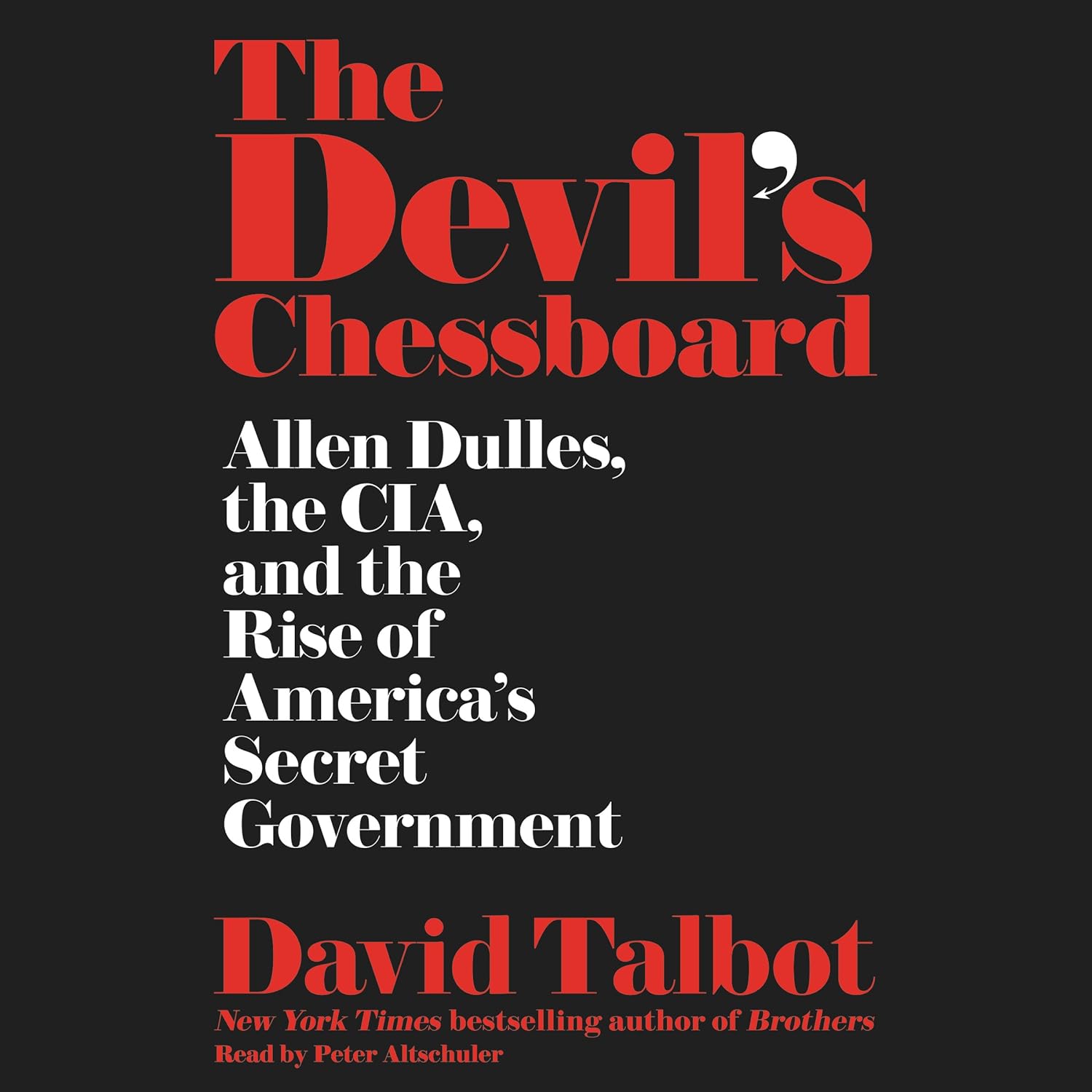
The Devil's Chessboard
David Talbot


 Apple Books


 122 Min Reading Time
 Audio Version Available
About this book
Delve into the hidden history of American power with David Talbot's "The Devil's Chessboard," a chilling exposé of Allen Dulles, the CIA, and the rise of America's secret government. From his covert manipulations during World War II to his shaping of Cold War policies, Dulles relentlessly pursued his own agenda, often at odds with presidents and the Constitution.
Talbot uncovers the dark side of Dulles's ambition, revealing his involvement in the overthrow of foreign governments, the support of dictators, and the suppression of dissent. Witness how Dulles transformed the CIA into a powerful, unaccountable force, one that would ultimately play a role in the tragic death of President John F. Kennedy, who sought to rein in the agency's excesses.
"The Devil's Chessboard" is a disturbing and timely account of unchecked power, corporate greed, and the enduring consequences of a secret government operating in the shadows. It's a must-read for anyone seeking to understand the hidden forces that have shaped our world.
Summary of Key Ideas
- •
The Architect of the Modern CIA
Allen Dulles's Central Role: The book argues that Allen Dulles, as the Director of Central Intelligence (DCI), significantly shaped the CIA's development and operations. It explores how his personal beliefs, connections, and ambitions influenced the agency's transformation into a powerful, often unchecked, force within the U.S. government. Talbot emphasizes Dulles's long tenure and his profound impact on American foreign policy during the Cold War era, suggesting that understanding Dulles is crucial to understanding the CIA's trajectory.
- •
The Dark Side of American Intelligence
Ethical Lapses and Moral Ambiguity: Talbot highlights the ethical compromises and morally questionable actions undertaken by Dulles and the CIA under his leadership. This includes involvement in covert operations, assassinations, and the overthrow of democratically elected governments. The book suggests that Dulles prioritized American interests, as he defined them, above international law and ethical considerations, leading to a legacy of controversy and distrust surrounding the CIA.
- •
Forging the National Security State
The Rise of the National Security State: A central theme is the emergence of a powerful national security apparatus within the United States, with the CIA at its core. Talbot contends that Dulles played a key role in building this apparatus, which operated with increasing secrecy and autonomy. The book explores the implications of this development for American democracy, arguing that it led to a concentration of power in the hands of unelected officials and a weakening of transparency and accountability.
- •
Power Through Connections
Dulles's Personal Connections and Influence: The book emphasizes the importance of Dulles's personal relationships and connections within the American elite. Talbot details Dulles's ties to Wall Street, corporate law, and influential political figures, arguing that these connections enabled him to wield significant power and influence. These networks provided Dulles with resources, support, and protection, allowing him to operate with relative impunity.
- •
Bay of Pigs: A Study in Misjudgment
The Bay of Pigs Debacle: The disastrous Bay of Pigs invasion is presented as a key example of Dulles's flawed judgment and the CIA's overreach. Talbot argues that Dulles underestimated the Cuban people's support for Fidel Castro and overestimated the likelihood of a successful invasion. The failure of the Bay of Pigs is portrayed as a turning point, leading to increased scrutiny of the CIA and ultimately contributing to Dulles's dismissal by President Kennedy.
- •
Shadows of Conspiracy: JFK's Assassination
Potential Involvement in the JFK Assassination: The book explores the controversial theory that Dulles may have been involved in the assassination of President John F. Kennedy. While not definitively asserting Dulles's guilt, Talbot presents evidence and raises questions about Dulles's motives and actions in the lead-up to the assassination. He highlights the animosity between Kennedy and Dulles, as well as Dulles's connections to individuals who may have been involved in the assassination plot.
- •
The Culture of Secrecy
Secrecy and Lack of Accountability: Talbot stresses the culture of secrecy that pervaded the CIA under Dulles's leadership. He argues that this secrecy shielded the agency from public scrutiny and accountability, allowing it to operate outside the bounds of the law and ethical norms. The book suggests that this lack of transparency contributed to the CIA's excesses and abuses of power.
- •
Cold War Justifications
The Cold War Context: The book situates Dulles's actions within the context of the Cold War, arguing that the perceived threat of communism justified extreme measures in the eyes of Dulles and his allies. However, Talbot questions whether these measures were truly necessary or whether they ultimately undermined American values and interests. The Cold War is presented as both a cause and a justification for the CIA's excesses.
- •
A Lingering Legacy
Lasting Impact on American Foreign Policy: The book contends that Dulles's legacy continues to shape American foreign policy to this day. Talbot argues that the CIA's interventions in foreign countries, its use of covert operations, and its culture of secrecy have had a lasting impact on America's relationship with the world. He suggests that understanding Dulles's influence is essential for understanding the challenges facing American foreign policy in the 21st century.
Chapter Recap

About The Author
David Talbot
David Talbot, born and raised in Los Angeles, California, is an American journalist, author, activist and independent historian. Talbot is from a media and entertainment family. Talbot attended the Harvard School for Boys but did not graduate after falling afoul of the school's headmaster and ROTC program during the Vietnam War. After graduating from the University of California at Santa Cruz, the only university that would accept him, he returned to Los Angeles, where he co-wrote a history of the Hollywood Left, *Creative Differences*, with Barbara Zheutlin, and freelanced for *Crawdaddy*, *Rolling Stone*, and other magazines. He was later hired by Environmental Action Foundation in Washington, D.C. to write *Power and Light*, a book about the politics of energy. After returning to California, he worked as an editor at *Mother Jones* magazine before *San Francisco Examiner* publisher William Randolph Hearst hired him to edit the newspaper's Sunday magazine, *Image*. It was at the *Examiner* that Talbot developed the idea for *Salon*, a web magazine, and convinced several of his newspaper colleagues to join him. In 1995, Talbot founded *Salon* in San Francisco. The magazine gained a large following and broke several major national stories. Originally created to cover books and popular culture, the website became increasingly politicized during the Clinton impeachment drama in the late 1990s. *Salon* broke from the mainstream press by defending the Clinton presidency and investigating the right-wing prosecutorial apparatus headed by Kenneth Starr and Rep. Henry Hyde, whose own infidelity *Salon* exposed. Talbot stepped down as CEO and editor-in-chief of *Salon* in 2005, and returned briefly as CEO in 2011, but has since left the company. Since leaving *Salon*, Talbot has researched and written on the Kennedy assassination and other areas of what he calls the "hidden history" of U.S. power and the liberal movements to change America, as well as his public advocacy. Source: [Wikipedia](https://en.wikipedia.org/wiki/David_Talbot887\))
Main Quotes
"There is an implacable brutality to power that is familiar throughout the world and throughout history."
"If Dulles could use a person, that person was somehow real for him. If not, that person didn't exist."
"His covert operators needed to be able to lie convincingly, to betray, even to kill."
"Dulles was a true believer in the American Century—and in his own manifest destiny to guide it."
"He saw himself as a warrior in a twilight struggle against the dark forces of history."
"He was a man of immense charm and sophistication, but also of ruthless ambition and unwavering conviction."
"The Cold War was his chessboard, and the world was his to manipulate."
"Secrecy was his religion."
"He was a master of deception, a puppeteer who pulled the strings of governments and revolutions."
"Dulles believed that the ends justified the means, that anything was permissible in the defense of freedom."
Who Should Read This Book
Readers interested in US history, particularly the Cold War era
Individuals fascinated by the CIA and its covert operations
Those interested in biographies and investigative journalism
Readers who enjoy political thrillers and stories about power and corruption
People curious about the Kennedy assassination and conspiracy theories
Readers seeking critical perspectives on American foreign policy
Individuals interested in intelligence agencies and espionage
Book Summaries Like
The Devil's Chessboard
FAQ

Free Access to LitNotes