




 DISCORD
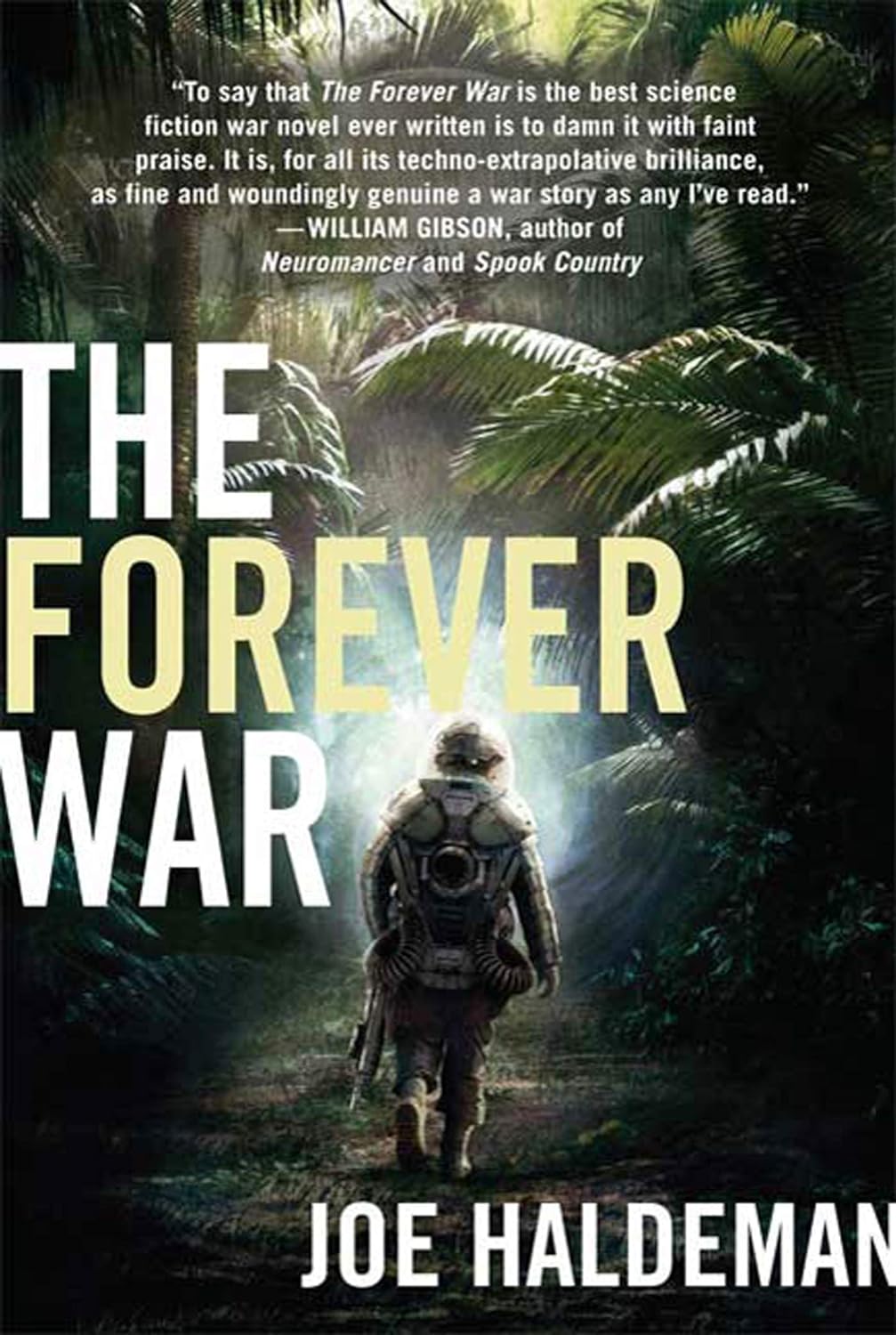
The Forever War
Joe Haldeman


 Apple Books


 102 Min Reading Time
 Audio Version Available
About this book
In a chilling vision of interstellar war, Joe Haldeman's "The Forever War" tells the story of William Mandella, a reluctant soldier drafted into an elite military unit and thrust across vast distances of space and time to fight an enigmatic alien enemy, the Taurans.
As centuries pass on Earth with each relativistic space jump, Mandella and his comrades experience the profound isolation of being adrift in time. Returning home becomes a journey to an unrecognizable world, where society has been reshaped by technological advancements and the ever-present shadow of a war without end.
More than just a science fiction epic, "The Forever War" is a poignant exploration of the human cost of conflict, the alienation of the warrior, and the nature of identity in a universe indifferent to mankind. Through Mandella's eyes, Haldeman masterfully critiques the military industrial complex and offers a timeless reflection on the absurdity and tragedy of war.
Summary of Key Ideas
- •
The Dehumanizing Impact of War and Alienation
The book critiques the dehumanizing aspects of war and its profound psychological impact on soldiers. The protagonist, William Mandella, and his fellow soldiers experience significant alienation as they travel through space and time, returning to an Earth that becomes increasingly foreign and incomprehensible. This theme is explored through Mandella's struggles to reintegrate into society, form meaningful relationships, and reconcile his experiences with the constantly evolving cultural norms of Earth. The story highlights the emotional toll of prolonged conflict, the loss of connection with one's home and peers, and the difficulty of finding purpose and meaning in a world that has moved on without them. This idea underscores the long-lasting effects of war that extend far beyond the battlefield.
- •
The Disorienting Effects of Time Dilation
Time dilation, a consequence of relativistic space travel, is a central theme in "The Forever War." As soldiers travel at near-light speeds, time passes differently for them compared to people on Earth. This creates a significant disconnect, as years or even decades can pass on Earth during relatively short space voyages. This temporal disparity leads to cultural and societal shifts that leave the returning soldiers feeling like strangers in their own world. The theme of time dilation emphasizes the isolation and disorientation experienced by the protagonists, as they struggle to adapt to the ever-changing world and grapple with the loss of their connections to the past.
- •
The Absurdity and Bureaucracy of War
The narrative explores the changing justifications for war and the often arbitrary nature of conflict. As the war drags on for centuries, the reasons for fighting become increasingly vague and bureaucratic. The enemy, the Taurans, remain largely enigmatic, and the motivations for the ongoing conflict are often questioned by the soldiers themselves. This theme underscores the absurdity of war, the tendency for conflicts to perpetuate themselves beyond any clear purpose, and the manipulation of soldiers by distant, often indifferent, authorities. The story critiques the military-industrial complex and the ease with which societies can become entrenched in perpetual warfare.
- •
Societal Evolution and Adaptation
"The Forever War" delves into the theme of societal evolution and adaptation. As centuries pass, humanity undergoes significant transformations, including genetic engineering, cloning, and shifts in social structures. These changes alter the nature of human relationships, family dynamics, and cultural values. The soldiers, returning from their time-dilated missions, find themselves in a world that is vastly different from the one they left behind. This theme highlights the rapid pace of technological and social change, the challenges of adapting to new norms, and the potential for humanity to evolve in unexpected ways, both for better and for worse.
- •
Critique of the Military-Industrial Complex
The book offers a critical commentary on the military-industrial complex and its role in perpetuating conflicts. The war becomes a self-sustaining enterprise, driven by economic and political interests rather than genuine security concerns. The soldiers are often treated as expendable resources, their lives sacrificed for the sake of maintaining the war machine. This theme exposes the dark side of institutionalized warfare, the potential for corruption and exploitation, and the dehumanizing impact on those who serve in the military. The story challenges readers to question the motives behind war and the interests that benefit from it.
- •
Love, Loss, and the Search for Connection
Throughout the narrative, the story explores themes of love, loss, and the search for connection in a world torn apart by war. The protagonist, William Mandella, forms deep bonds with his fellow soldiers, particularly his lifelong partner, Marygay Potter. However, the effects of time dilation and the constant threat of death make it difficult to maintain stable relationships. The characters grapple with the pain of separation, the loss of loved ones, and the challenge of finding meaning and purpose in a world defined by violence and uncertainty. This theme highlights the importance of human connection in the face of adversity and the enduring power of love and friendship.
Chapter Recap

About The Author
Joe Haldeman
Main Quotes
"The most important fact about the war, to most people, was that if it ended suddenly, Earth's economy would collapse."
"It was so long ago that the war seemed as unimportant as the grumbling of a mosquito; দূর"
"You know how it feels to be in a war? Like watching yourself from a distance."
"Time dilation, the enemy you can never escape."
"I never found anybody else and I don't want anybody else. I don't care whether you're ninety years old or thirty. If I can't be your lover, I'll be your nurse."
"I am glad you're taking good care of yourselves, because each of you represents an investment of over a million dollars and one-fourth of a human life."
"Maybe war is an inevitable product of human nature. Maybe to get rid of war, we have to become something other than human."
"At the end peace comes because the majority of humanity has melded into a collective mind."
"I suspect that war will become obsolete only when something worse supercedes it."
"We were experimental material."
Who Should Read This Book
Science fiction readers, particularly those interested in military science fiction
Readers interested in war commentary and anti-war themes
Fans of classic science fiction literature
Readers who enjoy thought-provoking explorations of time dilation, cultural change, and the human condition
Vietnam War veterans and those interested in the Vietnam War era
Readers interested in social commentary through science fiction
Readers of authors like Robert Heinlein and John Scalzi
Readers who appreciate science fiction with philosophical and political themes
Book Summaries Like
The Forever War

FAQ

Free Access to LitNotes