




 DISCORD
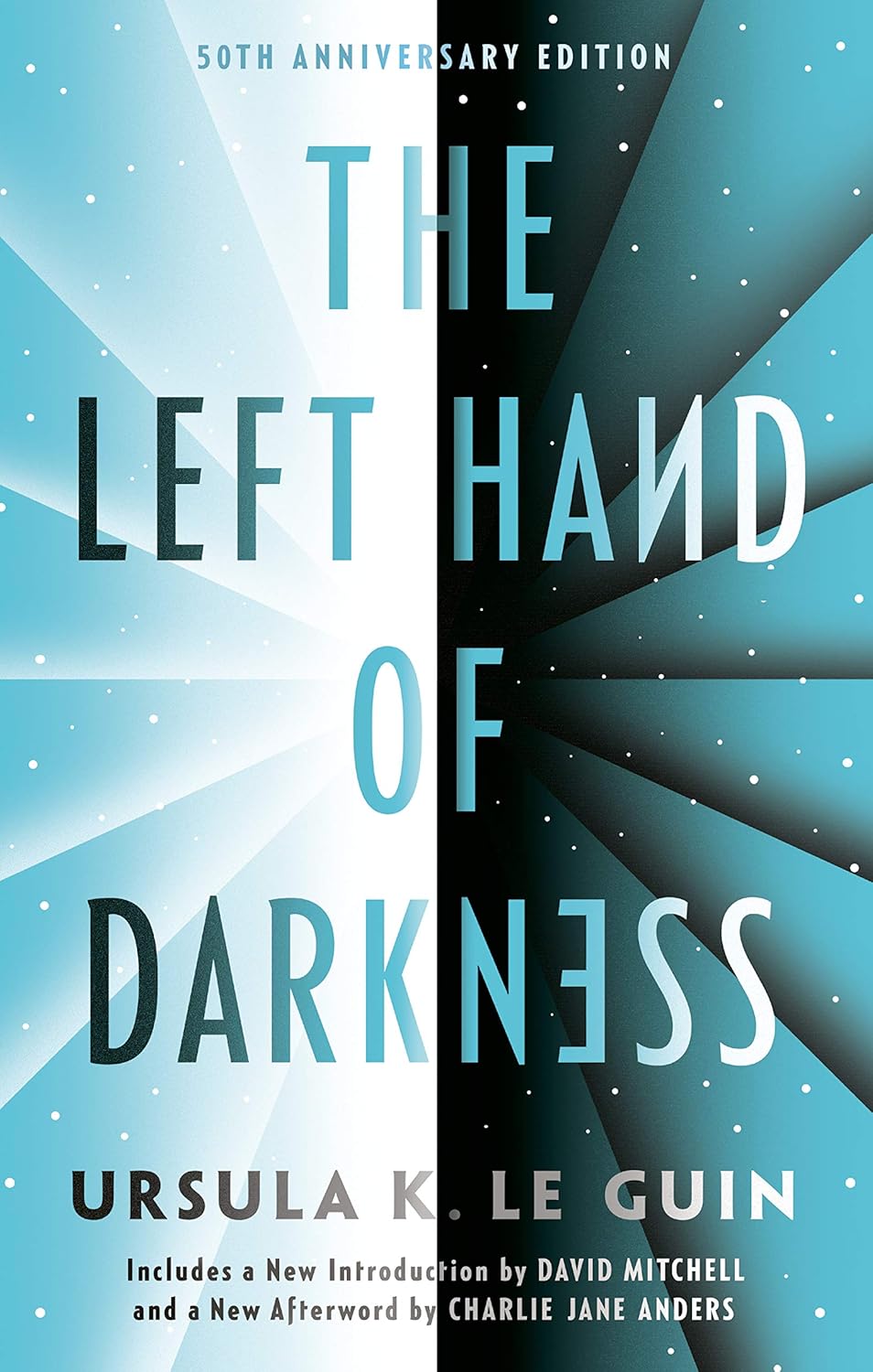
The Left Hand of Darkness
Ursula K. Le Guin


 Hugo Awards
 Indie Bestsellers


 72 Min Reading Time
 Audio Version Available
About this book
On the icy planet of Gethen, also known as Winter, gender is fluid. Here, the inhabitants are ambisexual, able to shift between male and female during their reproductive cycle. Genly Ai, a human emissary from the Ekumen, a confederation of planets, arrives on Gethen to invite them to join. But his mission is fraught with challenges, as he struggles to understand and be understood by a culture so fundamentally different from his own.
Caught in a web of political intrigue, Ai finds an unlikely ally in Estraven, a Gethenian official ostracized for his progressive views. Together, they embark on a perilous journey across the frozen landscape, facing not only the harsh elements but also the deep-seated prejudices and misunderstandings that threaten to derail Ai's mission and their fragile bond.
The Left Hand of Darkness is a groundbreaking exploration of gender, identity, and the nature of human connection. Through Ai's eyes, we confront our own biases and assumptions about what it means to be human, challenging us to imagine a world where differences are not a barrier but a bridge to understanding. This Hugo and Nebula Award-winning novel remains a powerful and thought-provoking masterpiece, prompting readers to question the very foundations of society and self.
Summary of Key Ideas
- •
Gender as a Social Construct
The novel explores the profound impact of gender on culture and society by depicting a world without fixed gender roles. On Gethen, individuals are ambisexual, only developing sexual characteristics during a period called kemmer. This unique biological feature shapes Gethenian society, influencing their social structures, political systems, and interpersonal relationships. Le Guin challenges the reader to consider how deeply ingrained gender biases are in their own perspectives and to imagine a world where gender is not a primary determinant of social roles or individual identity. By removing this fundamental aspect of human experience, Le Guin prompts reflection on the nature of identity, communication, and the potential for understanding beyond gendered expectations.
- •
The Challenges of Cross-Cultural Communication
Genly Ai's mission as an envoy of the Ekumen is to bridge the gap between vastly different cultures. The novel highlights the challenges of cross-cultural communication, where misunderstandings arise from differing social cues, values, and perceptions of reality. Ai struggles to gain the trust of the Gethenians, whose cultural norms are foreign to him. This theme underscores the importance of empathy, open-mindedness, and the willingness to learn and adapt when interacting with cultures that differ from one's own. The novel suggests that true understanding requires a conscious effort to overcome ingrained biases and to appreciate the validity of alternative ways of life. The concept of 'shifgrethor' embodies the complexity of Gethenian communication, where social status and indirectness play crucial roles, creating a constant source of potential misinterpretation for Ai.
- •
Environment as a Shaping Force
The stark, icy landscape of Gethen, also known as Winter, is more than just a backdrop; it is a powerful force shaping the planet's inhabitants and their way of life. The harsh environment demands resilience, adaptability, and a collectivist approach to survival. The constant struggle against the cold influences their social structures, their technology, and their philosophical outlook. The Gethenians have learned to live in harmony with their environment, developing a deep respect for the natural world and a pragmatic approach to resource management. The unforgiving climate also serves as a metaphor for the emotional and psychological barriers that exist between individuals and cultures, highlighting the challenges of building trust and forging meaningful connections in a world marked by difference and adversity.
- •
The Paradox of Loyalty and Betrayal
Loyalty and betrayal are central themes, explored primarily through the complex relationship between Genly Ai and Estraven. Estraven's actions, often misunderstood and misinterpreted by those around him, are ultimately driven by a deep sense of loyalty to his nation and his commitment to bringing Gethen into the Ekumen. However, his unconventional methods and his close relationship with Ai lead to accusations of treason and ultimately result in his exile and death. This theme raises questions about the nature of loyalty, the conflict between personal and political allegiances, and the potential for misunderstanding and injustice when individuals act according to their own moral compass, even when it conflicts with the prevailing social norms.
- •
Overcoming Otherness
The concept of 'otherness' is pervasive throughout the novel, as Genly Ai represents the alien outsider attempting to navigate the intricacies of Gethenian society. Both Ai and the Gethenians struggle to overcome their preconceived notions and biases in order to understand and connect with one another. Le Guin explores the fear and suspicion that often arise when encountering those who are different, and she highlights the importance of empathy and open-mindedness in bridging the gaps between individuals and cultures. The novel suggests that true understanding requires a willingness to challenge one's own assumptions and to embrace the unfamiliar, even when it is uncomfortable or unsettling.
- •
Contrasting Political Systems
The two major political entities on Gethen, Karhide and Orgoreyn, represent contrasting approaches to governance and social organization. Karhide is characterized by its complex social hierarchy, its emphasis on honor and tradition, and its somewhat volatile political landscape. Orgoreyn, on the other hand, is a more bureaucratic and collectivist society, where individual freedoms are often suppressed in the name of social order. Le Guin uses these contrasting political systems to explore the inherent tensions between individual liberty and social stability, and to examine the potential pitfalls of both authoritarianism and unchecked individualism. The novel suggests that a healthy society requires a delicate balance between these competing values, and that neither extreme can guarantee lasting peace or prosperity.
- •
The Elusive Nature of Truth
The novel delves into the nature of truth and the subjective ways in which it is perceived and communicated. The Gethenians, with their unique understanding of time and their cultural emphasis on indirectness, often present information in a way that is ambiguous or open to interpretation. Genly Ai, as an outsider, struggles to discern the truth from the carefully constructed narratives that are presented to him. Le Guin challenges the reader to consider the role of perspective in shaping our understanding of reality and to question the reliability of any single point of view. The novel suggests that truth is often multifaceted and elusive, and that it can only be approached through a process of dialogue, empathy, and critical self-reflection.
Chapter Recap

About The Author
Ursula K. Le Guin
Main Quotes
"The only certainty is that nothing is certain."
"To learn which questions are unanswerable, and not to answer them: this skill is most needful in times of stress and darkness."
"Light is the left hand of darkness and darkness the right hand of light. Two are one, life and death, lying together like lovers in kemmer."
"The king was pregnant."
"A mind that is afraid of itself cannot love."
"The traitor is the man who says he is not a traitor."
"Love does not sit still, like a stone, it has to be made, like bread; re-made all the time, made new."
"An asking glance is a ready command."
"It is yin and yang. Light is the left hand of darkness... how did it go? Light, dark. Fear, courage. Cold, warmth. Female, male. It is yourself, Therem."
"I'll make my report as if I told a story."
Who Should Read This Book
Readers of science fiction, especially those interested in sociological and anthropological themes
Readers interested in gender studies and explorations of gender roles
Fans of Ursula K. Le Guin's other works
Readers who enjoy thought-provoking and philosophical novels
Individuals interested in exploring themes of cultural differences, communication, and understanding
Readers who appreciate literary science fiction with complex characters and world-building
Readers interested in political science and social commentary through the lens of science fiction
Book Summaries Like
The Left Hand of Darkness


FAQ

Free Access to LitNotes