




 DISCORD
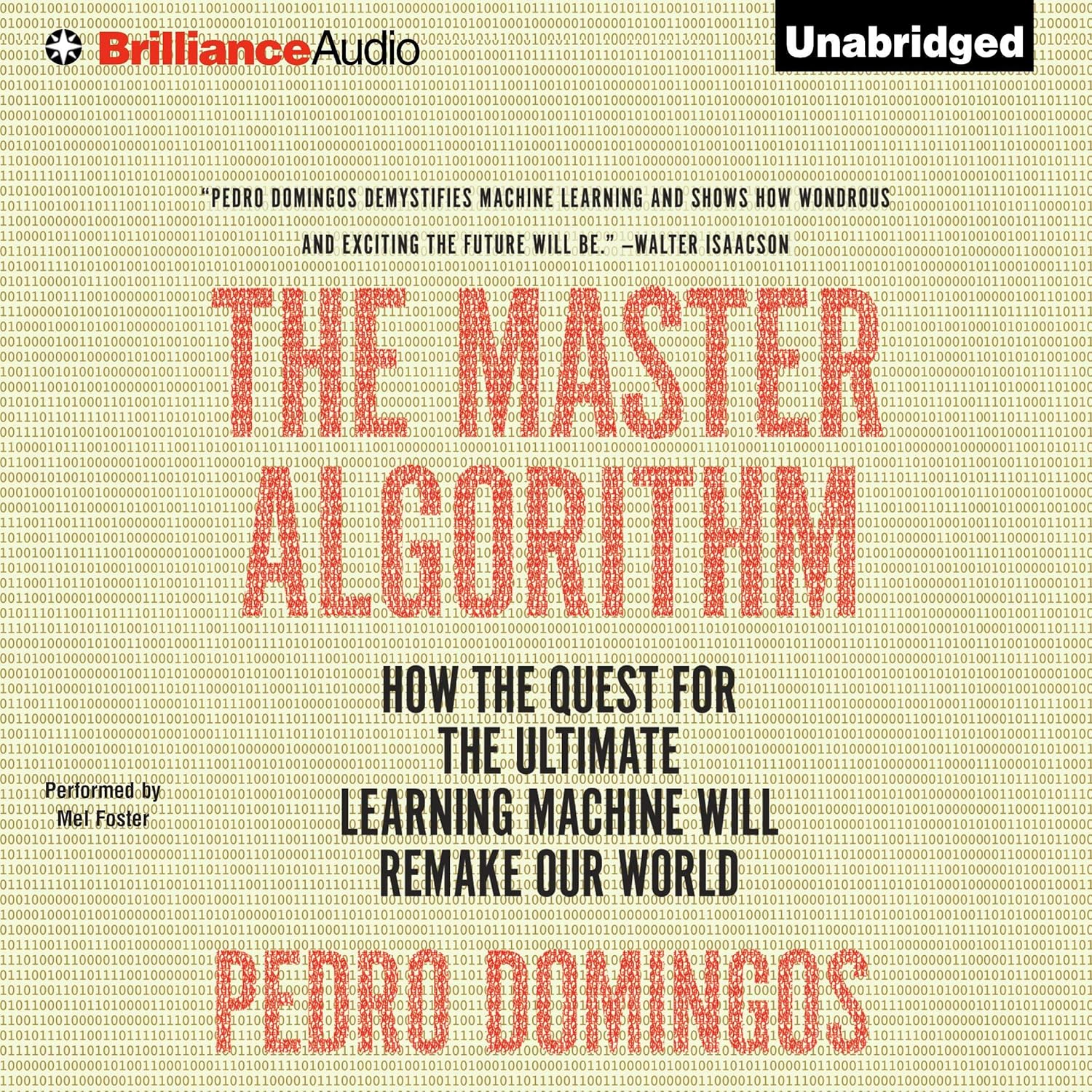
The Master Algorithm
Pedro Domingos


 Apple Books


 76 Min Reading Time
 Audio Version Available
About this book
Imagine a world where computers can learn anything, solve any problem, and anticipate your needs before you even voice them. In the groundbreaking book, "The Master Algorithm," pioneering computer scientist Pedro Domingos unveils the quest to discover the ultimate learning algorithm—the key to unlocking artificial intelligence as flexible and intuitive as our own.
Domingos takes you behind the scenes of the machine learning revolution, offering a rare glimpse into the inner workings of the algorithms that power tech giants like Google, Amazon, and your very own smartphone. He masterfully explains the five major schools of thought driving this revolution, drawing inspiration from neuroscience, evolution, psychology, physics, and statistics.
"The Master Algorithm" isn't just about the future of technology; it's about the future of humanity. Domingos explores the profound implications of this universal learner for business, science, and society, painting a vivid picture of a world transformed by the automation of discovery.
A thought-provoking journey into the heart of AI, "The Master Algorithm" is essential reading for anyone seeking to understand the next great technological leap and its impact on our world. Prepare to have your mind expanded and your perspective forever changed.
Summary of Key Ideas
- •
The Quest for the Master Algorithm
The central thesis of the book revolves around the idea that all machine learning algorithms are, at their core, solving the same fundamental problem: inferring patterns from data. Domingos proposes that a "Master Algorithm" exists – a single algorithm that can learn anything from data, combining the strengths of various existing approaches. This algorithm, once discovered, would revolutionize fields ranging from science and technology to business and society by enabling machines to learn and adapt in unprecedented ways. The book explores the ongoing quest to find this ultimate learning machine and its potential impact on the future.
- •
The Five Tribes of Machine Learning
Domingos identifies five major schools of thought in machine learning, each with its own core algorithm and approach to learning. These are: Symbolists (inverse deduction), Connectionists (backpropagation), Evolutionaries (genetic programming), Bayesians (probabilistic inference), and Analogizers (kernel machines). Understanding these tribes, their strengths, and their limitations is crucial to synthesizing a Master Algorithm. Each tribe has achieved success in specific areas, but a unified approach could unlock far greater potential.
- •
Symbolists: Rules and Logic
Symbolists, inspired by logic and philosophy, use inverse deduction to derive rules from data. They aim to create systems that can reason and solve problems like a human. Their core algorithm involves inverting logical rules to explain observations. One limitation is difficulty dealing with uncertainty and noisy data. They excel at knowledge representation and reasoning but struggle with pattern recognition in complex, real-world scenarios.
- •
Connectionists: Neural Networks and the Brain
Connectionists, drawing inspiration from the brain, use backpropagation in neural networks to learn. These networks are composed of interconnected nodes that process and transmit information. By adjusting the connections between nodes based on errors, the network learns to map inputs to outputs. While Connectionism excels at pattern recognition and dealing with noisy data, it can be a black box, lacking transparency and interpretability. Understanding how neural networks arrive at their conclusions can be difficult.
- •
Evolutionaries: Natural Selection in Algorithms
Evolutionaries employ genetic algorithms and genetic programming to evolve solutions over generations. Inspired by natural selection, they create populations of candidate solutions, evaluate their fitness, and selectively breed the best ones to create new generations. This approach is effective for exploring complex search spaces and finding creative solutions, but it can be computationally expensive and may not always converge on the optimal solution. Evolutionaries are great for problems where the solution space is vast and poorly understood.
- •
Bayesians: Probability and Inference
Bayesians rely on probabilistic inference to make predictions based on data. They use Bayes' theorem to update their beliefs as new evidence becomes available. This approach is well-suited for dealing with uncertainty and making decisions under incomplete information. However, Bayesian methods can be computationally intensive, especially when dealing with high-dimensional data or complex models. They are particularly strong in situations where prior knowledge can be effectively incorporated into the learning process.
- •
Analogizers: Learning from Similarity
Analogizers, use kernel machines like support vector machines to find similar examples and make predictions based on them. They excel at pattern recognition and classification tasks, particularly in high-dimensional spaces. Analogizers find similarities between new data points and those they have already seen, basing their predictions on these relationships. This approach is effective when data is well-structured and relevant features can be identified, but it may struggle with unstructured or noisy data.
- •
Combining Approaches for a Unified Algorithm
The book emphasizes the importance of combining these different approaches to create a more powerful and versatile Master Algorithm. By integrating the strengths of Symbolists, Connectionists, Evolutionaries, Bayesians, and Analogizers, it might be possible to overcome the limitations of each individual approach. This fusion could lead to algorithms that are not only accurate but also interpretable, adaptable, and capable of handling a wide range of tasks.
- •
Ethical and Societal Implications
Domingos explores the ethical and societal implications of the Master Algorithm. As machines become more intelligent and capable, it's crucial to consider the potential consequences for employment, privacy, and decision-making. The book raises important questions about how to ensure that AI is used responsibly and ethically, and how to mitigate the risks associated with increasingly powerful learning machines. These considerations are crucial for navigating the future of AI and its impact on society.
- •
The Importance of Unsupervised Learning
Unsupervised learning, where algorithms learn from unlabeled data, is presented as a key component of the Master Algorithm. The ability to discover patterns and structures without explicit guidance is essential for machines to truly understand the world around them. Domingos highlights unsupervised learning as a crucial step toward creating algorithms that can learn autonomously and adapt to new situations without human intervention. This is a fundamental aspect of achieving artificial general intelligence.
Chapter Recap

About The Author
Pedro Domingos
Main Quotes
"The Master Algorithm will be the thing that knows us best, and helps us decide, not just what to do, but who to be."
"The goal of machine learning is to produce systems that learn automatically."
"The most effective way to tackle a problem is to solve a more general problem first."
"Every algorithm has three components: a representation, an evaluation function, and an optimization method."
"Learning is, in large part, about overcoming our cognitive biases."
"The world is complex, and intelligent systems need to be able to cope with that complexity."
"In the long run, the companies that figure out how to master machine learning will be the ones that survive and thrive."
"The connections model sees all learning as symbol manipulation."
"The key to the future is not replacing humans with computers, but augmenting them with computers."
"The more data we have, the more we can learn."
Who Should Read This Book
Readers with a general interest in artificial intelligence and machine learning
Non-technical readers seeking an accessible introduction to machine learning concepts
Professionals in fields that are being impacted by AI, such as business, healthcare, and finance
Students studying computer science, data science, or related fields
Readers interested in the future of technology and its potential impact on society
Individuals curious about the underlying principles behind AI algorithms
Experts in computer science and machine learning seeking a high-level overview of different approaches to AI.
Book Summaries Like
The Master Algorithm
FAQ

Free Access to LitNotes