




 DISCORD
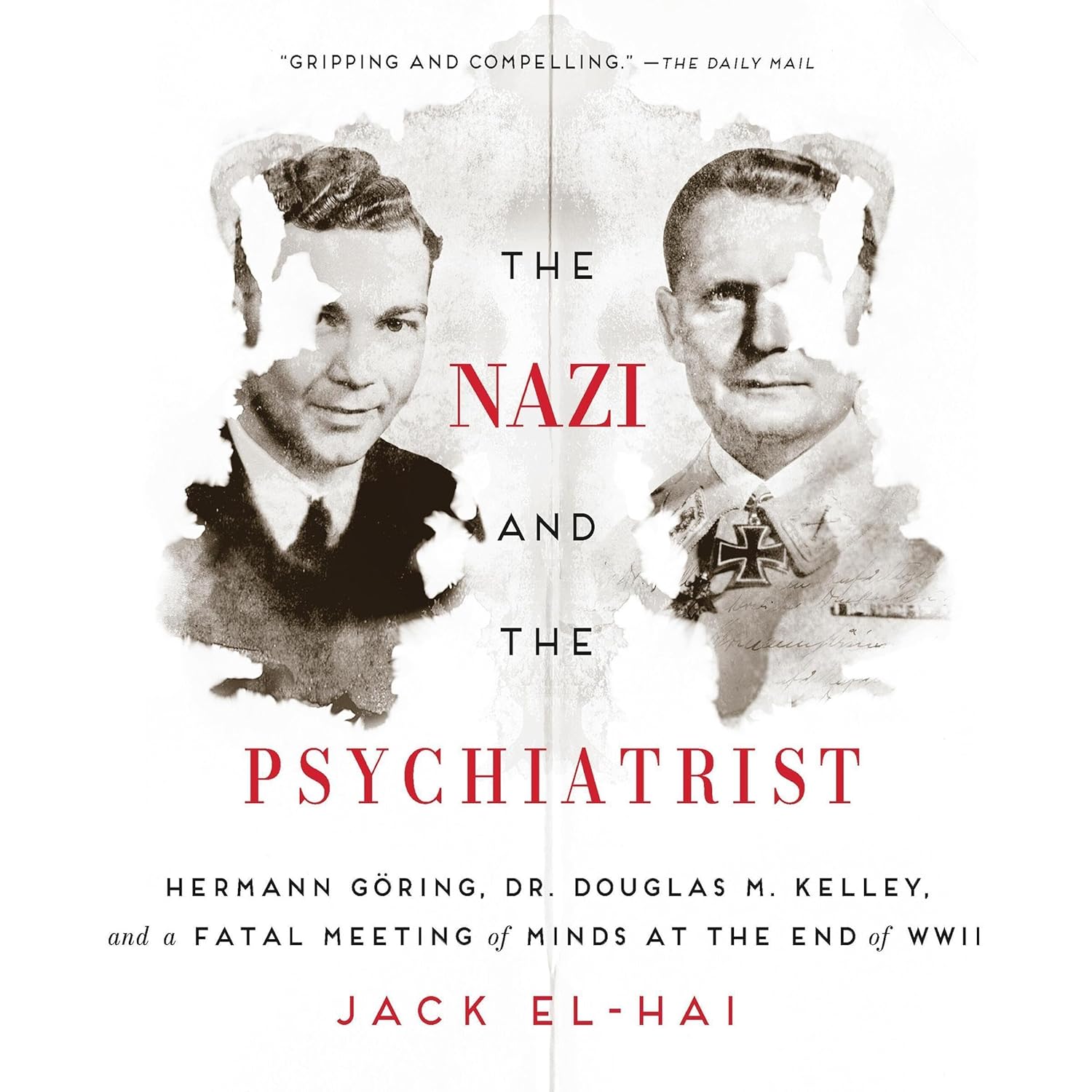
The Nazi and the Psychiatrist
Jack El


 Apple Books


 47 Min Reading Time
 Audio Version Available
About this book
In the aftermath of World War II, Hermann Göring, Hitler's notorious right-hand man, was captured and imprisoned in Luxembourg. Among his possessions: sixteen suitcases filled with ill-gotten riches and a hidden vial of cyanide. Tasked with evaluating Göring and the other captured Nazi elite for the Nuremberg trials was Captain Douglas M. Kelley, an ambitious American psychiatrist.
Kelley sought to uncover the psychological root of unspeakable evil, but what began as a professional pursuit soon spiraled into a dangerous and unsettling relationship with his captive. As Kelley delved deeper into Göring's psyche, he found himself grappling with unexpected empathy for the unrepentant Nazi leader.
Based on newly revealed documents and medical records, "The Nazi and the Psychiatrist" unveils the complex dynamic between captor and captive, exploring the disturbing allure of evil and the perilous consequences of confronting it face-to-face.
Summary of Key Ideas
- •
The Paradox of Evil: Exploring the Minds of Nazis
The book explores the complex relationship between Hermann Göring, a leading Nazi figure, and Dr. Douglas Kelley, the psychiatrist assigned to assess the mental state of the Nazi prisoners during the Nuremberg trials. It examines how Kelley, initially driven by a desire to understand the psychology of evil, became increasingly fascinated and disturbed by Göring's seemingly normal demeanor and intelligence, challenging his own beliefs about the nature of human monstrosity. The narrative delves into the psychological complexities of both men, revealing their contrasting backgrounds, motivations, and eventual fates, and thus highlighting the unsettling possibility that extreme evil can reside within seemingly ordinary individuals.
- •
Sanity of Evil: Rationality and Atrocity in Nazi Leadership
A central idea revolves around the question of whether the Nazi leaders were truly mad or simply rational actors who embraced an evil ideology. Kelley's psychiatric evaluations aimed to determine if the defendants were fit to stand trial, and his findings suggested that they were not inherently insane. Instead, the book posits that the Nazis were largely sane individuals who were capable of embracing and enacting horrific policies. This raises profound questions about the nature of evil, responsibility, and the potential for ordinary people to commit extraordinary atrocities, challenging simplistic explanations of Nazi behavior.
- •
Moral Accountability: Individual Choice in a Totalitarian State
The narrative delves into the concept of moral responsibility and the extent to which individuals can be held accountable for their actions within a totalitarian regime. It prompts reflection on the factors that influenced the Nazi leaders' decisions, including ambition, conformity, and the seductive power of ideology. It examines the degree to which the defendants were aware of the implications of their actions, and to what extent they believed they were serving a greater good. This consideration complicates any easy judgement, highlighting the complexities of individual choice within a system of collective evil.
- •
Limits of Psychiatry: Understanding Evil Beyond the Couch
The book implicitly critiques the limitations of psychiatric understanding in fully explaining or excusing the behavior of the Nazi leaders. While Kelley sought to apply psychological principles to comprehend their motivations, the narrative reveals the inadequacy of such approaches in grasping the full scope of their actions. The book demonstrates that psychiatry alone cannot fully account for the political, social, and historical factors that contributed to the rise of Nazism and the Holocaust, showing that a more holistic understanding requires insights from multiple disciplines.
- •
The Nuremberg Effect: Psychological Scars of Justice
The book explores the psychological impact of the Nuremberg trials on both the defendants and the observers. The trials served as a stage for the Nazi leaders to confront the consequences of their actions, while also providing an opportunity for the world to grapple with the horrors of the Holocaust. For Kelley, the experience of interacting with the Nazis had a profound effect on his own psyche, leading to disillusionment and eventually contributing to his tragic end. It unveils the emotional toll of confronting extreme evil and the challenges of seeking justice in the aftermath of unimaginable atrocities.
- •
The Power of Ideology: Manipulation and Moral Compromise
A key idea in the book is the unsettling examination of how easily individuals can be swayed by ideologies and propaganda, leading them to commit acts they might otherwise find unthinkable. The Nazi regime effectively manipulated public opinion through propaganda, creating a climate of fear and hatred that normalized violence and discrimination. This suggests a disturbing potential within human nature, where susceptibility to influence and the desire for belonging can override moral considerations. It serves as a warning about the dangers of unchecked power and the importance of critical thinking and resistance to manipulation.
- •
Legacy of Trauma: Memory, Justice, and the Prevention of Atrocity
The book also examines the lasting impact of the Nazi regime and the Holocaust on collective memory and the ongoing struggle to confront historical trauma. It highlights the importance of remembrance and education in preventing future atrocities. The Nuremberg trials, documented extensively, serve as a reminder of the need for international justice and accountability for crimes against humanity. The legacy of the Holocaust continues to shape our understanding of human potential for both good and evil, informing efforts to promote human rights and prevent genocide.
Chapter Recap

About The Author
Jack El
Main Quotes
"Naturally, I am the leader, so it is my problem to see that each of us contributes his share."
"For many of the defendants, especially Goering and Speer, the realization of defeat came as a profound shock."
"Kelley recognized that the Nazis were not insane in any clinical sense."
"The court became the stage upon which the drama of Nazism’s ruin would be played out."
"Göring was a master of manipulation, a chameleon who could adapt his personality to suit his purposes."
"Kelley found himself drawn into a complex and ultimately destructive relationship with Göring."
"The doctor’s own psyche became a battleground."
"He began to question his own values and beliefs."
"The war had ended, but the battle for Kelley’s soul had just begun."
"The ghosts of Nuremberg would haunt him for the rest of his days."
Who Should Read This Book
Readers interested in World War II history
Readers interested in psychology and psychiatry, particularly the psychology of evil
Readers interested in true crime
Readers interested in biography and historical biography
Readers interested in the Nuremberg trials
Readers interested in the intersection of history and psychology
Readers interested in the inner workings and motivations of Nazi leaders
Readers interested in the psychology of Dr. Douglas M. Kelley
Book Summaries Like
The Nazi and the Psychiatrist




FAQ

Free Access to LitNotes