




 DISCORD
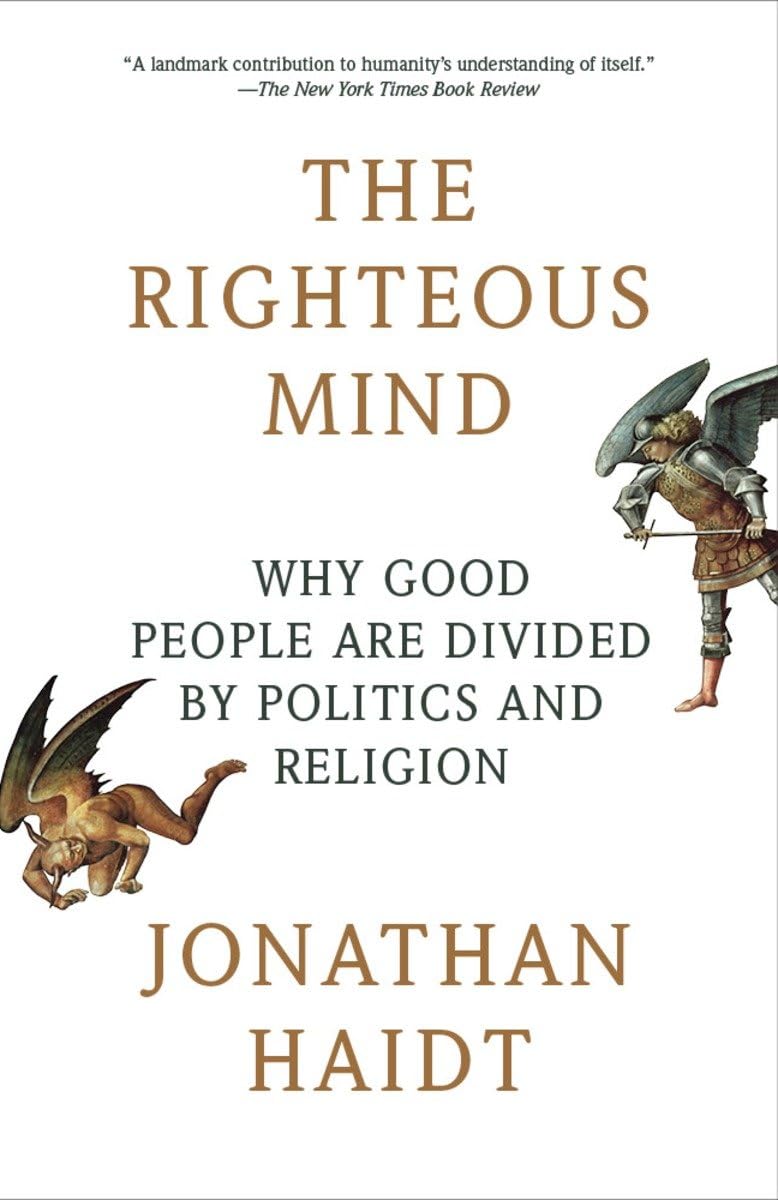
The Righteous Mind
Jonathan Haidt, Antonio Kuntz


 Apple Books


 66 Min Reading Time
 Audio Version Available
About this book
Why can't we all get along? In The Righteous Mind, social psychologist Jonathan Haidt explores the origins of our deepest divisions and points the way toward a more compassionate understanding. Drawing on decades of research, Haidt reveals that our moral judgments spring from gut feelings, not reason, and that liberals, conservatives, and libertarians possess surprisingly different moral intuitions. Discover why each side believes they're right, how our "groupishness" unites and divides us, and how we can bridge the ideological gaps that threaten to tear us apart. Prepare to trade anger for understanding and unlock the secrets of the righteous mind.
Summary of Key Ideas
- •
Intuition Drives Moral Judgment
Intuition First, Strategic Reasoning Second: Haidt argues that moral judgments are primarily driven by intuition and emotion, rather than conscious reasoning. Our gut feelings come first, and then we construct logical arguments to justify our pre-existing beliefs. This "intuitionist" perspective challenges the traditional rationalist view of morality, suggesting that our moral positions are often based on immediate, affective responses. Understanding this process is crucial for navigating moral disagreements and appreciating the power of emotional appeals in shaping our moral landscape. This core concept underpins many of the book's subsequent arguments about political and religious divides.
- •
Beyond Harm and Fairness: Six Moral Foundations
Morality as More Than Harm and Fairness: The book challenges the common liberal conception of morality as being primarily concerned with care/harm and fairness/reciprocity. Haidt introduces the concept of 'moral foundations theory,' positing that there are at least six fundamental moral foundations: care, fairness, loyalty, authority, sanctity, and liberty. While liberals tend to emphasize the first two, conservatives give weight to all six. This difference in moral emphasis explains much of the political divide, as conservatives are more likely to value social order, group cohesion, and respect for tradition alongside individual well-being.
- •
Moral Diversity: Cultural and Political Variations
Moral Foundations Vary Across Cultures and Political Affiliations: Haidt demonstrates that different cultures and political groups prioritize different moral foundations. Western, educated, industrialized, rich, and democratic (WEIRD) societies often focus on individualistic morality, while other cultures may emphasize collectivist values, such as loyalty and respect for authority. Similarly, liberals tend to emphasize care and fairness, while conservatives give more weight to loyalty, authority, and sanctity. This variation highlights the cultural and contextual nature of morality and the importance of understanding diverse moral perspectives.
- •
Morality Binds and Blinds
Groups are Bound Together by Shared Morality: Haidt argues that morality serves not only to regulate individual behavior but also to bind groups together. Shared moral values create a sense of community and cooperation, enabling individuals to work together towards common goals. This 'groupish' aspect of morality explains phenomena such as patriotism, religious devotion, and political tribalism. By understanding the binding function of morality, we can better appreciate the power of shared values in shaping social cohesion and the challenges of bridging moral divides.
- •
Activating the Hive Switch
The Hive Switch: Humans have the capacity to transcend their individualistic concerns and experience a sense of collective unity, which Haidt calls the 'hive switch.' This phenomenon can be triggered by shared rituals, collective action, and experiences of awe and wonder. When the hive switch is activated, individuals become more cooperative, altruistic, and willing to sacrifice for the group. Understanding the conditions that activate the hive switch can provide insights into how to foster greater social cohesion and cooperation, even across moral and political divides.
- •
The Social Benefits of Religion
Religion as a Socially Adaptive Institution: Haidt challenges the New Atheist critique of religion, arguing that it plays a crucial role in fostering social cohesion and promoting prosocial behavior. Religions provide shared moral frameworks, rituals, and institutions that bind communities together and encourage cooperation. While religion can also be a source of conflict and division, Haidt emphasizes its positive contributions to social order and collective well-being. This perspective highlights the functional role of religion in human societies and the need to understand its complex relationship with morality.
- •
Embracing Moral Humility
The Importance of Moral Humility: Haidt advocates for moral humility, recognizing that our own moral beliefs are shaped by our individual experiences, cultural backgrounds, and political affiliations. He encourages us to approach moral disagreements with empathy and understanding, recognizing that others may hold different moral values for valid reasons. By cultivating moral humility, we can foster more productive dialogue, bridge political divides, and build more inclusive and tolerant societies. This is not to say that all moral viewpoints are equally valid but that we should strive to understand different perspectives before judging them.
Chapter Recap

About The Author
Jonathan Haidt
Main Quotes
"The righteous mind is like a tongue that always seeks flavor."
"Intuitions come first, strategic reasoning second."
"Morality binds and blinds."
"We are terrible at seeking evidence that challenges our own beliefs."
"The main way we change our minds on moral issues is by interacting with other people."
"Politics is applied moral psychology."
"If you really want to understand another person, you need to climb inside their head and feel what it is like to affirm their moral values."
"Moral systems are interlocking sets of values, virtues, norms, practices, identities, institutions, and technologies that work together to suppress selfishness and make cooperative societies possible."
"Humans are not purely selfish actors; we are groupish, tribal, and divided by ideology."
"It is not really possible to understand the present situation in American politics unless you understand the moral foundations theory."
Who Should Read This Book
Individuals interested in psychology, especially moral psychology and social psychology
People interested in understanding political polarization and cultural divides
Readers of non-fiction books exploring social and political issues
Those interested in anthropology, sociology, and philosophy
Individuals seeking to understand different perspectives and improve communication across ideological divides
Anyone curious about the origins of morality and ethics
Readers interested in the relationship between reason and intuition in moral decision-making
People involved in politics, public policy, and social activism
Those working in fields related to conflict resolution and mediation
Educators and students in relevant academic disciplines
Individuals interested in self-improvement and understanding their own biases
Readers of authors like Daniel Kahneman, Steven Pinker, and other popular science writers
Book Summaries Like
The Righteous Mind

FAQ

Free Access to LitNotes