




 DISCORD
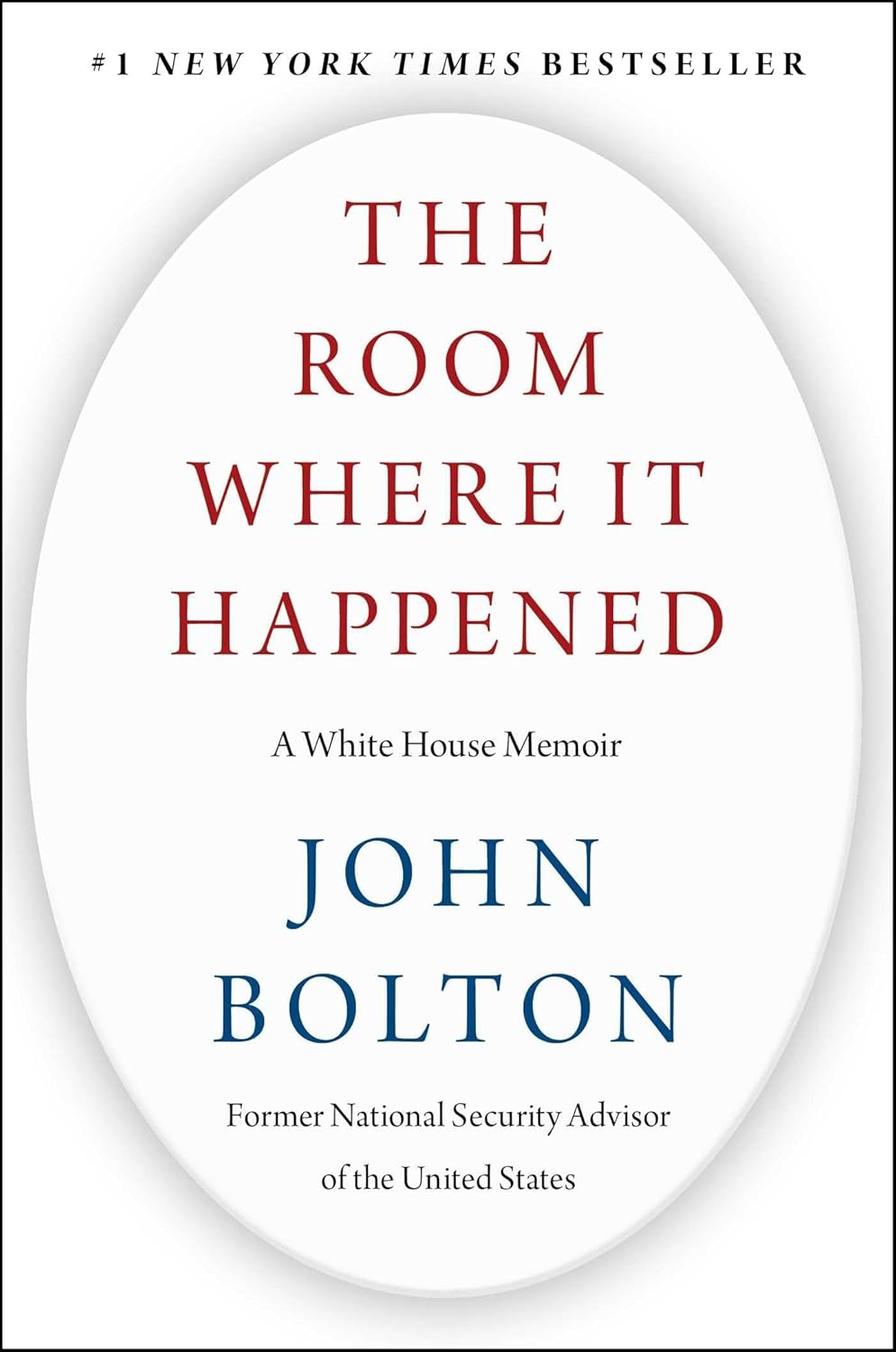
The Room Where It Happened
John R. Bolton


 Amazon Best Sellers
 Apple Books


 145 Min Reading Time
 Audio Version Available
About this book
Go inside the White House with John Bolton, President Trump's National Security Advisor, and witness history in the making. In The Room Where It Happened, Bolton delivers a stunningly detailed and unsparing account of his tumultuous tenure, revealing the inner workings of an administration unlike any other.
From explosive encounters with world leaders to the president's most controversial decisions, Bolton exposes the rivalries, betrayals, and chaotic decision-making that defined the Trump White House. He paints a portrait of a president driven by impulse, personal gain, and a startling lack of knowledge about the world.
Bolton's insider perspective sheds new light on key events, including the Ukraine scandal, dealings with China, negotiations with North Korea, and the administration's approach to Iran. This is more than just a memoir; it's a crucial historical document that will reshape our understanding of American foreign policy and the Trump presidency. Gripping, controversial, and utterly unforgettable, The Room Where It Happened is a must-read for anyone seeking to understand one of the most consequential periods in American history.
Summary of Key Ideas
- •
Transactional Foreign Policy
Trump's transactional and often inconsistent foreign policy decision-making is a central theme. Bolton portrays Trump as lacking a deep understanding of international relations, often making decisions based on personal whims or perceived political advantages rather than strategic considerations. This approach led to unpredictable shifts in policy and strained relationships with key allies. Bolton details instances where Trump's decisions were driven by personal relationships with foreign leaders, sometimes at the expense of U.S. national interests. This transactional approach is contrasted with Bolton's more traditional, hawkish foreign policy views.
- •
Internal Conflicts and Power Struggles
The book reveals the internal conflicts and power struggles within the Trump administration. Bolton describes frequent clashes between different factions, particularly between those advocating for more traditional Republican foreign policy approaches and those aligned with Trump's populist, isolationist tendencies. These internal disputes often resulted in policy paralysis or inconsistent implementation. Bolton highlights the difficulties in navigating these internal conflicts and the challenges of maintaining a coherent foreign policy agenda amidst the competing interests and personalities.
- •
Hawkish Foreign Policy Advocacy
Bolton's hawkish foreign policy views and his advocacy for a strong U.S. role in global affairs are a recurring theme. He consistently pushed for a more assertive stance against perceived adversaries like Iran, North Korea, and Venezuela. Bolton's descriptions reveal his frustration with Trump's reluctance to use military force or impose tougher sanctions in certain situations. He often found himself at odds with other advisors who favored a more cautious approach. The book showcases Bolton's conviction that American leadership is essential for maintaining global stability and deterring aggression.
- •
Concerns About Foreign Election Interference
The book raises serious questions about Trump's conduct related to foreign interference in U.S. elections. Bolton alleges that Trump sought assistance from foreign leaders, including China's Xi Jinping, to influence the outcome of the 2020 election. These allegations formed a key part of the impeachment proceedings against Trump. Bolton's account suggests a willingness on Trump's part to prioritize personal political gain over the integrity of the democratic process. This theme underscores the potential dangers of foreign influence in U.S. elections and the need for vigilance in safeguarding democratic institutions.
- •
Critique of Trump's Leadership Style
Bolton presents a highly critical assessment of Trump's leadership style, portraying him as impulsive, uninformed, and easily manipulated. He describes instances where Trump demonstrated a lack of knowledge about basic geopolitical facts and a tendency to rely on gut feelings rather than expert advice. Bolton's account suggests that Trump's leadership style often created chaos and uncertainty within the administration, making it difficult to develop and implement coherent policies. The book offers a scathing critique of Trump's character and his fitness for the presidency.
- •
Insider's Perspective on Foreign Policy Events
The book offers an insider's perspective on key foreign policy events and decisions during Trump's presidency. Bolton provides detailed accounts of meetings with foreign leaders, internal deliberations on policy options, and the implementation of specific initiatives. These behind-the-scenes narratives shed light on the complexities of foreign policymaking and the challenges of navigating international relations. Bolton's account offers valuable insights into the inner workings of the Trump administration and the factors that shaped its foreign policy decisions.
- •
Skepticism Towards Diplomacy with Adversaries
Bolton expresses deep skepticism towards diplomatic efforts with adversaries like North Korea and Iran. He views these regimes as untrustworthy and believes that negotiations are unlikely to yield meaningful results. Bolton advocates for a policy of maximum pressure, including sanctions and military threats, to force these countries to change their behavior. His skepticism towards diplomacy reflects a broader worldview that emphasizes the importance of strength and deterrence in international relations. This perspective often clashed with Trump's willingness to engage in direct talks with leaders like Kim Jong-un.
- •
The Complexities of the U.S.-China Relationship
The book explores the complexities of the U.S.-China relationship under Trump. Bolton describes Trump's inconsistent approach to China, oscillating between trade negotiations, accusations of unfair practices, and even seeking China's help with his re-election. Bolton details the internal debates within the administration regarding how to best address China's growing economic and military power. The book highlights the challenges of balancing economic interests with security concerns in the U.S.-China relationship and the difficulty of formulating a coherent long-term strategy.
Chapter Recap

About The Author
John R. Bolton
American attorney, diplomat, Republican consultant, and political commentator.
Main Quotes
"I am not a fan of the President."
"I didn't have a lot of respect for him."
"Instinct, personal relations, and showmanship are elements of any President's repertoire. But they are not all of it, by a long stretch."
"One attraction of being National Security Advisor is the sheer multiplicity and volume of challenges that confront you."
"Isn't Finland kind of a satellite of Russia?"
"My goal was not to get a membership card but to get a driver's license."
"One of Bolton's key contentions is that the so-called “adults in the room” did more harm than good by working against the president's objectives."
"Everything they can do to stir mistrust, to undercut the legitimacy of our democratic institutions helps to paralyze America. And a weaker, ..."
"Who among all the bad people in the world could Donald Trump be saying this about in the presence of his National Security Advisor, John Bolton?"
"Individual liberty is the whole purpose of political life, and I thought it was threatened then and I think it's threatened now."
Who Should Read This Book
Individuals interested in US politics and government
Readers of political memoirs and biographies
Those following the Trump presidency and its key figures
People interested in foreign policy and national security
Readers seeking insider accounts of White House operations
Individuals with strong opinions about Donald Trump and his administration
Journalists, political analysts, and historians
Book Summaries Like
The Room Where It Happened
FAQ

Free Access to LitNotes