




 DISCORD
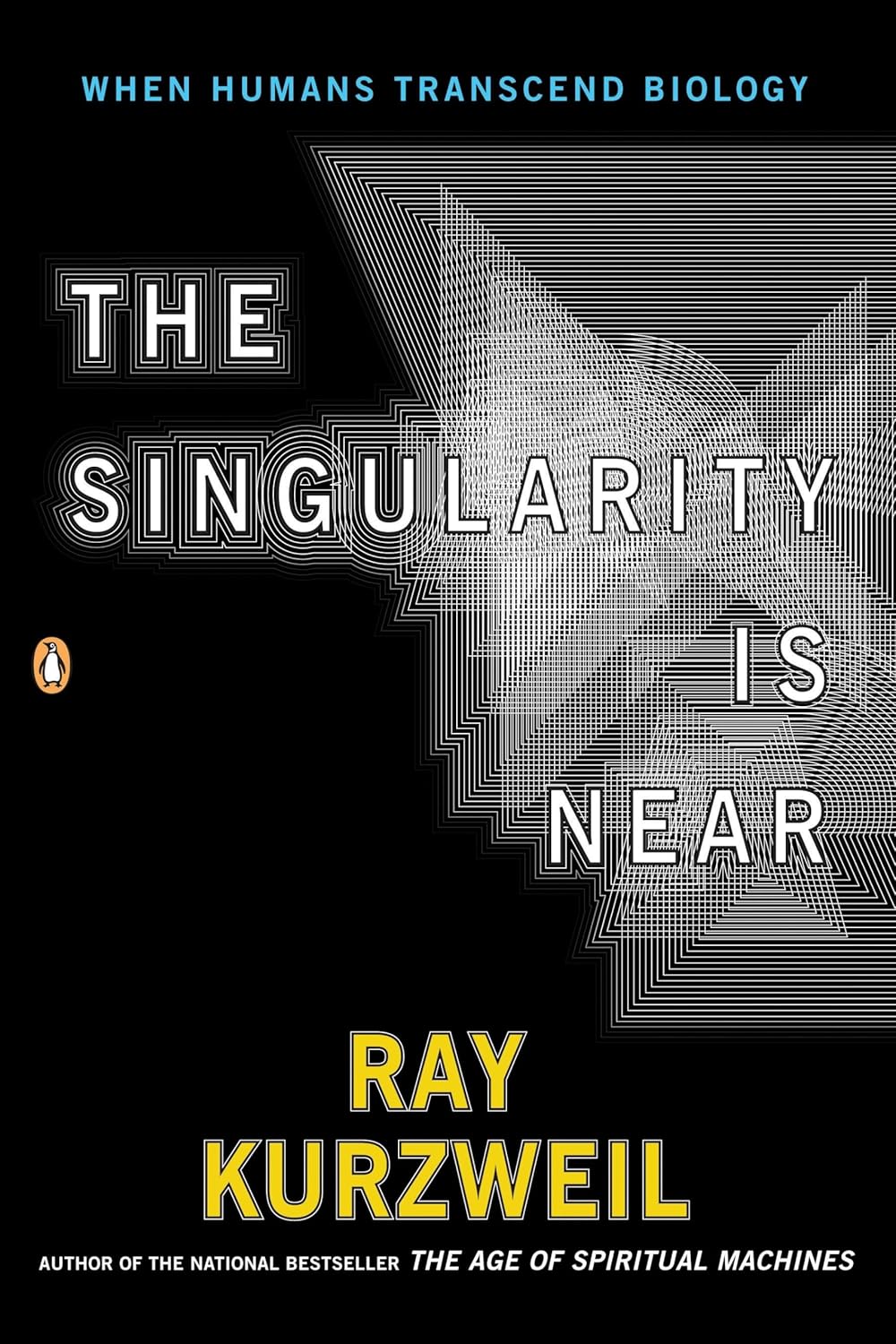
The Singularity Is Near
Ray Kurzweil


 Apple Books


 149 Min Reading Time
 Audio Version Available
About this book
Ray Kurzweil, the futurist hailed by Bill Gates as "the best person I know at predicting the future of artificial intelligence," unveils a breathtaking vision of tomorrow in The Singularity Is Near. Are you ready for a world where humanity transcends its biological limitations?
Kurzweil argues that we stand on the cusp of the Singularity, an era of unprecedented technological advancement where humans and machines merge. Genetics, nanotechnology, and robotics (GNR) will revolutionize our existence, promising radical gains in intelligence, longevity, and material progress. Imagine a future where aging and disease are relics of the past, where pollution and poverty are eradicated through the power of nanotechnology, and where our minds achieve unimaginable heights by fusing with artificial intelligence.
The Singularity Is Near offers a startling yet ultimately optimistic roadmap to this future. Kurzweil addresses the profound social and philosophical implications of these changes, confronting both the immense possibilities and the potential perils that lie ahead. Prepare to have your understanding of humanity's destiny challenged and expanded in this bold and inspiring exploration of the age to come.
Summary of Key Ideas
- •
The Law of Accelerating Returns
The Law of Accelerating Returns posits that technological progress happens at an exponential rate, not a linear one. This means that the rate of change itself is increasing, leading to dramatic advancements in shorter and shorter periods. Kurzweil argues that we often underestimate the power of future technologies because we intuitively think linearly, failing to grasp the compounding nature of technological growth. This accelerating pace is a fundamental driver of the Singularity, as it suggests that changes in the coming decades will far surpass those of the past centuries.
- •
The Singularity: A Point of Unprecedented Change
Kurzweil envisions the Singularity as a point in time when technological growth becomes uncontrollable and irreversible, resulting in changes so profound that they alter the very nature of humanity. This transformation is driven by the convergence of several technologies, most notably artificial intelligence, nanotechnology, and biotechnology. The Singularity is not necessarily a utopian or dystopian future, but rather a period of radical uncertainty where the future is fundamentally unpredictable.
- •
The Rise of Artificial Intelligence
Artificial intelligence (AI) plays a central role in Kurzweil's vision of the future. He predicts that AI will eventually surpass human intelligence, leading to the creation of superintelligent machines capable of solving complex problems and driving further technological innovation. This 'strong AI' will not only replicate human cognitive abilities but also exceed them, leading to unforeseen breakthroughs and transformations across all fields.
- •
The Nanotechnology Revolution
Nanotechnology, the manipulation of matter at the atomic and molecular level, is another key technology driving the Singularity. Kurzweil envisions nanobots being used for a wide range of applications, including medical treatments, environmental cleanup, and manufacturing. Nanotechnology could revolutionize medicine by repairing cells and tissues at the molecular level, potentially eradicating diseases and extending human lifespans dramatically.
- •
The Convergence of Biology and Technology
Biotechnology, including genetic engineering and personalized medicine, is also expected to play a significant role in the Singularity. Kurzweil predicts that we will be able to reprogram our biology to overcome genetic predispositions to disease, enhance our physical and cognitive abilities, and extend our lifespans. This merging of biology and technology will blur the lines between human and machine, leading to new possibilities for human enhancement and transformation.
- •
Radical Life Extension
Kurzweil explores the potential for radical life extension as a result of technological advancements. He argues that the combination of nanotechnology, biotechnology, and AI will enable us to slow down and even reverse the aging process, potentially allowing humans to live for centuries or even indefinitely. This raises profound ethical and societal questions about resource allocation, overpopulation, and the very meaning of life.
- •
Transcending Biology: The Merging of Human and Machine
One of the most transformative aspects of the Singularity is the potential for humans to transcend their biological limitations through merging with technology. This could involve implanting chips in our brains to enhance cognitive abilities, replacing organs with artificial components, or even uploading our consciousness to a computer. This merging of human and machine would create a new form of intelligence that surpasses the capabilities of either alone.
- •
Embracing Change and Adaptation
Kurzweil emphasizes the importance of embracing change and adapting to the rapid pace of technological progress. He argues that those who resist or ignore these changes risk being left behind, while those who embrace them will be best positioned to thrive in the future. This requires a willingness to learn new skills, adapt to new technologies, and challenge our assumptions about the future.
- •
Ethical and Societal Implications
Kurzweil addresses the ethical and societal implications of the Singularity, acknowledging that these powerful technologies could be used for good or ill. He stresses the importance of developing ethical frameworks and regulations to ensure that these technologies are used responsibly and for the benefit of humanity. This requires a global dialogue involving scientists, policymakers, and the public to address the potential risks and opportunities of the Singularity.
Chapter Recap

About The Author
Ray Kurzweil
Main Quotes
"Evolution is a process of creating patterns."
"Technology is a story of accelerating returns."
"We can transcend these limitations of biology."
"The Singularity will allow us to transcend these limitations of our biological bodies and brains."
"Our version 1.0 biological bodies are frail and subject to a myriad of limitations."
"Intelligence is inherently and necessarily technology-creating."
"The most important form of intelligence is the intelligence to create new knowledge."
"This is one aspect of the uniqueness of our species: our intelligence is just sufficiently above the critical threshold necessary for us to scale our own intelligence."
"Ultimately, the entire universe will become saturated with our intelligence. This is the destiny of the universe."
"The resources of computation are growing exponentially."
Who Should Read This Book
Technology enthusiasts
Futurists and science fiction fans
Academics and researchers in AI, computer science, and related fields
Transhumanists and those interested in the future of humanity
Investors and entrepreneurs looking for emerging technologies
Readers interested in the intersection of technology and philosophy
Individuals concerned with the ethical implications of advanced technology
People interested in predictions about the future of technology and society
Readers interested in artificial intelligence, biotechnology, and nanotechnology
General readers interested in complex, forward-thinking ideas
Book Summaries Like
The Singularity Is Near

FAQ
Free Access to LitNotes