




 DISCORD
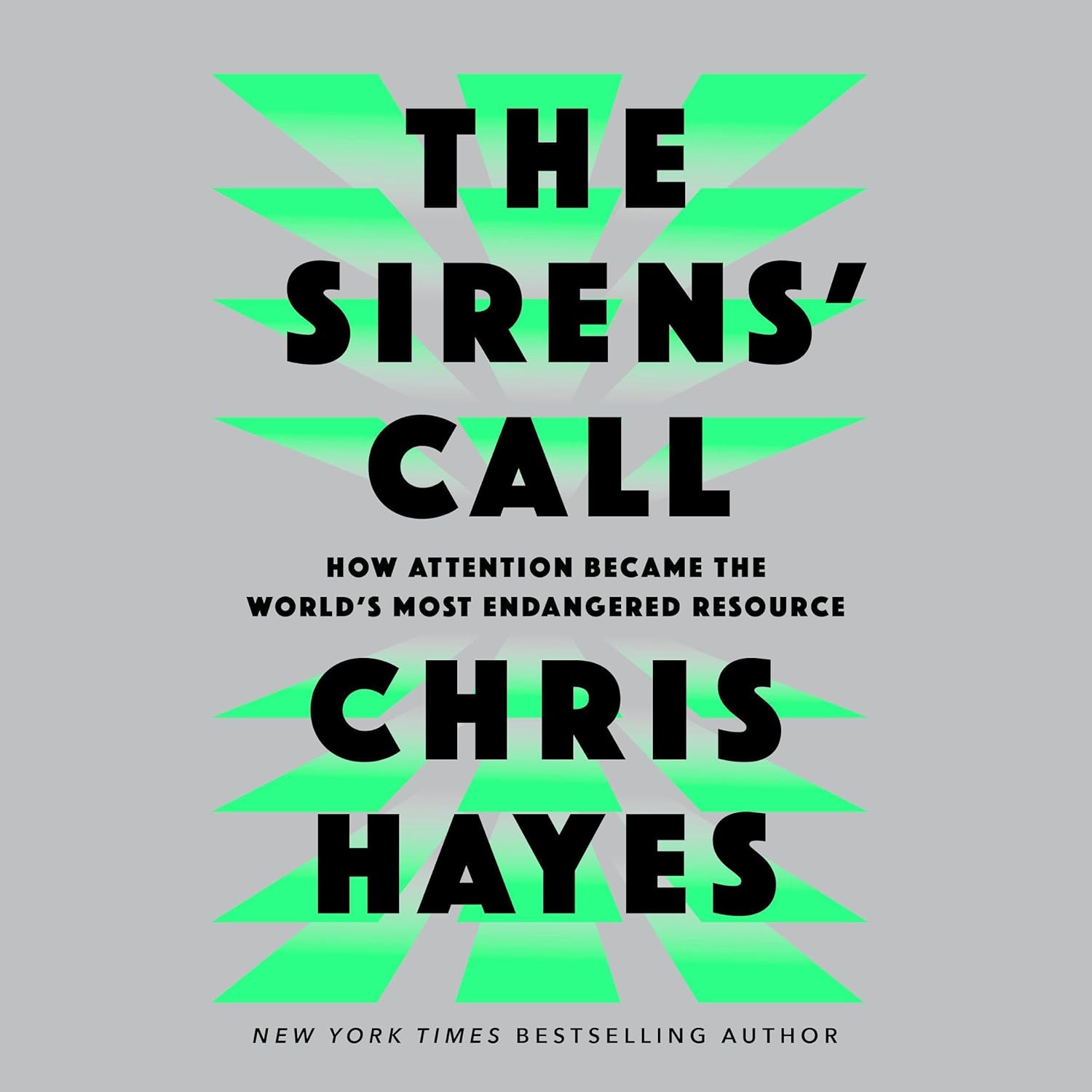
The Sirens' Call
Chris Hayes


 Apple Books


 55 Min Reading Time
 Audio Version Available
About this book
We've all felt it: the constant distractions, the struggle to focus, the addictive pull of our screens. In The Sirens' Call, New York Times bestselling author Chris Hayes delivers a powerful and urgent examination of how "attention capitalism" has seized our minds, reshaped our politics, and fundamentally altered the fabric of society.
Hayes argues that we are living through a profound shift, where our very attention has become a commodity, harvested and exploited by tech giants. Like the mythical sirens of old, these modern entities lure us in with irresistible calls, eroding the boundaries between public and private, and preying on our deepest neurological impulses.
The Sirens' Call is a vital, big-picture analysis that offers clarity and guidance in a world saturated with distraction. It's a call to reclaim control of our lives, our politics, and our future before the sirens' song consumes us entirely.
Summary of Key Ideas
- •
The Scarcity of Attention
Attention as a Finite Resource: Hayes argues that in the information age, attention has become a scarce and endangered resource. Like any finite resource, it is subject to exploitation and depletion. This scarcity has profound implications for individuals and society, shaping our ability to focus, think critically, and engage meaningfully with the world around us. The book delves into how the competition for our attention influences our daily lives, from the media we consume to the political discourse we engage in.
- •
Rise of the Attention Economy
The Attention Economy: Hayes examines the rise of the attention economy, where businesses and platforms compete to capture and monetize our attention. This economy has created an environment where algorithms, persuasive technologies, and manipulative marketing tactics are employed to grab and hold our focus. The book uncovers the mechanisms through which our attention is commodified and sold to advertisers and other interested parties, raising ethical questions about the control and autonomy we have over our own minds.
- •
Hacking Human Attention
Exploitation of Neural Responses: A key theme is how attention merchants exploit our basic neural and psychological responses to capture and maintain our focus. This involves understanding and leveraging cognitive biases, emotional triggers, and addictive tendencies to keep us hooked on screens and platforms. Hayes explores the science behind these techniques, revealing how they bypass our rational decision-making processes and hijack our attention for commercial gain. This exploitation has significant consequences for our mental health and well-being.
- •
Erosion of Civic Engagement
Social and Political Deformations: Hayes connects the attention economy to broader social and political issues, arguing that the constant competition for attention has led to a decline in civic engagement, critical thinking, and informed decision-making. The book explores how misinformation, polarization, and outrage are amplified in the attention economy, making it harder to address complex problems and build consensus. This dynamic threatens democratic institutions and undermines our ability to collectively solve challenges facing society.
- •
Attention Alienation
Echoes of Marx's Alienation: The book draws parallels between the attention economy and Karl Marx's theory of alienation. Just as industrial capitalism alienated workers from their labor, the attention economy alienates individuals from their own minds. We become detached from our thoughts, feelings, and experiences as our attention is constantly directed and manipulated by external forces. This alienation has profound consequences for our sense of self, autonomy, and purpose.
- •
Reclaiming Our Focus
The Need for Attention Management: Hayes emphasizes the importance of developing strategies for managing our attention in the face of relentless demands. This involves cultivating mindfulness, setting boundaries with technology, and consciously choosing where to focus our mental energy. The book encourages readers to take control of their attention and resist the manipulative forces that seek to capture it. By reclaiming our attention, we can enhance our cognitive abilities, improve our well-being, and strengthen our capacity for critical thinking and civic engagement.
Chapter Recap

About The Author
Chris Hayes
Main Quotes
"The Sirens of lore and the sirens of the urban streetscape both compel our attention against our will."
"We are built and formed by attention, destroyed by neglect."
"If you can't be heard, it doesn't matter what you say. And right now it's both easier than ever to shout and harder than ever to be heard."
"Attention is the most precious resource we have."
"The feeling of being present, in your body, in the world, is the feeling of being alive."
"The paradox of the internet is that it offers both unprecedented access to information and unprecedented opportunities for distraction."
"We are living in an attention economy, where our focus is constantly being bought and sold."
"The more mediated our experiences become, the more we crave authenticity."
"The opposite of attention isn't distraction. It's boredom."
"The cure for the attention crisis is not more self-discipline. It's a world worth paying attention to."
Who Should Read This Book
Individuals interested in media and politics
Readers concerned about the impact of social media and technology on society
People seeking to understand the attention economy
Those interested in political analysis and commentary
Individuals looking for strategies to regain control of their attention
Readers of non-fiction books on current affairs and social issues
Viewers of Chris Hayes's MSNBC show
Book Summaries Like
The Sirens' Call

FAQ

Free Access to LitNotes