




 DISCORD
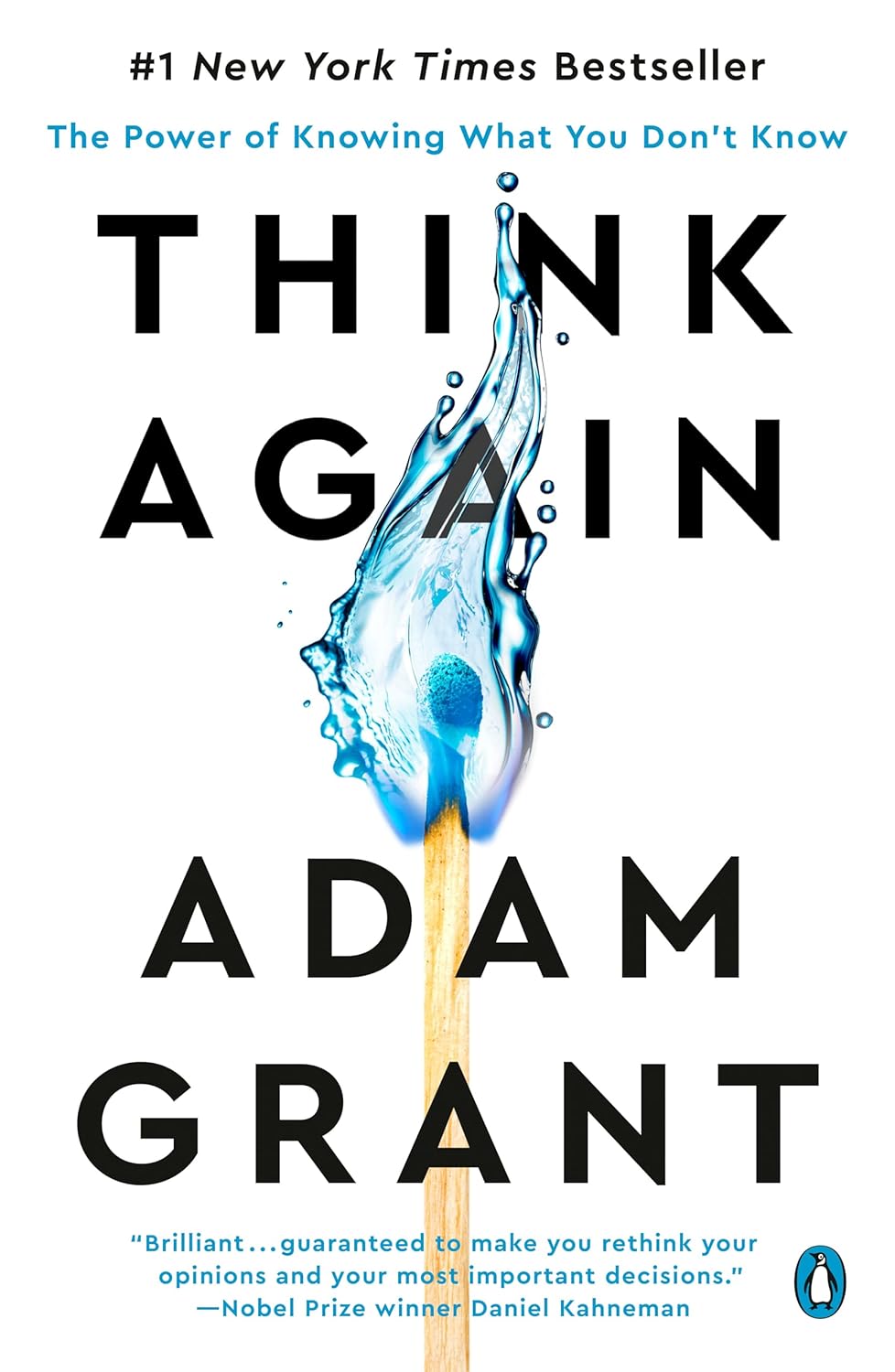
Think Again
Adam Grant


 Amazon Best Sellers
 Apple Books


 49 Min Reading Time
 Audio Version Available
About this book
In a world of rapid change, intelligence isn't just about what you know, but how quickly you can unlearn and rethink. Adam Grant, the #1 New York Times bestselling author of Give and Take and Originals, challenges us to embrace the power of doubt and the joy of being wrong.
Think Again explores how rethinking can lead to excellence at work and wisdom in life. Grant dismantles the barriers to intellectual humility, revealing how to move beyond rigid beliefs and cultivate mental flexibility. Through compelling stories—from debate champions to vaccine whisperers—he demonstrates how rethinking fosters productive conversations, bridges divides, and creates lifelong learners.
Discover how to argue like you're right but listen like you're wrong, and why knowing what you don't know is the ultimate wisdom. Think Again is an invitation to question your assumptions, open your mind, and thrive in an ever-evolving world.
Summary of Key Ideas
- •
The Importance of Rethinking
Embrace the Power of Rethinking: Grant emphasizes that the ability to rethink and unlearn is a crucial skill in a rapidly changing world. Rethinking involves actively questioning your assumptions, beliefs, and opinions, and being open to revising them in light of new information or perspectives. This adaptability is essential for personal growth, effective decision-making, and navigating complex situations.
- •
Cultivate a Scientific Mindset
Think Like a Scientist: Adopting a scientific mindset is central to Grant's argument. This means approaching your beliefs as hypotheses to be tested rather than fixed truths. It involves being curious, seeking evidence, and being willing to change your mind when the evidence contradicts your initial hypothesis. This approach encourages intellectual humility and prevents you from becoming too attached to your own ideas.
- •
Practice Confident Humility
Confident Humility: Grant introduces the concept of 'confident humility,' which balances confidence in your ability to learn and grow with humility about your current knowledge. Confident humility involves recognizing that you don't have all the answers and being open to learning from others, even those with differing viewpoints. This mindset fosters intellectual curiosity and a willingness to engage in constructive dialogue.
- •
Separate Opinions from Identity
Detach Your Opinions from Your Identity: One of the biggest obstacles to rethinking is tying your opinions to your sense of self. When your beliefs become part of your identity, it becomes difficult to change your mind without feeling like you're betraying who you are. Grant argues that detaching your opinions from your identity allows you to be more objective and open to new perspectives, making rethinking easier and less threatening.
- •
Embrace Being Wrong
The Joy of Being Wrong: Grant reframes being wrong as an opportunity for learning and growth. Instead of viewing mistakes as failures, he encourages us to see them as valuable data points that can help us refine our understanding of the world. Embracing the possibility of being wrong fosters a growth mindset and encourages intellectual risk-taking.
- •
Listen Actively and Argue with Nuance
Listen and Argue with Nuance: Effective communication and persuasion involve listening actively to understand the other person's perspective, rather than simply trying to win an argument. Grant emphasizes the importance of arguing with nuance, acknowledging the complexities of the issue and avoiding simplistic or polarizing statements. This approach fosters mutual respect and increases the likelihood of finding common ground.
- •
Focus on 'How' Not Just 'Why'
The Power of Asking 'How' Instead of 'Why': When trying to understand or solve a problem, Grant suggests focusing on 'how' rather than 'why.' Asking 'how' encourages exploration of the specific processes and mechanisms involved, leading to more concrete and actionable insights. In contrast, asking 'why' can often lead to abstract or philosophical debates that don't necessarily lead to practical solutions.
- •
Foster a Culture of Learning
Create a Culture of Learning: Rethinking isn't just an individual skill; it's also a collective one. Grant argues that organizations and teams should cultivate a culture of learning where people feel safe to challenge assumptions, experiment with new ideas, and learn from their mistakes. This involves creating a psychologically safe environment where people are rewarded for intellectual curiosity and open-mindedness, rather than punished for being wrong.
- •
The Value of Productive Conflict
Learn to Love Confict (the right kind): Grant is careful to clarify the importance of productive conflict. He advocates for task conflict, which is centered around ideas and problem solving, as opposed to relationship conflict, which focuses on personal attacks. Task conflict, when managed well, can help teams and organizations avoid groupthink and make better decisions.
Chapter Recap

About The Author
Adam Grant
Main Quotes
"Being wrong isn't a reflection of your worthiness; it's a signal that there's something new to be discovered."
"Intelligence is traditionally viewed as the ability to think and learn. Yet in a turbulent world, there’s another set of cognitive skills that might matter even more: the ability to rethink and unlearn."
"We laugh at people who still use Windows XP, yet we cling to opinions that we formed in 1995."
"The curse of knowledge is that it closes our minds to what we don’t know."
"Confidence is a measure of how sure you are that you’re right. Humility is being willing to wonder why you might be wrong."
"Holding too tightly to opinions can blind us to new possibilities."
"If knowledge is power, knowing what we don't know is wisdom."
"A hallmark of wisdom is knowing when it’s time to abandon some of your most cherished tools—and some of the most cherished parts of your identity."
"Our convictions can lock us in prisons of our own making. The solution is not to wallow in doubt and uncertainty. It’s to develop confident humility."
"Thinking like a scientist involves more than just reacting with an open mind. It means actively looking for reasons why you might be wrong."
Who Should Read This Book
Professionals in leadership and management roles
Individuals interested in personal development and critical thinking
People seeking strategies for productive communication and debate
Educators and students
Anyone wanting to improve their learning agility and adaptability
Readers of behavioral science and psychology books
Individuals interested in overcoming biases and improving decision-making
Those seeking to navigate a rapidly changing world with more open-mindedness
Readers interested in self-improvement through intellectual humility
Individuals looking to enhance their problem-solving skills
Book Summaries Like
Think Again
FAQ

Free Access to LitNotes