




 DISCORD
Thinking, Fast and Slow
Daniel Kahneman


 Amazon Best Sellers
 The New York Times Best Sellers


 163 Min Reading Time
 Audio Version Available
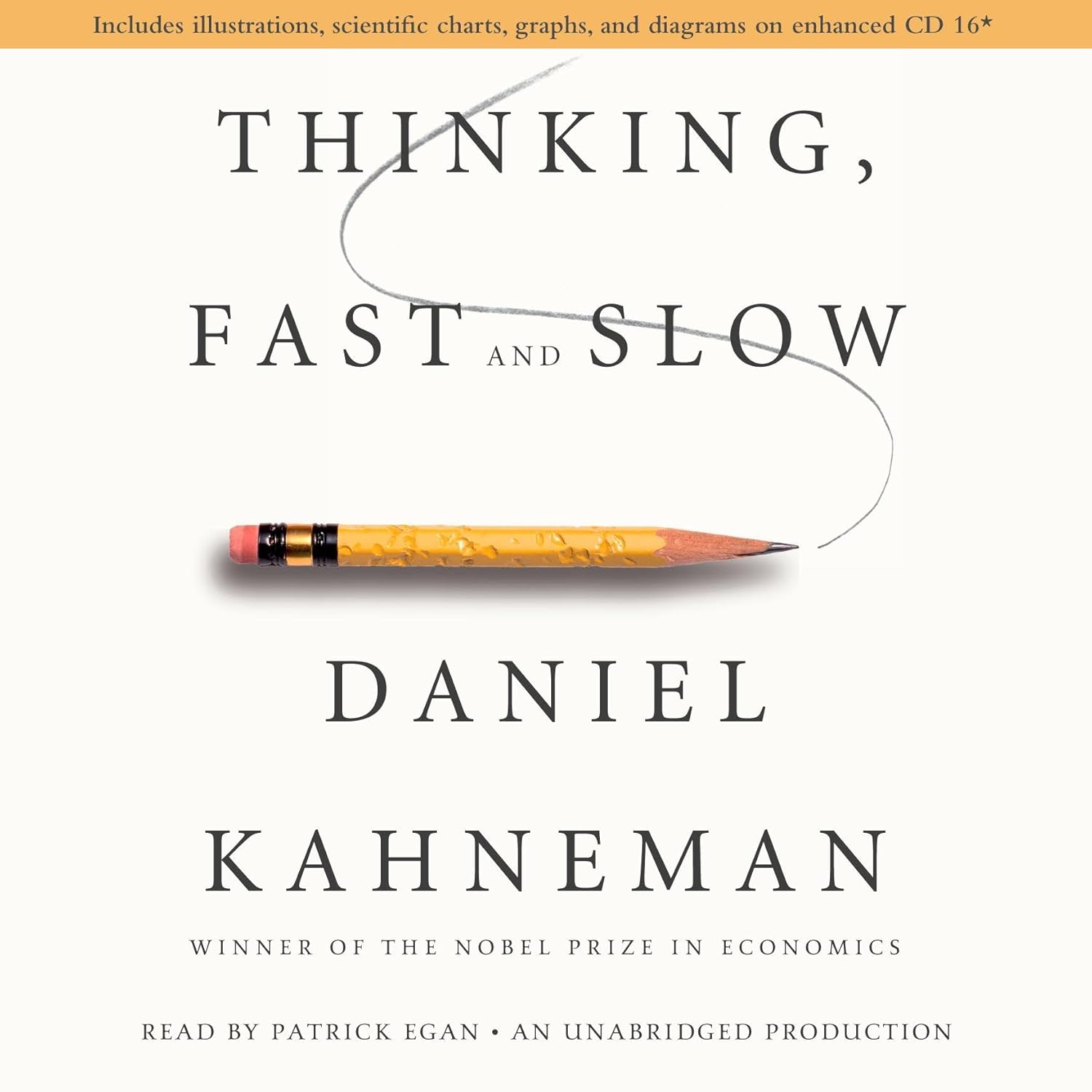
About this book
Delve into the groundbreaking exploration of the human mind with Nobel laureate Daniel Kahneman in Thinking, Fast and Slow. This bestselling book unveils the two distinct systems that drive our thinking: System 1, which is fast, intuitive, and emotional, and System 2, which is slower, more deliberate, and logical.
Kahneman masterfully exposes the extraordinary capabilities and inherent biases of fast thinking, revealing the profound impact of intuitive impressions on our thoughts and actions. Through engaging explanations and real-world examples, he illuminates how these systems shape our judgments and decisions, influencing everything from corporate strategies to personal vacation planning.
Discover when to trust your intuition and how to harness the power of slow thinking to overcome mental pitfalls. Thinking, Fast and Slow provides practical insights and techniques to make better choices in both your business and personal life, offering a transformative understanding of how we think and decide.
Summary of Key Ideas
- •
The Dual Systems of Thinking
The book's central thesis revolves around the existence of two distinct systems of thought: System 1 and System 2. System 1 operates automatically and quickly, with little or no effort and no sense of voluntary control. It relies on intuition, associations, and heuristics, making it prone to biases and systematic errors. System 2, on the other hand, is deliberate, effortful, and analytical. It is responsible for complex computations and logical reasoning. Kahneman explores how these systems interact and influence our judgments, decisions, and overall understanding of the world. Recognizing the interplay between these systems is crucial for understanding human behavior.
- •
The Power and Perils of Heuristics
Heuristics are mental shortcuts that System 1 employs to simplify complex decisions and solve problems quickly. While often useful, these heuristics can lead to systematic biases and errors in judgment. The book delves into various types of heuristics, such as the availability heuristic (relying on readily available information), the representativeness heuristic (judging based on similarity to stereotypes), and the anchoring effect (over-reliance on initial information). Understanding these heuristics and their potential pitfalls is essential for making more rational and informed decisions.
- •
The Sting of Losses: Loss Aversion
Loss aversion is a cognitive bias where the pain of losing something is psychologically more powerful than the pleasure of gaining something of equal value. Kahneman highlights how this bias influences our decisions, often leading us to avoid risks even when they are rationally advantageous. This concept has significant implications for various fields, including economics, finance, and negotiation. Understanding loss aversion can help individuals and organizations make more balanced and effective choices by recognizing and mitigating its impact.
- •
The Art of Persuasion: Framing Effects
Framing effects demonstrate how the way information is presented can significantly impact our choices, even when the underlying facts remain the same. Kahneman illustrates that people respond differently to the same scenario depending on whether it is framed as a gain or a loss. This bias highlights the importance of critical thinking and awareness of how information is presented. Understanding framing effects enables us to evaluate options more objectively and avoid being unduly influenced by manipulative or misleading presentations.
- •
The Illusion of Skill: Overconfidence Bias
Overconfidence is a pervasive bias that leads individuals to overestimate their abilities, knowledge, and the accuracy of their predictions. Kahneman explores how overconfidence can result in poor decision-making in various domains, from personal finance to business strategy. He emphasizes the importance of recognizing our limitations and seeking diverse perspectives to mitigate the negative consequences of overconfidence. By acknowledging our fallibility, we can make more realistic assessments and improve our chances of success.
- •
Two Selves: Experiencing vs. Remembering
The experiencing self and the remembering self are two distinct perspectives on happiness and well-being. The experiencing self is concerned with moment-to-moment feelings, while the remembering self evaluates experiences based on how they are recalled later. Kahneman demonstrates that these two selves often have conflicting interests, leading to discrepancies in how we perceive and pursue happiness. Understanding the difference between these selves is crucial for making choices that promote both immediate well-being and lasting satisfaction.
- •
The Comfort of Familiarity: Cognitive Ease
Cognitive ease refers to the subjective experience of fluency and lack of strain when processing information. When things are easy to understand, we are more likely to trust them and believe them. Kahneman explains how factors like clear presentation, repetition, and familiarity contribute to cognitive ease, which can influence our judgments and decisions. This concept highlights the importance of clear communication and the potential for manipulation through techniques that enhance cognitive ease, even if the underlying information is flawed.
- •
The Art of Prediction and Planning Fallacy
The book explores the concept of biases in predicting future outcomes and how individuals tend to make overly optimistic forecasts based on limited information and unrealistic expectations. Kahneman discusses the planning fallacy, which is the tendency to underestimate the time, costs, and risks of future actions and at the same time overestimate the benefits. He offers strategies for improving forecasting accuracy, such as using reference class forecasting and considering base rates to avoid the pitfalls of intuitive prediction.
Chapter Recap

About The Author
Daniel Kahneman
Main Quotes
"The world makes much less sense than you think. The coherence comes mostly from the way your mind works."
"We can be blind to the obvious, and we are also blind to our blindness."
"Nothing in life is as important as you think it is when you are thinking about it."
"The easiest way to increase happiness is to control your use of time."
"Intelligence is not only the ability to reason; it is also the ability to find relevant material in memory and to deploy attention when needed."
"A reliable way to make people believe in falsehoods is frequent repetition, because familiarity is not easily distinguished from truth."
"Our comforting conviction that the world makes sense rests on a secure foundation: our almost unlimited ability to ignore our ignorance."
"The idea that large historical events are determined by luck is profoundly shocking, although it is demonstrably true."
"Loss aversion refers to the relative intensity of two motives: we are driven more strongly to avoid losses than to achieve gains."
"Speaking of illusions, one of my favorites: People tend to assess the relative importance of issues by the ease with which they are retrieved from memory—and this is largely determined by the extent of coverage in the media."
Who Should Read This Book
Individuals interested in psychology and cognitive science
Readers interested in behavioral economics
Professionals in fields like marketing, finance, and public policy
Anyone seeking to improve their decision-making skills
People interested in understanding the biases that affect human judgment
Students and academics in related fields
General readers interested in self-improvement and understanding the human mind
Readers of popular science books
Individuals interested in understanding how the mind works
Book Summaries Like
Thinking, Fast and Slow

FAQ

Free Access to LitNotes