




 DISCORD
This Is How You Lose the Time War
Amal El-Mohtar, Max Gladstone


 Hugo Awards
 USA Today Best Sellers


 30 Min Reading Time
 Audio Version Available
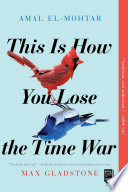
About this book
In a war that transcends time itself, two elite agents from rival factions leave trails of blood and quantum entanglement across history. Red, a hardened soldier of the technologically advanced Agency, and Blue, a bio-engineered master of Garden's organic consciousness, are locked in a deadly game of cat and mouse, each striving to secure their future by manipulating the past.
But when a cryptic letter surfaces on a ravaged battlefield—"Burn before reading. Signed, Blue"—an unlikely correspondence ignites between the adversaries. What begins as taunts and boasts evolves into a clandestine affair, a dangerous dance of intellect and emotion that defies the very foundations of their warring worlds.
As their connection deepens through coded messages and daring rendezvous, Red and Blue find themselves caught between duty and desire, loyalty and love. Their forbidden romance could rewrite history, but discovery means certain annihilation. In a war where victory demands everything, can they risk it all for a love that could save—or destroy—them both?
Summary of Key Ideas
- •
The Time War: A Battle for History
The central conflict revolves around a literal 'Time War' between two powerful, technologically advanced agencies, each seeking to shape history to their advantage. Red represents a technologically superior, hive-mind collective, while Blue embodies a more organic, evolutionary force. Their clashes occur across various timelines and historical periods, resulting in a complex and ever-shifting battlefield. This war serves as the backdrop for the evolving relationship between Red and Blue, highlighting the futility and destructive nature of unending conflict while exploring the potential for connection even amidst opposing ideologies.
- •
Love Letters Across Time
The story unfolds primarily through letters exchanged between Red and Blue. These missives begin as taunts and strategic communications but gradually evolve into a deep and intimate correspondence. The epistolary format allows the reader to witness the slow burn of their relationship, revealing their vulnerabilities, shared experiences, and growing affection. The letters become a space for them to explore their identities beyond their roles as agents of war, offering a sanctuary from the conflict and a medium for genuine connection.
- •
Forbidden Love: Finding Connection in Conflict
Despite being enemies on opposing sides of the Time War, Red and Blue develop a profound romantic connection. Their love blossoms through their correspondence, fueled by mutual respect, intellectual curiosity, and a shared desire for something beyond the endless conflict. This romance challenges the boundaries of their allegiances and forces them to question the nature of their war and the identities they have forged within it. Their love becomes a symbol of hope and rebellion against the rigid structures that seek to define them.
- •
Redefining Identity Beyond War
The narrative explores the fluidity and constructed nature of identity. Red and Blue, initially defined by their respective agencies and roles in the Time War, begin to question and redefine themselves through their relationship. They discover aspects of themselves that were suppressed or unexplored within the confines of their factions. Their evolving identities become intertwined with their growing love, demonstrating the transformative power of connection and the ability to transcend imposed limitations.
- •
Free Will vs. Destiny in the Timestream
The novel delves into the complex themes of free will versus determinism. As agents tasked with manipulating timelines, Red and Blue grapple with the consequences of their actions and the extent to which they can truly control the course of history. Their relationship introduces an element of unpredictability and challenges the deterministic nature of the Time War, suggesting that individual choices and connections can disrupt even the most meticulously planned strategies. This tension highlights the ongoing debate about agency and the power of human connection to alter predetermined paths.
- •
The Butterfly Effect and the Weight of Choice
The book uses time travel as a narrative device to explore the far-reaching consequences of choices and actions. Red and Blue witness firsthand how even seemingly small alterations to the past can have significant impacts on the future. This exploration of causality underscores the interconnectedness of events and the ethical considerations involved in manipulating time. The narrative encourages readers to contemplate the responsibility that comes with the ability to influence the past and the potential for both positive and negative outcomes.
- •
The Beauty and Fragility of History
Through vivid descriptions of various historical periods and alternate timelines, the authors explore the beauty and fragility of history. Red and Blue's journeys through time reveal the richness and diversity of human experience, highlighting both the triumphs and tragedies that have shaped the world. This exploration serves as a reminder of the value of preserving history and the importance of understanding the past in order to create a better future.
- •
The Power of Communication and Connection
The story emphasizes the power of communication and shared experience to bridge divides and foster understanding. Despite their initial animosity, Red and Blue find common ground through their letters, gradually building a connection based on mutual respect and empathy. Their ability to communicate openly and honestly, even amidst conflict, allows them to transcend their differences and forge a meaningful relationship. This highlights the importance of dialogue and connection in overcoming ideological barriers and building bridges between opposing forces.
Chapter Recap

About The Author
Amal El-Mohtar
Main Quotes
"Love spreads back through time. It claims our earliest association, our battles and losses. Assassinations become assignations."
"I write to you in stings, Red, but this is me, the truth of me, as I do so: broken open by the act, in the palm of your hand, dying."
"I want to be a body for you. I want to chase you, find you, I want to be eluded and teased and adored; I want to be defeated and victorious"
"I love you the way time loves itself. It is the only thing that moves forward."
"Intricate and infinite, like time itself, our letters weave the fabric of the universe."
"You've whetted me like a stone."
"Love is what we have, against time and death, against all the powers ranged to crush us down."
"I'll be all the poets, I'll kill them all and take each one's place."
"I want to scorch the thousand earths between us to see what blooms from the ash, so we can discover it hand in hand, content within context"
"No death sticks to a woman who wins."
Who Should Read This Book
Readers of science fiction and fantasy, particularly those who enjoy unconventional narratives
Readers interested in love stories that transcend traditional romance tropes
Individuals who appreciate lyrical and poetic prose
Those who enjoy books with epistolary elements
Readers seeking LGBTQ+ representation in science fiction/fantasy
Fans of authors like Neil Gaiman, Catherynne Valente, and China Miéville
Adults interested in thought-provoking and philosophical themes within a science fiction context
Book club participants looking for discussion-rich material
Book Summaries Like
This Is How You Lose the Time War
FAQ

Free Access to LitNotes