




 DISCORD
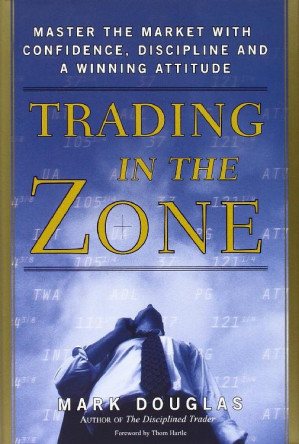
Trading in the Zone
Mark Douglas


 Apple Books


 40 Min Reading Time
 Audio Version Available
About this book
Are you a trader plagued by inconsistency, despite your knowledge and skill? Do self-sabotaging thoughts and impulsive decisions undermine your potential? In "Trading in the Zone," Mark Douglas, a renowned trading coach, reveals the mental barriers that separate successful traders from the struggling masses.
Going beyond conventional market analysis, Douglas delves into the psychology of trading, exposing the myths and misconceptions that hold traders back. He provides a step-by-step guide to cultivating a winning mindset, teaching you to think in probabilities, overcome fear, and develop unwavering confidence.
Discover how to:
- Master your emotions and stay focused in the face of market volatility.
- Break free from ingrained mental habits that lead to costly errors.
- Understand and accept the true nature of risk and uncertainty.
- Develop a consistent approach to trading based on probabilities.
- Enter the "zone," where you can execute trades with clarity and conviction, regardless of market conditions.
"Trading in the Zone" is not just another trading strategy; it's a transformative journey into the mind of a successful trader, providing you with the tools and insights to unlock your full potential and achieve consistent profitability.
Summary of Key Ideas
- •
Embrace Probabilities, Not Certainties
Trading is a Probability Game: Douglas emphasizes that trading is a game of probabilities, not certainties. Individual trades have random outcomes, and success comes from aligning oneself with the overall probabilities of a trading strategy. This understanding helps traders avoid getting emotionally attached to single trades and to accept losses as a part of the process. Consistent profitability arises from executing a strategy with a positive expectancy over a large number of trades, rather than trying to predict the outcome of each trade.
- •
Master Your Mindset for Trading Success
The Importance of a Trader's Mindset: The book posits that mastering the mental aspect of trading is more critical than mastering market analysis. A 'trader's mindset' involves thinking in probabilities, accepting risk, and staying disciplined regardless of market conditions. Douglas argues that many traders fail not because of a lack of knowledge, but because of undisciplined thinking and emotional reactions to market movements. Developing the right mindset is crucial for consistent profitability.
- •
Conquer Fear and Greed
Eliminating Fear and Greed: Fear and greed are two dominant emotions that can sabotage a trader’s decision-making process. Fear can lead to premature exits from profitable trades or hesitation to enter good trades, while greed can result in holding onto losing trades for too long or taking excessive risks. Douglas provides techniques to recognize and manage these emotions, advocating for a detached, objective approach to trading based on pre-defined rules and risk management strategies.
- •
Predefine and Accept the Risk
Defining and Accepting Risk: Successful trading requires a clear understanding and acceptance of risk. Douglas stresses the importance of defining risk parameters before entering a trade, including stop-loss levels and position sizing. Accepting risk means acknowledging that losses are inevitable and that each trade carries the potential for loss. By predefining and accepting the risk, traders can avoid emotional decision-making when the market moves against them.
- •
Stay Present in the 'Now Moment'
The 'Now Moment' Focus: Staying focused on the 'now moment' is essential for executing a trading plan effectively. This involves concentrating on the current trade and the present market conditions, without being influenced by past trades or future expectations. By staying present, traders can react objectively to market signals and avoid making impulsive decisions based on emotions or biases. This mindfulness allows for consistent execution of the trading strategy.
- •
Take Responsibility for Your Results
Taking Responsibility for Your Trades: Douglas emphasizes the importance of taking full responsibility for trading outcomes. Blaming the market, brokers, or other external factors prevents traders from learning from their mistakes and improving their strategies. Accepting responsibility involves analyzing both winning and losing trades to identify areas for improvement and refining the trading plan accordingly. This self-awareness and accountability are key to long-term success.
- •
Trust in the Law of Averages
Believing in the Law of Averages: This key idea revolves around understanding that in the long run, probabilities even out. Individual trades are subject to random outcomes, but over a series of trades, the expected results of a sound strategy will manifest. Traders must trust their system and continue to execute it consistently, even through periods of losses, knowing that the law of averages will ultimately work in their favor. This requires discipline and unwavering belief in the trading plan.
- •
Navigate the Trading Paradox
The Paradox of Trading: Trading requires a unique mindset that is often paradoxical. It involves simultaneously believing in one's ability to predict market movements while accepting that any single prediction may be wrong. It requires being confident in one's strategy while remaining flexible and adaptable to changing market conditions. This ability to hold seemingly contradictory beliefs is crucial for navigating the uncertainties of the market and maintaining a balanced perspective.
Chapter Recap

About The Author
Mark Douglas
Main Quotes
"Anything can happen."
"You don't need to know what is going to happen next in order to make money."
"There is a random distribution between wins and losses for any given set of variables that define an edge."
"An edge is nothing more than an indication of a higher probability of one thing happening over another."
"Every moment in the market is unique."
"The market is not your enemy; your mind is."
"To whatever degree you haven't accepted the risk, is the same degree to which you'll avoid the risk."
"Predefine your risk before entering the trade."
"The moment you accept the risk, you will be at peace with any outcome."
"I objectively identify my edges."
Who Should Read This Book
Active traders in stocks, futures, forex, or options markets.
Traders struggling with consistency and profitability.
Traders seeking to improve their mental discipline and emotional control.
Those interested in the psychology of trading.
Technical analysts who understand market mechanics but struggle to execute their strategies effectively.
Beginner traders seeking to understand the mindset required for success.
Experienced traders looking to overcome limiting beliefs and self-sabotaging behaviors.
Book Summaries Like
Trading in the Zone

FAQ
Free Access to LitNotes